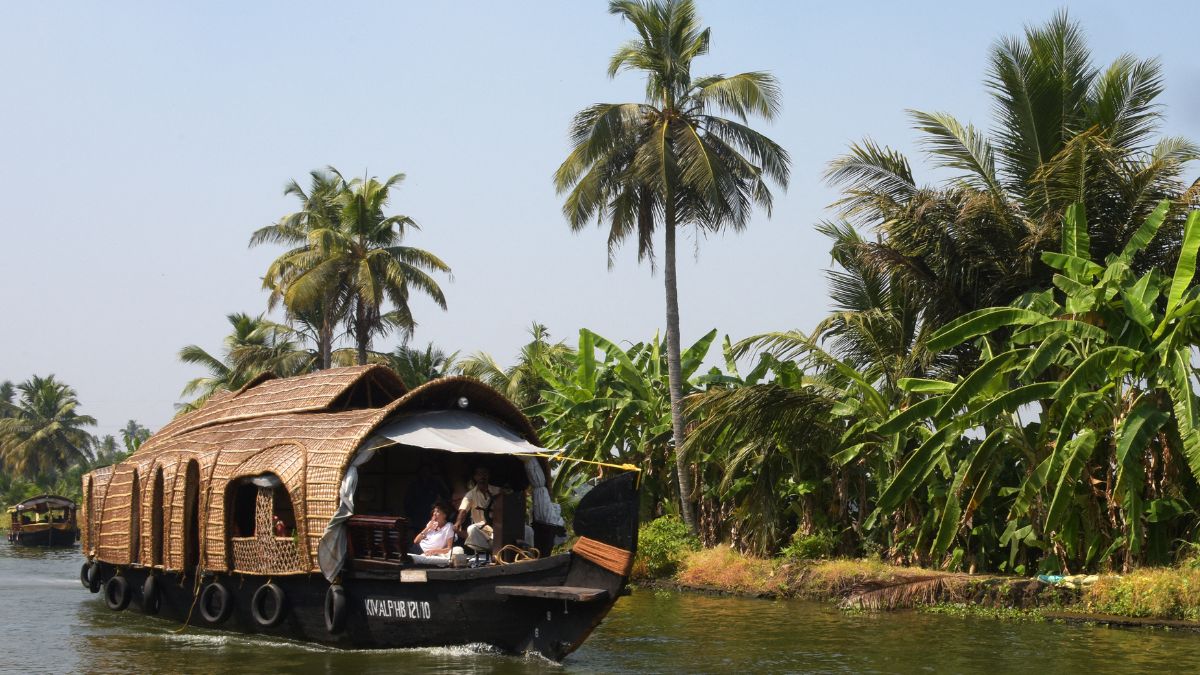
 "A houseboat travelling on the Kerala Backwaters, near the city of Alappuzha in Kerala, January 9, 2018. File Photo/AFP")
West Bengal Chief Minister Mamata Banerjee has reiterated her demand to change the name of her state. This comes after the Union Cabinet on Tuesday (February 24) green-lit the Kerala government’s proposal to rename the state as “Keralam”.
Banerjee has long been demanding revising the West Bengal’s name to Bangla. However, the Centre has previously turned down the request.
What does it take to change a state’s name in India? We take a look.
Will Kerala soon become Keralam?
The Union Cabinet has approved the renaming of ‘Kerala’ to ‘Keralam.’ This comes after the Kerala Assembly unanimously passed a resolution in June 2024, urging the Centre to modify the southern state’s name.
The Kerala Assembly had passed a similar resolution in 2023. It had also sought an amendment in the Constitution where the state is referred to as Kerala.
Last month, Kerala BJP President Rajeev Chandrasekhar wrote to Prime Minister Narendra Modi and Chief Minister Pinarayi Vijayan to extend the saffron party’s support to the move.
The 2024 resolution pointed out that the name of the state in Malayalam is Keralam, but its name in the First Schedule of the Constitution is Kerala. It further said that states were reorganised on linguistic lines on November 1, 1956, which is observed as Kerala Piravi (Kerala Formation Day).
In the resolution, the Kerala Assembly requested the Union government to take immediate steps under Article 3 of the Constitution to change the name to Keralam.
Quick Reads
View AllImportance of Keralam
Kerala , widely popular as “God’s Own Country”, gained statehood following the integration of princely states post-Independence.
The United State of Travancore and Cochin was created by merging two erstwhile princely states of Travancore and Cochin on July 1, 1949. The next year, in January, it was renamed the State of Travancore-Cochin.
In 1956, the Malabar Coast of Madras state (now Tamil Nadu) and the Kasargod taluka (administrative subdivision) of South Kanara were added to Travancore-Cochin to form the present state of Kerala.
But where does this name come from?
There are various theories as to the origin of the name “Kerala”. The earliest known reference arises from the 3rd century BCE inscriptions of Mauryan emperor Ashoka.
Rock Edict II mentions “Keralaputra”, which is Sanskrit for “son of Kerala”. It is believed the term was used to refer to the Chera dynasty, as per Indian Express.
The Chera dynasty ruled parts of present-day Kerala and Tamil Nadu from around the 4th century BCE to the 12th century CE.
According to German scholar Herman Gundert, keram is the Kannada version of cheram. Keralam was referred to as Cheram, the region between Gokarnam and Kanyakumari. The root “cher” is said to mean “to join”, and appears in “Cheralam”, with “alam” meaning land or region.
How state names are changed
After a state Assembly passes a resolution to change the name, it is sent to the Ministry of Home Affairs (MHA). The MHA examines the request and seeks No Objection Certificates (NOCs) from various departments such as the Ministry of Railways, the Intelligence Bureau, the Department of Posts, Survey of India, and the Registrar General of India.
Parliamentary approval is needed to rename a state. Article 3 of the Indian Constitution empowers Parliament to alter the name of any state.
The Union government has to draft legislation to modify a state’s name.
But such a bill can be introduced in Parliament only on the recommendation of the President of India. From the MHA, the renaming proposal goes to the President.
According to Article 3, “Provided that no Bill for the purpose shall be introduced in either House of Parliament except on the recommendation of the President and unless, where the proposal contained in the Bill affects the area, boundaries or name of any of the States, the Bill has been referred by the President to the Legislature of that State for expressing its views thereon within such period as may be specified in the reference or within such further period as the President may allow and the period so specified or allowed has expired.”
The President then refers the bill to the affected state’s legislature to seek their views within a set time. The state’s opinion is, however, not binding.
Even if the state Assembly opposes the change, the Parliament can still proceed with the legislation once the “stipulated period" has elapsed.
After the President recommends the bill, it is then introduced in either the Lok Sabha or the Rajya Sabha.
A simple majority, meaning more than 50 per cent of the members present and voting in both the Houses, is required for the bill to be passed.
Once cleared by Parliament, the Bill goes back to the President for assent. After she signs the bill, it becomes an Act. The state’s name is then officially changed in the First and Fourth Schedules of the Constitution.
Will West Bengal become Bangla?
After the Union Cabinet gave a nod to renaming Kerala, West Bengal CM Banerjee on Tuesday condemned what she called the Centre’s political double standards and its “anti-Bengali” stance.
She alleged that the Centre remembers Bengal only during elections. “I think they are not approving it because they are anti-Bengali. They disrespect the icons and visionaries of Bengal. They only use the word ‘Bangla’ during polls to get electoral benefit. That is why they have not given the approval to rename the state,” the West Bengal CM claimed.
Banerjee had first proposed changing the state’s name after assuming power in 2011.
At the time, she suggested renaming West Bengal to Paschim Banga or Paschim Bango. However, this was rejected, citing that it was a minor change, as per NDTV.
In 2024, Banerjee pushed for altering West Bengal’s name to Bangla . The CM said that as her state’s name begins with ‘W’, representatives of Bengal have to wait long to address state-specific events, as the roll call goes alphabetically.
In competitions, the state’s children compete last and are often exhuasted by the time.
“We don’t think there is no need to divide when the name of the state is Bangla. Pakistan has a province named Punjab. India too has a state named Punjab. If Bangladesh can stay Bangladesh internationally, why can’t West Bengal be changed to Bangla,” she said at the time.
Government sources have told NDTV that there are significant reasons not to change West Bengal’s name to Bangla. They said the name Bangla is similar to Bangladesh and could lead to confusion in the international community.
A 2018 proposal to rename West Bengal as Bangla was rejected by the Ministry of External Affairs, which flagged concerns about its similarity with Bangladesh.
With inputs from agencies