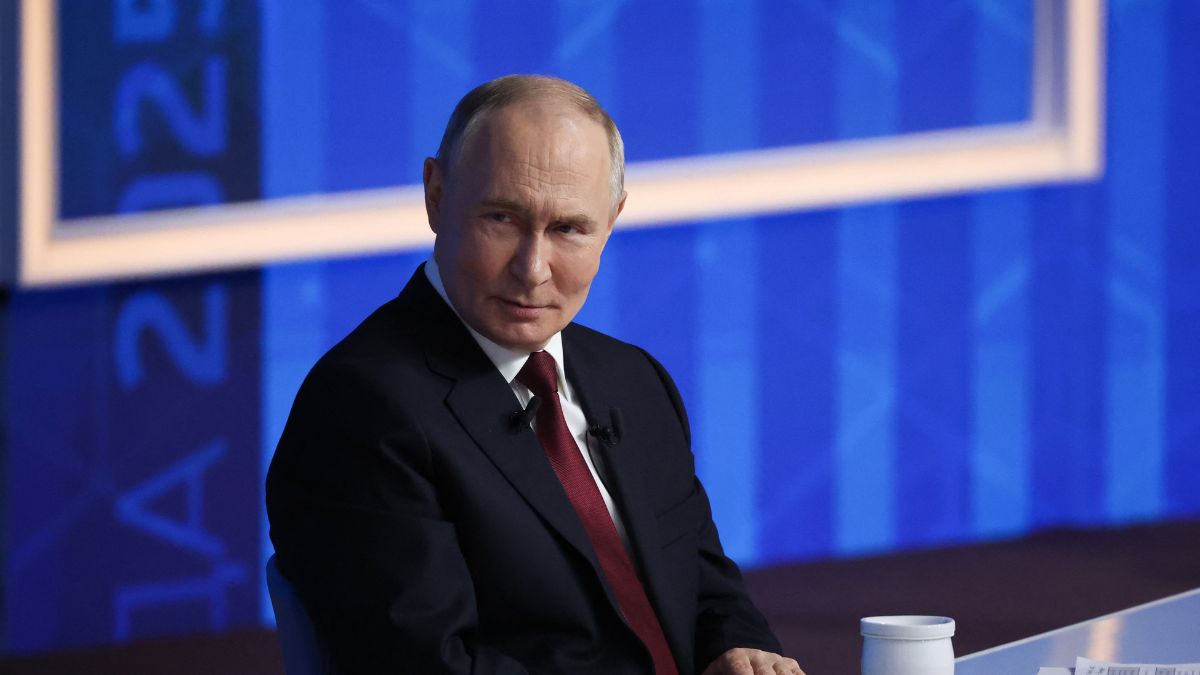
 "Russian President Vladimir Putin had expressed concern about Pakistan's nuclear weapons. AFP")
Declassified documents are shedding light on what George W Bush and Vladimir Putin think about Pakistan’s nuclear weapons.
The newly unclassified documents, released after being processed by the National Archives and Records Administration (NARA), outlined multiple conversations between the two men. This followed a Freedom of Information Act lawsuit in the United States.
But what do we know? What did the two men really think about Pakistan’s nukes?
Let’s take a closer look.
What Putin, Bush really thought
First, let’s set the scene. At the time, Pakistan was being ruled by General Pervez Musharraf , who had taken power after ousting then Prime Minister Nawaz Sharif in a 1999 coup. Putin, a former KGB agent, had come to power in 2000 after taking over from Boris Yeltsin.
Bush, meanwhile, had won a controversial election in 2000 against Al Gore and came to power in January 2001. The documents covered meetings and calls between the two men between 2001 and 2008.
During Bush and Putin’s first meeting in Slovenia in June 2001, the Russian president expressed concern about Pakistan’s nuclear programme. “I am concerned about Pakistan,” Putin told Bush. “It is just a junta with nuclear weapons. It is no democracy, yet the West does not criticise it. Should talk about it.”
Pakistan had first begun trying to acquire nuclear weapons in the aftermath of its defeat in the 1971 war with India. It was then President Zulfikar Ali Bhutto who, in January 1972, began the quest for the bomb. Scientist AQ Khan, known as the ‘father of Pakistan’s nuclear bomb’, later helped Pakistan become the world’s first Islamic nuclear power.
The two men also commiserated about worries that Islamabad could aid in the proliferation of nuclear weapons. “But it’s not clear what the labs (Iran) have, where they are… Cooperation with Pakistan still exists,” Putin said.
“I talked to Musharraf about that. I told him we’re worried about transfers to Iran and North Korea. They put AQ Khan in jail, and some of his buddies. Under house arrest. We want to know what they said. I keep reminding Musharraf of that. Either he’s getting nothing, or he’s not being forthcoming,” Bush said.
The United States at the time was building a relationship with the Musharraf regime. The government would invade Afghanistan after the September 11, 2001, attacks, with the aim of rooting out Al-Qaeda and capturing Osama bin Laden.
In 2002, after the two men had another conversation that focused on the risks of nuclear proliferation, Putin said: “As far as I understand, they found uranium of Pakistani origin in the centrifuges.”
President Bush replied, “Yes, the stuff the Iranians forgot to tell the IAEA about. That’s a violation.”
“It was of Pakistani origin. That makes me nervous,” Putin said.
“It makes us nervous, too,” Bush added.
“Think about us,” Putin said.“We don’t need a lot of religious nuts with nuclear weapons. That’s what Iran has running the country,” Bush added.
Khan was placed under effective house arrest in the capital, Islamabad, in 2004 after he admitted to running a proliferation network to three countries. In 2006, he was diagnosed with prostate cancer but recovered after surgery.
A court ended his house arrest in February 2009, but his movements were strictly guarded, and he was accompanied by authorities every time he left his home in an upscale sector of leafy Islamabad.
“I saved the country for the first time when I made Pakistan a nuclear nation and saved it again when I confessed and took the whole blame on myself,” Khan said in an interview in 2008 while under effective house arrest.
India’s stance proved right
India has for years been warning the international community about Pakistan’s nuclear programme. Indian officials have repeatedly argued that Pakistan’s political instability, deep links between the military and Islamist groups, and weak civilian oversight made its nuclear arsenal uniquely risky. Those warnings were often brushed aside by Washington.
However, the newly declassified conversations between Bush and Putin show that New Delhi’s concerns were right on the mark. Even as India raised red flags about proliferation and the dangers of radicalisation within Pakistan, the US continued to treat Islamabad as an indispensable ally in the War on Terror.
Successive Indian governments privately complained that Washington was choosing short-term tactical cooperation over long-term global security. The transcripts now show that American leaders privately shared many of the same fears they publicly downplayed.
Strategic considerations — particularly the need for cooperation in Afghanistan — meant that Washington prioritised engagement over pressure, often downplaying longer-term risks.
What the transcripts now indicate is that American leaders privately acknowledged many of the same issues that Indian officials had been highlighting publicly. Concerns about the security of Pakistan’s nuclear arsenal, the strength of civilian oversight, and the potential for proliferation were clearly part of internal discussions in both Washington and Moscow.