

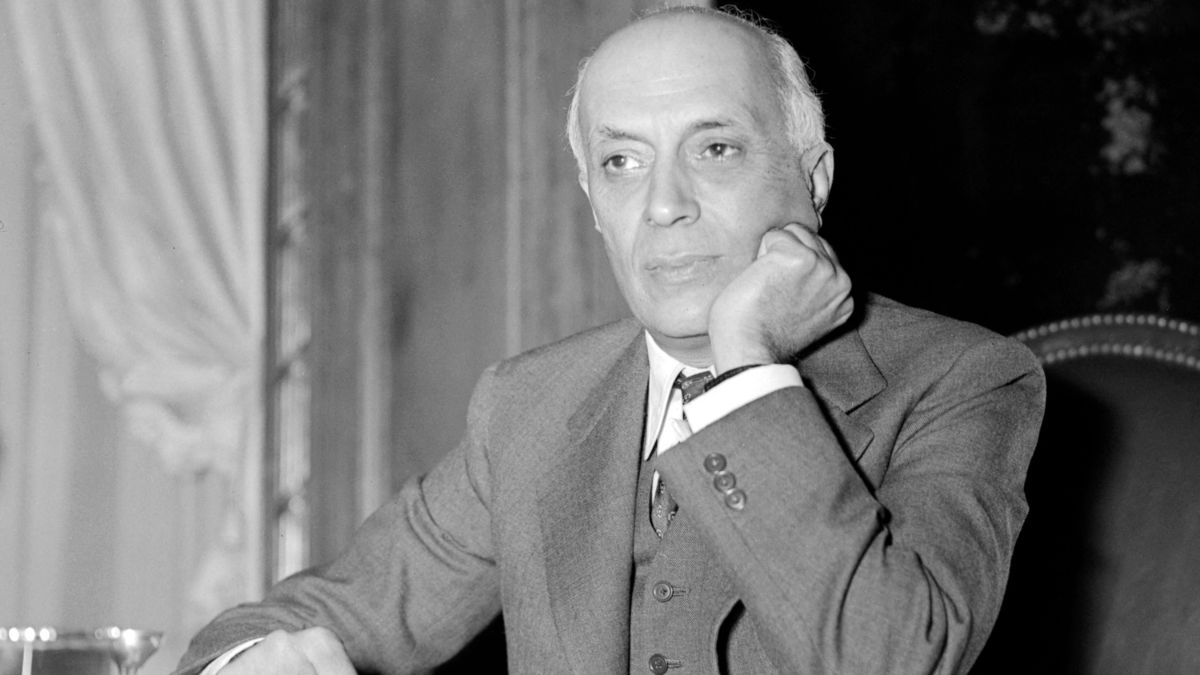
 "Why Nehru favoured 'Jana Gana Mana' over 'Vande Mataram' as India’s national anthem")
The Parliament is debating the history of ‘Vande Mataram’ to commemorate the 150th anniversary of India’s national song. On Monday (December 8), Prime Minister Narendra Modi led the charge in the Lok Sabha, accusing the Congress of removing some stanzas from the national song for its “politics of appeasement”.
During a special discussion on ‘Vande Mataram’, Modi hit out at the Congress and former PM Jawaharlal Nehru for doing ‘tukde tukde’ of the national song. He accused the Grand Old Party of “sowing the seeds of Partition” by adopting the shortened version as the national song. “‘Vande Mataram’ was divided first, and then the country was divided”.
#WATCH | प्रधानमंत्री मोदी ने लोकसभा में 'वंदे मातरम्' की 150वीं वर्षगांठ पर कहा, "तुष्टीकरण की राजनीति के दबाव में कांग्रेस वंदे मातरम् के बंटवारे के लिए झुकी इसलिए कांग्रेस को एक दिन भारत के बंटवारे के लिए झुकना पड़ा... दुर्भाग्य से कांग्रेस की नीतियां वैसी की वैसी हैं, INC… pic.twitter.com/Gtal47A6kB
— ANI_HindiNews (@AHindinews) December 8, 2025
But why did Nehru not want ‘Vande Mataram’ as India’s national anthem? Why was the truncated version declared India’s national song? We will explain.
Origins of ‘Vande Mataram’
'Vande Mataram' was composed by Bankim Chandra Chattopadhyay in 1875. An expanded version of the poem was included in his novel Anandamath in 1881.
The six additional stanzas portrayed the Fakir-Sannyasi Rebellion in which Hindu monks fought against the Muslim rulers in Bengal in the early 1770s, at a time when the state was struggling with famines and agrarian crises.
Quick Reads
View AllAccording to political thinker Aurobindo Ghosh’s translation of ‘Vande Mataram’, the song begins with the line “I bow to thee, Mother” and then refers to her as a giver of boons and bliss. Mother possesses strength that she bestows on her people.
In the later stanzas, she is described as a saviour and compared to goddesses Durga and Laxmi.
Why Nehru chose ‘Jana Gana Mana’ for national anthem
India’s first Prime Minister, Jawaharlal Nehru, was not in favour of adopting ‘Vande Mataram’ as the country’s national anthem. Instead, he preferred ‘Jana Gana Mana’ of Rabindranath Tagore as India’s national anthem and ‘Vande Mataram’ as the national song.
In a Cabinet note on May 21, 1948, Nehru detailed his reasons for the choice. As per the former PM, ‘Vande Mataram’, which became a rallying cry for freedom fighters, was not an “easy tune” to play frequently by orchestras and bands.
“A National Anthem is, of course, a form of words, but it is even more so a tune or a musical score. It is played by orchestras and bands frequently and only very seldom sung. The music of the National Anthem is, therefore, the most important factor. It is to be full of life as well as dignity and it should be capable of being effectively played by orchestras, big and small, and by military bands and pipes. It is to be played not only in India but abroad and should be such as is generally appreciated in both these places. Jana Gana Mana appears to satisfy these tests … Vande Mataram for all its beauty and history is not an easy tune for orchestral or band rendering,” he wrote.
Nehru described the song as “plaintive”, “mournful” and “repetitive”. “It is particularly difficult for foreigners to appreciate it as a piece of music. It has not got those peculiar distinctive features which Jana Gana Mana has. It represents very truthfully the period of our struggle in longing and not so much the fulfilment thereof in the future.”
Nehru also pointed out that the language of Vande Mataram was “very difficult for an average person”, while ‘ Jana Gana Mana' “is simpler though it is capable of improvement and some changes are necessary in the present context”.
“… Bearing all these considerations in mind, I suggest that we might provisionally accept Jana Gana Mana as the National Anthem which should be played on all suitable occasions,” he said.
The former PM made similar arguments in a letter to Syama Prasad Mookerjee, who was then a minister in his Cabinet, on June 21, 1948.
He objected to selecting Vande Mataram as the national anthem “chiefly because of its tune which does not suit orchestral or band rendering”.
“Vande Mataram is of course intimately connected with our entire national struggle and we are all emotionally attached to it and will continue to be so attached. It will, in any event, remain as a famous national song, but I personally think that a song which represents poignant longing for freedom is not necessarily a song which fits in with the achievement of freedom. Jana Gana Mana has an element of triumph and fulfilment about it. But the main consideration is the music,” he wrote.
The then PM was responding to a letter by Mookerjee — who went on to launch the Bharatiya Jana Sangh — who proposed that the government issue a press statement in the wake of strong reactions to the Cabinet’s provisional decision to adopt Jana Gana Mana as the national anthem, as per Indian Express.
Nehru told Mookerjee that there was “no misunderstanding”, adding: “Our decision was that Jana Gana Mana should be used officially as an anthem till such time as a final decision is made by the Constituent Assembly”.
Replying to VC Kesava Rao’s question about whether the government told provincial administrations to consider ‘Jana Gana Mana’ as the national anthem, Nehru reiterated that Tagore’s song was more fit for band renditions. He also said, but Congress leader BC Roy, who became the first West Bengal chief minister, told him that “he and his government preferred Vande Mataram”.
“It is unfortunate that some kind of argument has arisen as between Vande Mataram and Jana Gana Mana. Vande Mataram is obviously and indisputably the premier national song of India, with a great historical tradition, and intimately connected with our struggle for freedom. That position it is bound to retain, and no other song can displace it. It represents the passion and poignancy of that struggle, but perhaps not so much the culmination of it,” he said.
Arguing in favour of Tagore’s song, he said the ‘Jana Gana Mana’ tune is “very distinctive” and has a “certain life and movement” in it.
“This question has to be considered by the Constituent Assembly, and it is open to that Assembly to decide as it chooses. It may decide on a completely new song or tune if such is available,” Nehru said in August 1948.
Why was ‘Vande Mataram’ trimmed?
The late historian Sabyasachi Bhattacharya wrote in his 2003 book, Vande Mataram: The Biography of a Song, that the song was revitalised after the British government announced the partition of Bengal in 1905 on religious lines.
The charged political atmosphere at the time further put the song into focus.
Bhattacharya wrote, “The emergence of the Muslim League and the Hindu Mahasabha among the contestants in the elections of 1926; major communal riots in different parts of India… created an ambience of tension in which the song increasingly became one of many causes of Hindu-Muslim conflict.”
The Muslim League believed the song promoted idol worship, which is forbidden in Islam. Mohammed Ali Jinnah opposed parts of the song, which he claimed was a “hymn to spread hatred for the Musalmans”.
According to Bhattacharya, it became vital for the Congress to clear its position on ‘Vande Mataram’, particularly as it was in power in several provinces by the 1930s and as the topic kept coming up during its outreach to Muslims.
In a letter to Subhas Chandra Bose in October 1937, Nehru said the outrage against Vande Mataram was “to a large extent a manufactured one by the communalists. At the same time there does seem some substance in it and people who were communalistically inclined have been affected by it. Whatever we do cannot be to pander to communalist feeling but to meet real grievances where they exist”.
While Bose defended the song, Tagore said he could not sympathise with the sentiments in the latter stanzas of ‘Vande Mataram’.
In a letter to Nehru, Tagore said that he “was the first person to sing it before a gathering of the Calcutta Congress”, likely referring to the 1896 session.
He added that a “national song, though derived from it, which has spontaneously come to consist only of the first two stanzas of the original poem, need not remind us every time of the whole of it, much less of the story with which it was accidentally associated. It has acquired a separate individuality and an inspiring significance of its own in which I see nothing to offend any sect or community.”
In October 1937, the Congress Working Committee tried to adopt a resolution on ‘Vande Mataram’. Nehru helped draft the resolution that said that the first two stanzas had become a “living and inseparable part of our national movement”, and that there was “nothing in these stanzas to which anyone can take exception. The other stanzas of the song are little known and hardly ever sung. They contain certain allusions and a religious ideology which may not be in keeping with the ideology of other religious groups in India. The Committee recognise the validity of the objection raised by Muslim friends to certain parts of the song.”
The committee recommended just limiting the song to only the first two stanzas when sung at national events, while giving “perfect freedom to the organisers to sing any other song of an unobjectionable character, in addition to, or in the place of, the Bande Mataram song.”
The Indian National Congress adopted a shorter version of ‘Vande Mataram’ as the national song. “This was the version adopted by the Constituent Assembly at the instance of Rajendra Prasad in 1951 as the national song, along with Jana Gana Mana, which was designated the national anthem,” according to Bhattacharya.
Even 150 years after it was penned, ‘Vande Mataram’ remains a topic of political debate. The song is expected to continue to be at the centre stage ahead of the West Bengal Assembly elections scheduled for 2026.
With inputs from agencies

 "Why is Mexico raising tariffs on Indian goods? How big will the impact be?")
 "Trump Gold Card is here: Which US visa does it replace? How does it differ from green card?")
 "Delhi court denies anticipatory bail to Luthra brothers in Goa nighclub fire case")
 "Pakistani military court sentences ex-ISI chief Faiz Hameed to 14 years")
 "Why is Mexico raising tariffs on Indian goods? How big will the impact be?")
 "Trump Gold Card is here: Which US visa does it replace? How does it differ from green card?")
 "Delhi court denies anticipatory bail to Luthra brothers in Goa nighclub fire case")
 "Pakistani military court sentences ex-ISI chief Faiz Hameed to 14 years")



