

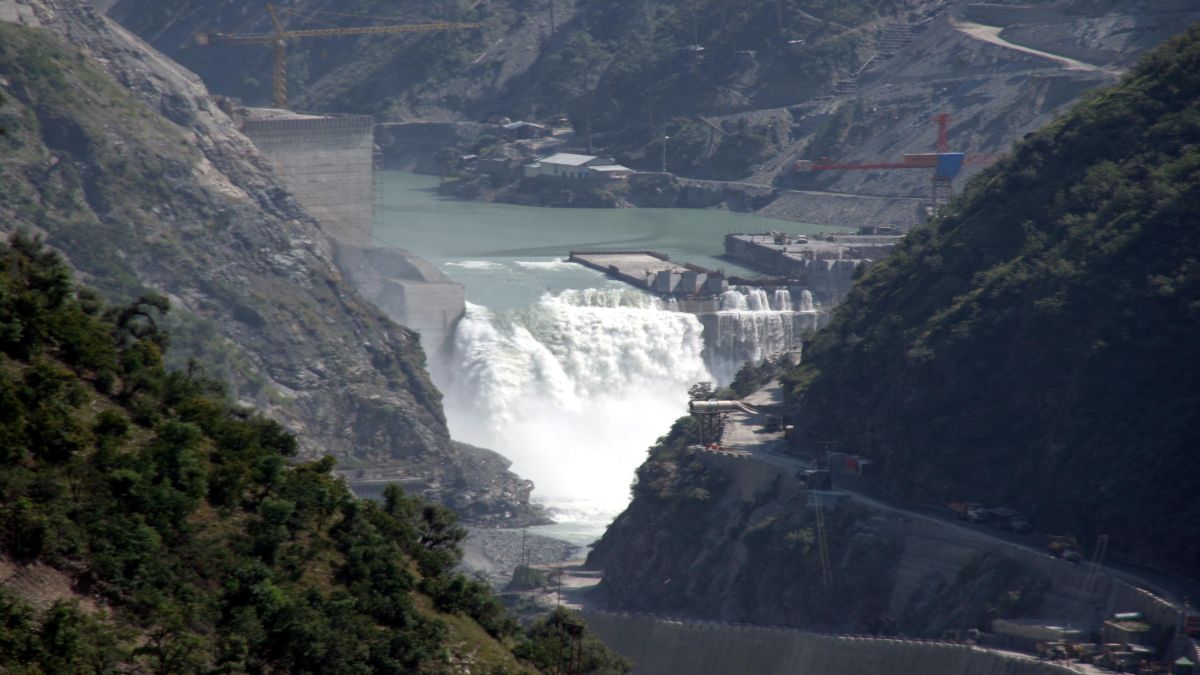
 "Is India blocking flow of Jhelum water as Pakistan claims?")
Pakistan is at it yet again.
Islamabad has now accused New Delhi of blocking the flow of Jhelum water. Pakistan’s Foreign Office, in a letter to India, has accused it of abruptly holding back and releasing water.
The development comes in the aftermath of India suspending the decades-old Indus Waters Treaty (IWT) following the Pahalgam terror attack in April, in which 26 were killed.
But what do we know? Is India really blocking the flow of Jhelum water as Pakistan claims?
What we know
Pakistani officials are claiming the Jhelum and Chenab rivers are witnessing an “unusual decline”. Officials have claimed that the water levels in the rivers dropped from over 5,000 cusecs to around 3,000 cusecs.
Pakistan this week sent a letter to India calling the development “serious and alarming”. Officials in the letter have claimed that the development is a threat to the food security and livelihoods of 240 million people. They noted that it comes during the Rabi sowing season, a key time in the agricultural cycle.
Pakistan’s Commissioner on the IWT, Syed Mehr Ali Shah, last week claimed that the Jhelum was witnessing reduced inflow from upstream in India to Mirpur’s Mangla Dam, which is around two hours from Islamabad. Large parts of Pakistan’s Punjab, including the Chaj Doab region, rely on the Jhelum.
“It is really serious and alarming because around 15 million of the total 25 million acres of agricultural land, which is irrigated through various canals, is receiving either less water or no water these days,” a senior official of the irrigation department told Dawn.
Pakistan, in an internal report, claimed that on December 14, the inflows and outflows of the Jhelum River at Mangla stood at 5,000 and 33,000 cusecs, respectively.
Quick Reads
View AllHowever, the inflows reduced to 3,300 cusecs on December 15 and remained at that level until December 19, while outflows remained at 33,000 cusecs.
During the same period last year, the inflows were at 4,400 cusecs and outflows at 25,000 cusecs.
“The data at the Kerot Hydropower Project, which comes just before Mangla Dam in Pakistan, is nearly identical. This indicates the abrupt holding and release of water by Indian authorities in their territory,” a senior official of the Private Power Infrastructure Board, which regulates the Kerot project, told the newspaper. “It is a serious matter,” he added.
Officials have accused India of deliberately holding back water at the Baglihar Dam. The ministry claimed that satellite imagery dated December 8 revealed a noticeable dip in the surface area of the Baglihar reservoir, a decline that became more pronounced by December 13.
According to the ministry, the pattern of reduction followed by an increase in the reservoir’s surface area suggested that the reservoir had been emptied and later refilled.
Is India blocking the flow of Jhelum water?
Pakistan last week sent a letter to New Delhi over alleged sudden variations in the flow of the Chenab. Geo News claimed India released 58,000 cusecs between December 7 and 8 before sharply bringing down the levels. However, Pakistan a few days later noted that the water levels in the Chenab have stabilised.
Despite Pakistan’s claims, it is yet to formally reach out to India. Shah has said that Pakistan is monitoring the levels of the rivers.
“For now, we have written a letter to India about the Chenab River. We will look into the issue further upon receipt of a reply,” Shah said.
India, meanwhile, is yet to reply to any of the letters sent by Pakistan. Thus far, there is no evidence to suggest that India is doing this deliberately.
Experts say that such shifts are not unusual, as the flow of rivers changes depending on factors such as the seasons, snowmelt, rainfall, and dam operations.
The Indus Waters Treaty
India signed the Indus Waters Treaty in 1960 with Pakistan under the then Jawaharlal Nehru government.
The treaty outlines how the waters of six rivers and their tributaries, known as the Indus waters, would be used by the two countries. Under the agreement, India was given unrestricted use of three eastern rivers — the Ravi, the Sutlej, and the Beas. Pakistan, on the other hand, was given control of the western rivers — the Indus, the Chenab, and the Jhelum — known as the western rivers.
India, in the aftermath of the Pahalgam attack, put the treaty on hold until “Pakistan credibly and irrevocably abjures its support for cross-border terrorism”.
Pakistan responded by calling the move an ‘act of war’.
“Any attempt to stop or divert the flow of water belonging to Pakistan as per the Indus Waters Treaty, and the usurpation of the rights of the lower riparian, will be considered an Act of War and responded to with full force across the complete spectrum of National Power,” it said in a statement.
With inputs from agencies


 "Swedish activist Greta Thunberg arrested at 'Prisoners For Palestine' protest in London")
 "8,000 new Epstein-linked documents out, DoJ urges caution on Trump references")
 "How Ukraine’s Chernobyl plant is one strike away from complete collapse")
 "A pill a day to keep obesity away?")
 "Swedish activist Greta Thunberg arrested at 'Prisoners For Palestine' protest in London")
 "8,000 new Epstein-linked documents out, DoJ urges caution on Trump references")
 "How Ukraine’s Chernobyl plant is one strike away from complete collapse")
 "A pill a day to keep obesity away?")



