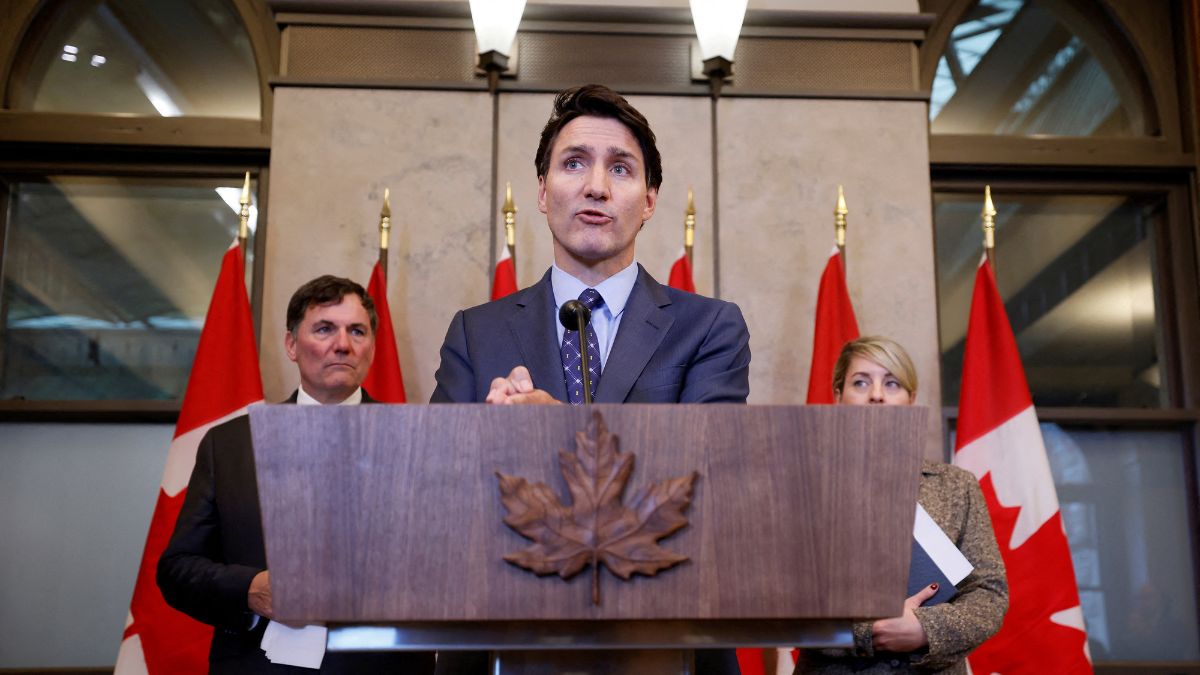
 "Canada's Prime Minister Justin Trudeau, with Minister of Foreign Affairs Melanie Joly, and Minister of Public Safety, Democratic Institutions and Intergovernmental Affairs Dominic LeBlanc, takes part in a press conference on Parliament Hill in Ottawa, Ontario, Canada, October 14, 2024. File Image/Reuters")
Canadian Prime Minister Justin Trudeau is facing significant challenges, both domestically and internationally.
A sharp decline in popularity, rising internal dissent within his own party, and a diplomatic crisis with India over the investigation into the death of Sikh separatist Hardeep Singh Nijjar have put his leadership under intense scrutiny.
Many critics argue that Trudeau’s approach to the Nijjar probe may be more about deflecting from his sinking political fortunes than pursuing justice.
How unpopular is Trudeau in Canada?
Trudeau’s political standing in Canada has suffered dramatic declines over the past year. Rising inflation, unaffordable housing, and increasing unemployment have caused public frustration, leading to a significant drop in approval ratings.
According to an Angus Reid Institute poll, Trudeau’s disapproval rating has skyrocketed from 39 per cent in September 2023 to 65 per cent in 2024. Meanwhile, his approval rating has plummeted from 51 per cent to 30 per cent, raising concerns about the survival of his government.
Internally, Trudeau is also contending with growing unrest within his own Liberal Party. The Canadian Broadcasting Corporation (CBC) reported that at least 20 Liberal MPs have signed a document calling for his resignation, as they fear a complete electoral collapse under his leadership.
In recent by-elections in Montreal and Toronto, which have traditionally been Liberal strongholds, the party suffered embarrassing defeats. Analysts say this growing dissent signals deeper instability, with Bloomberg reporting that up to 30 or even 40 MPs may be prepared to call for a leadership change, though the number may fall short of a critical mass.
The CBC’s Poll Tracker shows that Trudeau’s Liberals are trailing the Conservatives by about 20 percentage points, with Conservative leader Pierre Poilievre gaining ground as a preferred candidate for prime minister.
An Ipsos poll revealed that only 26 per cent of Canadians see Trudeau as the best candidate for the job, a figure that lags significantly behind Poilievre.
What is the latest in Canada-India ties?
Amid this domestic crisis, Trudeau’s government has escalated tensions with India by linking Indian diplomats to the murder of Khalistani separatist Hardeep Singh Nijjar in Surrey, British Columbia, in June 2023.
Nijjar was a vocal advocate of the Khalistan movement, a separatist campaign demanding an independent Sikh state in India. Trudeau accused India of having a “potential” role in Nijjar’s killing, claims that New Delhi has vehemently denied.
In response, India has rebuked the allegations, with the Ministry of External Affairs (MEA) dismissing Trudeau’s charges as “preposterous” and accusing him of pursuing a political agenda centered around “vote bank politics.”
India’s high commissioner to Canada, Sanjay Kumar Verma, who has served as a diplomat for 36 years, was implicated in the investigation, a move India condemned as part of Trudeau’s “deliberate strategy of smearing India.”
“Since Prime Minister Trudeau made certain allegations in September 2023, the Canadian government has not shared a shred of evidence with the Government of India, despite many requests from our side,” the MEA said in a statement.
The diplomatic tension has further deteriorated ties, with India accusing Canada of allowing violent extremists to operate freely, harass Indian diplomats, and promote the separatist agenda.
Was this a deliberate move by Trudeau to secure votes?
Trudeau’s motives for escalating the Nijjar probe have come under scrutiny, with critics suggesting that his actions are more about securing votes than pursuing justice.
Canada is home to over 770,000 Sikhs, the fourth-largest ethnic community in the country, and some elements of this community are staunch supporters of the Khalistan movement. By championing their cause, Trudeau appears to be courting a key electoral demographic as his popularity sinks.
Observers point out that Trudeau has a history of leaning into Sikh politics for political gain. In 2018, during a controversial trip to India, Trudeau faced backlash after a convicted Sikh extremist was invited to a state dinner.
His government has also been reluctant to clamp down on pro-Khalistan activities in Canada, including protests outside Indian consulates where demonstrators burned the Indian flag.
Relations between India and Canada have soured further following Trudeau’s allegations about Indian involvement in Nijjar’s killing. During the G20 Summit in New Delhi in September 2023, Indian Prime Minister Narendra Modi expressed concerns over “anti-India activities” in Canada, citing the Canadian government’s failure to curb extremist activities.
India has temporarily suspended visa services in Canada and demanded reciprocity in diplomatic staffing, leading to the withdrawal of over 40 Canadian diplomats from India.
What does the Trudeau family history tell us?
This is not the first time tensions between India and Canada have escalated over Sikh separatism. In the 1980s, Trudeau’s father, Pierre Trudeau, faced similar criticism for mishandling ties with India.
His administration had refused to extradite Talwinder Singh Parmar, a Khalistani extremist and the alleged mastermind of the 1985 Air India bombing, one of the deadliest terrorist attacks in Canadian history. The Trudeau legacy on Sikh extremism continues to affect bilateral relations to this day.
“Under criticism for turning a blind eye to foreign interference in Canadian politics, his government has deliberately brought in India in an attempt to mitigate the damage,” the MEA added. India has repeatedly called for Canada to take action against Sikh extremists, and the situation has only worsened under Justin Trudeau’s leadership.
Despite the ongoing controversy, Trudeau shows no signs of backing down. During a meeting last week with Prime Minister Narendra Modi in Laos, he acknowledged his government’s tensions with India, stating, “We spoke about the work that we need to do,” signalling an ongoing investigation into the Nijjar case.
However, critics see this as a political maneuver to deflect attention from Trudeau’s unpopularity at home.
What next for Trudeau?
With federal elections to be held October next year, the stakes are high for Trudeau. His government is walking a tightrope, trying to manage a growing internal revolt while addressing a strained relationship with India.
The Nijjar probe and Trudeau’s accusations against India have already led to diplomatic fallout, and his handling of the situation will likely be a focal point in the upcoming elections.
Also Watch:
In the meantime, Trudeau’s approval ratings remain at historic lows, and his ability to lead his party into another electoral victory is increasingly in question.
With inputs from agencies