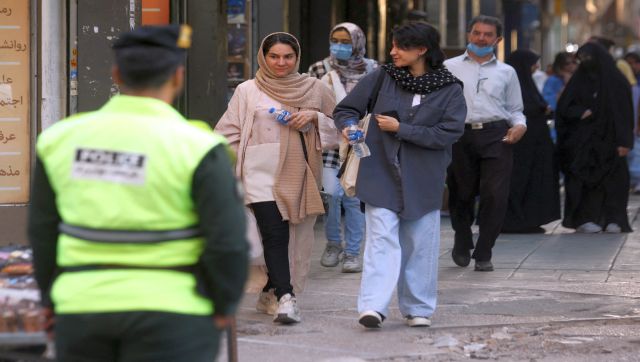
 "Iran’s Gasht-e-Ershad returns: How Muslim nations use morality police to crush women")
Iran’s morality police is back in the news again. The force, known as Gasht-e Ershad, will resume its controversial patrols to ensure women obey dress codes and cover their hair in public in the country.
Police spokesman Saeed Montazerolmahdi said, as quoted by hardline Tasnim news agency, said that the force will restart vehicle and foot patrols across the country and at first will warn women who are not complying with the rules and those who “insist on breaking the norms,” may face legal action.
Montazerolmahdi further added that the police expect everyone to conform to accepted dress codes so officers will have more time to deal with “other vital police missions”.
The Gasht-e Ershad or the morality police were thrown into the international spotlight last year in September when 22-year-old Mahsa Amini died three days after being arrested by the force for wearing her hijab, or headscarf, incorrectly and taken to a “re-education” centre.
Her death sparked nationwide protests that rocked the country’s foundation. Authorities responded to the protests violently – more than 500 were killed and nearly 20,000 detained. However, the protests led to the near-disappearance of the morality police with some reports emerging last December that the force had been abolished. This claim, however, was dismissed by the state media.
As the morality police makes its comeback, we take a deep dive into the history of this force in Iran and also a look at other countries where such morality police exist.
Quick Reads
View AllIran’s history of morality police
Iran’s brush with morality policing arrived after the revolution of 1979. Ayatollah Ruhollah Khomeini, the Shia cleric who then came to power, sought to rein in the behaviour of citizens after a period of secularism.
Roxane Farmanfarmaian, who teaches international politics of the Middle East and North Africa at the University of Cambridge, told TIME magazine that the morality police did not officially become a separate force until after the Iran-Iraq war in the 90s.
The Gasht-e-Irshad, as we know today, came into force in 2005 during the rule of then-President Mahmoud Ahmadinejad, an ultra-conservative. They are supported by Basij militia and their focus is on ensuring observance of hijab – mandatory rules requiring women to cover their hair and bodies and discouraging cosmetics.
The Gasht-e-Ershad is made up of men wearing green uniforms and women in black chadors, covering their head and upper body. Until now, they were empowered to issue a notice to those found flouting rules. They could also take a person to a so-called education and advice centre or a police station.
For many human rights activists, the Gasht-e-Ershad has been viewed as a scourge for women. In fact, until March 2014, the last date for which information is available, the morality police had issued warnings to almost three million women for not wearing their hijab properly.
They are also responsible for what happened to Mahsa Amini in September last year. She was allegedly beaten up by the morality police after being detained for “incorrectly” wearing the hijab. However, the Iranian government has denied that Amini was assaulted.
Moral policing in Saudi Arabia
Notably, Iran isn’t the only country with such a force. A Pew Research of 2012 revealed that at least 17 nations – nine per cent of the world – had a police to enforce religious norms. The research had revealed that such forces were particularly common in the Middle East and North Africa.
Saudi Arabia, according to a report in the Council on Foreign Relations, launched the first modern Islamic morality police in 1926, amid the rise of Wahhabism, a puritanical form of Sunni Islam.
Formally called the Committee for the Promotion of Virtue and the Prevention of Vice, the Mutawa is tasked with enforcing the observance of Islamic moral law. This includes overseeing any action considered immoral, from drug trafficking to bootleg smuggling – alcohol remains illegal – down to monitoring social behaviour including the strict segregation of the sexes.
And instead of a police-style uniform, they wear a traditional Saudi robe and keffiyeh.
Experts state that the initial purpose of this force was to serve as society’s spiritual guide. However, with the rise of Wahhabism, the Mutawa also transformed becoming stricter and more puritanical. They were harsh in their methods and in 2002, they were held responsible for the deaths of 15 school girls – the force reportedly prevented their escape from a burning building due to their immodest dress.
In 2016, Crown Prince Mohammed bin Salman curbed their powers. Under the new law, their mission was amended to “carrying out the duty of promoting virtue and preventing vice in a gentle and humane way, after the model set in this regard by the Prophet [Muhammad] and his rightful successors”.
The law further stated that officers will no longer be permitted to pursue suspects, arrest them or ask for identification – only report suspicious behaviour to regular police and anti-drug units, who will decide whether to take the matter further.
Sudan’s Public Order Police
In the African nation of Sudan, there’s the Public Order Police which was set up in 1993. Founded under the regime of President Omar al-Bashir, the Public Order Police was tasked with enforcing Sharia law.
They have the power to arrest, and suspects are tried – often at speed – in special Public Order Courts; punishments can include flogging or prison.
The force drew international condemnation in 2008 when female journalist Lubna al-Hussein was arrested and jailed after being caught wearing loose-fitting slacks in public.
Religious officers in Malaysia
The nation has its own morality police and its personnel are informally known as ‘religious officers’. They are tasked with enforcing Sharia law in the country – they can arrest people for alcohol consumption, not fasting during Ramadan, or not attending mosque on Fridays.
The agents also persecute Shiite Muslims as well as homosexuals and transsexuals, who are considered men who “dress or act” as women.
Nigeria’s morality police
Called the Kano State Hisbah Corps, it is the morality police predominantly present in the Kano state, Nigeria. Started in 1999, they are responsible for the enforcement of Sharia to only Muslims in Kano state and other parts of the northern Nigeria.
The Hisbah Corps do not have authority to execute arrests and officers are armed only with weapons for self-defence, such as batons. Hisbah officers who observe violations are also expected to simply alert the Nigeria Police Force.
However, in November 2013, they confiscated and destroyed over 240,000 bottles of beer and alcoholic drinks, to the consternation of many alcohol retailers and distributors in the state. In 2020, they also conducted a door-to-door search of ‘sinners’ and placed a ban on ‘stylish haircuts’, sagging trousers and playing of music at events.
Wilayatul Hisbah in Indonesia
The Wilayatul Hisbah, the morality police, is present only in Aceh Province of Indonesia. The origins of this force can be traced to 2001 when a special autonomy law was promulgated to allow for the state of Aceh to implement more elements of sharia law.
Afghanistan’s ministry of virtue and vice
Afghanistan, under the Taliban, has its own morality police under the Ministry for Propagation of Virtue and Prevention of Vice.
This force was tasked with enforcing the Taliban’s strict interpretation of Sharia law and it became infamous for beating women who it perceived were dressed “immodestly”, or who were outside without a male guardian. Girls were not allowed to be educated past primary school – a measure the group has now reportedly reintroduced.
Activities like music and dancing were banned by the morality police and prayer times were strictly enforced by them. Anyone found to have violated the rules was harshly punished – flogging, beatings, amputation and public execution were not uncommon.
With inputs from agencies


 "PM Modi speaks with Venezuela’s Rodríguez, vows to 'expand bilateral partnership' amid US tensions")
 "Trade rifts with Washington drive US allies to reset ties with Beijing")
 "Congress committed 'grave mistake' by pushing FTA with China, failed deals with Japan and Korea: Goyal")
 "US justice department releases more investigative records on Jeffrey Epstein")
 "PM Modi speaks with Venezuela’s Rodríguez, vows to 'expand bilateral partnership' amid US tensions")
 "Trade rifts with Washington drive US allies to reset ties with Beijing")
 "Congress committed 'grave mistake' by pushing FTA with China, failed deals with Japan and Korea: Goyal")
 "US justice department releases more investigative records on Jeffrey Epstein")