

 "How Italy's floods is yet another sign of the climate crisis across the world")
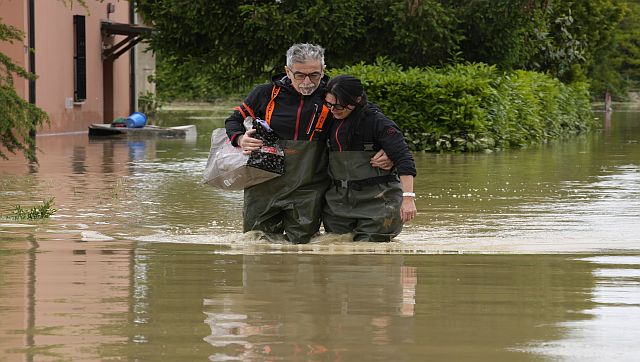
Italy is a flooded mess. Over 36,000 people have been displaced by the deadly floods in northeast Italy, as the waters swallow houses and landslides isolate the villages. According to the regional governor, floods in Italy’s northern Emilia-Romagna area have cause billions of dollars in harm, particularly to agriculture. On Sunday, Prime Minister Giorgia Meloni offered to assist in the recovery of flood-affected districts of northern Italy after returning early from the G7 conference in Japan to see the damage. According to scientists, the floods are another drenching dose of climate change’s all-or-nothing weather extremes, something that has been happening around the globe. The coastal region of Emilia-Romagna was struck twice, first by heavy rain two weeks ago on drought-parched ground that could not absorb it, causing rivers to overflow overnight, followed by this week’s deluge that killed 14 and caused damages estimated in the billions of euros. In a changing climate, more rain is coming, but it’s falling on fewer days in less useful and more dangerous downpours. The hard-hit Emilia-Romagna region was particularly vulnerable. Its location between the Apennine mountains and the Adriatic Sea trapped the weather system this week that dumped half the average annual amount of rain in 36 hours. “These are events that developed with persistence and are classified as rare,’’ Fabrizio Curcio, the head of Italy’s Civil Protection Agency, told reporters. Authorities on Friday said that 43 towns were impacted by flooding and landslides, and that more than 500 roads had been closed or destroyed. Antonello Pasini, a climate scientist at Italy’s National Research Council, said a trend had been establishing itself: “An increase in rainfall overall per year, for example, but a decrease in the number of rainy days and an increase in the intensity of the rain in those few days when it rains,” he said. [caption id=“attachment_12629062” align=“alignnone” width=“2560”] People are rescued in Faenza, Italy. Scientists say the floods that sent rivers of mud tearing through towns in Italy’s northeast are another soggy dose of climate change’s all-or-nothing weather extremes, something that has been happening around the globe. AP[/caption] Italy’s north has been parched by two years of drought, thanks to less-than-average snowfall during the winter months. Melting snow from the Alps, Dolomites and Apennines normally provides the steady runoff through spring and summer that fills Italy’s lakes, irrigates the agricultural heartland and keeps the Po and other key rivers and tributaries flowing. Without that normal snowfall in the mountains, plains have gone dry and riverbeds, lakes and reservoirs have receded. They cannot recover even when it rains because the ground is essentially “impermeable” and the rain just washes over the topsoil and out to the sea, Pasini said.
**Also Read: Emilia-Romagna GP cancelled due to deadly floods in Italy** “So, the drought is not necessarily compensated for by these extreme rains,” he said, “Because in northern Italy, the drought depends more on snow being stored in the Alps than on rain. And in the last two years, we have had very little snow.” Civil Protection Minister Nello Musumeci said the new normal of extreme weather events in the Mediterranean requires Italians to adapt and Italy to rethink its flood protections nationwide. He cited a fierce storm-triggered landslide last fall on the southern island of Ischia, off Naples, that left 12 dead. “We can’t just pretend that nothing is happening,” he said Thursday. “Everything must change: the programming in hydraulic infrastructures must change, the engineering approach must change.” He said those changes were necessary to prevent the types of floods that have left entire towns swamped with mud after two dozen rivers burst their banks. The key going forward is prevention, he said, acknowledging that’s not an easy sell due to costs. “We are not a nation inclined to prevention. We like to rebuild more than to prevent,” he told Sky TG24. [caption id=“attachment_12629082” align=“alignnone” width=“640”]
People sit on a truck after being rescued by firefighters in the village of Castel Bolognese, Italy. AP[/caption] Italy is far from alone in lurching from dry to deluge. California and the United States West sloshed their way from a record-setting megadrought to at least a dozen atmospheric rivers dousing the region with so much rain that a long-dormant lake reappeared. Scientists say flash floods of the kind seen in Germany and Belgium two years ago, which killed more than 220 people and caused billions of euros in damage, will become more likely as the planet warms. “The rainiest events seem to be in many places getting rainier,” Princeton University climate scientist Gabe Vecchi said Thursday. In 2021, the United Nations’ Intergovernmental Panel on Climate Change scientific panel said it was “established fact” that humans’ greenhouse gas emissions had made for more frequent and intense weather extremes. The panel called heat waves the most obvious, but said heavy precipitation events had also likely increased over most of the world. The UN report said “there is robust evidence” that record rainfall and one-in-five, one-in-10 and one-in-20 year type rainfall “became more common since the 1950s.” With inputs from AP Read all the Latest News , Trending News , Cricket News , Bollywood News , India News and Entertainment News here. Follow us on
Facebook,
Twitter and
Instagram.
Authorities have said that 43 towns have been impacted by flooding and landslides, and more than 500 roads have been closed or destroyed across Italy. In a changing climate, more rain is coming, but it’s falling on fewer days in less useful and more dangerous downpours
Advertisement
End of Article

 "Russian drones over Poland: Trump’s tepid reaction a wake-up call for Nato?")
 "As Russia pushes east, Ukraine faces mounting pressure to defend its heartland")
 "Why Mossad was not on board with Israel’s strike on Hamas in Qatar")
 "Turkey: Erdogan's police arrest opposition mayor Hasan Mutlu, dozens officials in corruption probe")
 "Russian drones over Poland: Trump’s tepid reaction a wake-up call for Nato?")
 "As Russia pushes east, Ukraine faces mounting pressure to defend its heartland")
 "Why Mossad was not on board with Israel’s strike on Hamas in Qatar")
 "Turkey: Erdogan's police arrest opposition mayor Hasan Mutlu, dozens officials in corruption probe")



