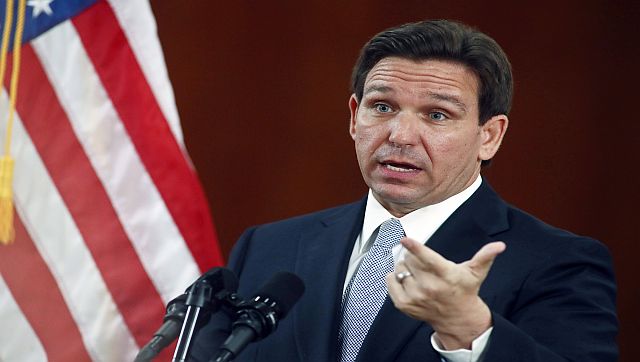
 "How Florida's Ron DeSantis is darkening the Sunshine State")
Florida has long been known for sunshine — not only the warm rays that brighten its beaches but also the light of public scrutiny afforded by some of the nation’s strongest meetings and records laws.
Although years of rollbacks have gradually clouded the impact, advocates are ringing alarms that this year presents the greatest threat to transparency yet in the state that coined the name “Sunshine Law” for its open-government rules.
Republican Florida Governor Ron DeSantis, weighing a presidential bid, is pursuing a home-state agenda that could make it harder for people to learn what public officials are doing or to speak out against them.
In an unprecedented move for the Sunshine State, DeSantis has claimed an executive right to keep key government records secret. He’s also seeking to weaken a nearly 60-year-old national legal precedent protecting journalists and others who publish critical comments about public figures.
Florida’s Republican-led Legislature appears eager to carry out his vision.
As their annual session began last week, lawmakers filed dozens of bills that would add to the state’s lengthy list of open-government exceptions.
“The state of sunshine is in peril,” warned Barbara Petersen, executive director of the Florida Centre for Government Accountability, who has been tracking the state’s public access laws for three decades.
DeSantis, who is expected to launch a presidential bid following the session, has thrilled conservative activists nationwide by leaning into fights against the GOP’s perceived political adversaries: public health officials, so-called “woke” leaders in business and public education — and the press.
Quick Reads
View AllFormer President Donald Trump, a potential rival and fellow Floridian, also is well-known for lambasting the press — describing the US media as “the enemy of the people.” Such criticism often plays well within the modern-day Republican Party, where mainstream media are perceived to side with the interests of Democrats and liberals.
But it runs contrary to Florida’s historic reputation as a place where reporters — and curious members of the public — can unearth government data and documents that shed light on the decisions made by elected officials.
Florida’s law making government records open to public inspection dates to 1909, long before similar measures emerged in many other states. It added a Sunshine Law requiring public meetings in 1967.
Then, in 1992, Florida voters approved a constitutional amendment guaranteeing a public right to access records and meetings. A decade later, as lawmakers were adding exemptions, voters approved another a constitutional amendment making it harder for legislators to approve future exceptions.
Florida newspapers launched the first “Sunshine Sunday” in 2002 to highlight the importance of public access to government information. That one-day event has since grown to an annual Sunshine Week observed nationally by media and First Amendment advocates.
As this year’s Sunshine Week began Sunday, lawmakers in state capitols were pursuing a mixture of proposals — some excluding more government records from public inspection; others increasing the ability of people to keep an eye on their government. But nowhere, perhaps, have Sunshine Week issues garnered as much attention as in Florida — due largely to DeSantis’ powerful platform to voice his complaints about the media.
Last month, DeSantis hosted a livestreamed “panel discussion on defamation” while attempting to build support for his plan to make it easier to bring defamation lawsuits against the media or people who post things on the internet about public officials and employees.
“You smear somebody, it’s false, and you didn’t do your homework, you’re going to have to be held accountable for that,” DeSantis said while concluding the event. “Hopefully, you’ll see more and more of that across the country.”
DeSantis is seeking to undercut a 1964 US Supreme Court decision that shielded news outlets from libel judgments unless proven that they were published with “actual malice” — knowing that something was false or acting with “reckless disregard” to whether it was true.
Florida legislation to carry out DeSantis’ plan would make it unnecessary to prove “actual malice” when the allegedly defamatory statements don’t relate to the reason why someone is a public figure.
Other provisions of the legislation would presume anonymous statements in news stories are false for the purposes defamation lawsuits and would treat accusations of racial, sexual or gender discrimination as intrinsically defamatory.
Petersen said such provisions appear to be a first nationally and could have a freezing effect on free speech.
But Republican state Representative Alex Andrade, who is sponsoring the bill, said it is “a sincere attempt to try and fix the problems that exist in this type of law.”
“This bill would make it easier for someone who’s actually been harmed by a defamatory statement to pursue justice in Florida courts,” Andrade said.
The defamation legislation is just one of several DeSantis administration policies prompting concern among media organisations.
Earlier this year, a Florida trial judge upheld DeSantis’ assertion of “executive privilege” in refusing to turn over information requested under the state’s public-records law about his screening of potential state Supreme Court nominees. That case is being watched by national media organisations as it’s being appealed.
The Florida Constitution contains no specific mention of “executive privilege.” Neither does the US Constitution, though courts have upheld the president’s prerogative to withhold documents to protect the confidentiality of advice received in the decision-making process. Governors in Oklahoma, Tennessee and Washington also have previously asserted the privilege.
Another DeSantis administration policy has slowed access to some public records. Television station WKMG reported last month that public records requests to some state agencies were being routed for review to the governor’s office, sometimes delaying their release by weeks or months.
Public protests at the Capitol also have been limited. Under a DeSantis administration rule that took effect 1 March, demonstrations at the Capitol Complex are only permitted outdoors. Requests to use space in the Capitol Complex must come from state agencies, the Legislature or judiciary, must be “consistent with the agency’s official purpose” and cannot include displays with “gratuitous violence or gore” that are “patently offensive to prevailing standards in the community.”
Florida’s open-government reputation already was fading before DeSantis took office in 2019, but that trend has gained steam. In his first year, lawmakers expanded the list of personal details forbidden to be disclosed about various public officials.
Last year, DeSantis signed a law shielding information about candidates for college and university presidencies.
This year, roughly five-dozen bills already have been filed proposing more open-government exemptions, Petersen said. Some of those would prohibit the agency that provides security for DeSantis from disclosing the governor’s travel arrangements — even after the fact.
Though DeSantis said he doesn’t support it, another bill filed this year would require bloggers to file periodic reports with the state if they are paid for posts about the governor, lieutenant governor, Cabinet members or legislative officials.
The cumulative effect is that “open government and public records laws are very much under the gun right now,” said Bobby Block, executive director of the First Amendment Foundation, a Florida nonprofit that advocates for the public’s right to open government.
“Every year, we’re seeing the vast sweep of the original intention chiselled away – sometimes bit by bit, other times chuck by chuck,” Block said, “and it’s definitely not the way it used to be.”
Read all the Latest News, Trending News, Cricket News, Bollywood News,
India News and Entertainment News here. Follow us on
Facebook,
Twitter and
Instagram.


 "'Indian food, our pride': $200k settlement in Palak Paneer case a moral victory against racism in the west")
 "India’s air dominance in Operation Sindoor forced Pakistan to seek ceasefire, European report says")
 "How Pakistan’s support may have led Bangladesh towards a very costly mistake")
 "India vs New Zealand Live Score 3rd T20: Kishan gone after IND cross 50 in just 3.1 overs")
 "'Indian food, our pride': $200k settlement in Palak Paneer case a moral victory against racism in the west")
 "India’s air dominance in Operation Sindoor forced Pakistan to seek ceasefire, European report says")
 "How Pakistan’s support may have led Bangladesh towards a very costly mistake")
 "India vs New Zealand Live Score 3rd T20: Kishan gone after IND cross 50 in just 3.1 overs")