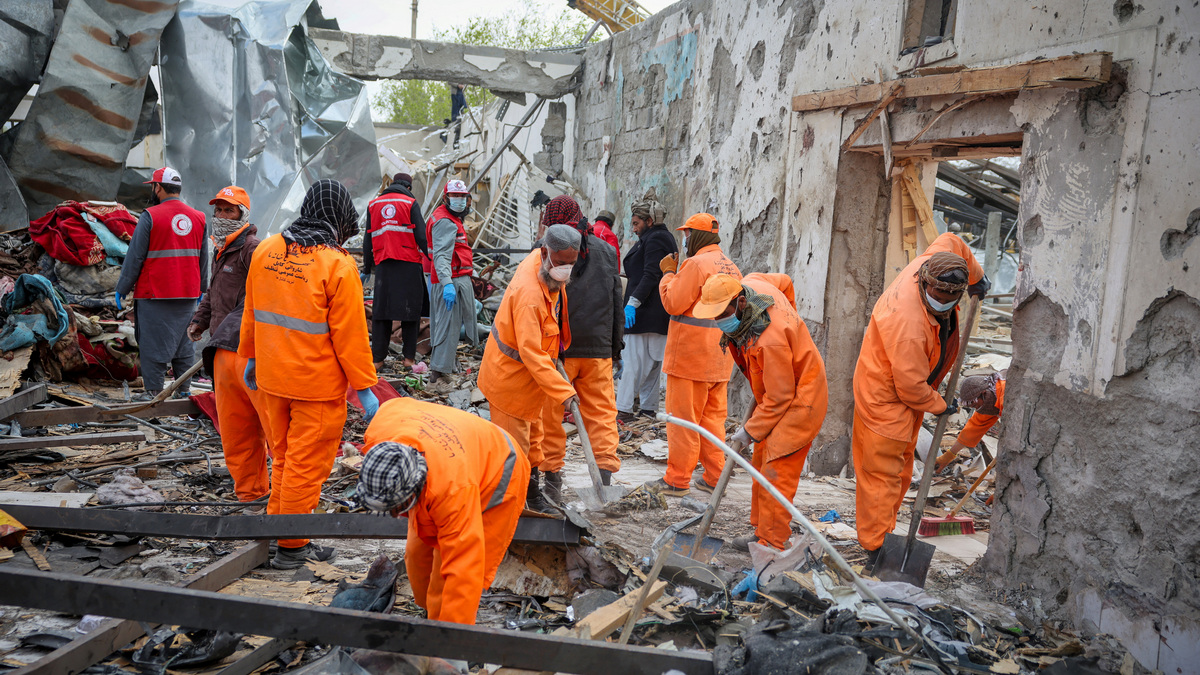
 "Volunteers clear the debris at the site of a drug rehabilitation hospital destroyed in what the Taliban said was a Pakistani air strike in Kabul. Reuters")
Pakistan’s airstrike on a hospital in Kabul has left hundreds of people dead and injured. Even the Taliban has called it a ‘crime against humanity’.
India too has unequivocally condemned Pakistan’s airstrikes on the Omid Addiction Treatment Hospital in Afghanistan, calling it a “cowardly and unconscionable act of violence”. India said the incident “has claimed the lives of a large number of civilians in a facility which can by no means be justified as a military target” and that Pakistan is “now trying to dress up a massacre as a military operation”.
However, Islamabad continues to insist that it only carried out a strike on a military facility and ‘terrorist support infrastructure’.
Now, eyewitnesses are debunking Pakistan’s claims on the Kabul airstrike.
But what do we know about the incident? What are the eyewitnesses saying? Let’s take a closer look.
What we know about the incident
The strike by Pakistan occurred around 9:00 PM on Monday night . The target was the Omid Addiction Treatment Hospital in Kabul, the capital of Afghanistan.
Videos and social media show that the 2,000-bed facility has been left in ruins. The Taliban has put the toll at around 400 dead and 250 injured.
“The Pakistani military regime has once again violated Afghanistan’s airspace and targeted a drug rehabilitation hospital in Kabul, resulting in the death and injury of addicts who were undergoing treatment. We strongly condemn this crime and consider such an act to be against all accepted principles and a crime against humanity,” Taliban spokesman Zabihullah Mujahid said on Monday.
What eyewitnesses are saying
Eyewitnesses are putting paid to Pakistan’s claims.Azmat Ali Momand had just finished his rounds, checking patients at the “Camp Omid” drug rehabilitation centre in the Afghan capital, Kabul, when the explosion erupted. “The room collapsed on me,” the 30-year-old doctor, who has worked at the centre for two years, said on Tuesday. “I got two stitches on my head and my leg was also injured.”
Momand was knocked out by the blast but after coming to, he went to the emergency ward where others wounded in the strike were arriving. “I gave them first aid. They were severely injured and then transferred them to the relevant hospitals,” he added.
“There are many dead, but we don’t know how many,” he said at the scene of the blast, which left the building in ruins, blackened and still smouldering in the daylight.
A team at the scene soon after the centre was hit on Monday night saw at least 30 dead bodies and dozens of wounded being taken away. Rescuers carried the dead and wounded from the devastated building on blankets due to a lack of stretchers, and dozens of ambulances took turns for much of the night taking casualties to hospitals.
The search for survivors carried on into Tuesday, when daylight showed the extent of the damage: a collapsed roof, shattered chairs and pieces of hospital beds, as well as blankets and even human remains. “All the people have not been pulled out yet from under the rubble,” said interior ministry official Sheikh Abdul Rahman Munir.
At the scene, nurses wept in a corner: “What has happened to our colleagues?” Momand said there were 2,000 beds at the centre, which treated patients addicted to marijuana, amphetamines or other synthetic drugs.
“They were in different buildings, 200 to 300 in each,” he said, adding that four of the five buildings had been destroyed. Crowds of men and women gathered in front of the centre, trying to get news of their loved ones. “My brother was here in the camp,” said Mohammad Daud, 28. “I wanted to check on him. We came at 12:00 am and were here until 3:00 am. “They do not give us any information and do not let us go further either.”
Daud’s brother had been at the centre for more than a month but believed he was in a building where fire did not break out. “I think he is OK,” he added.
‘It was doomsday’
Ahmad, 50, watched flames engulf his friends at a drug rehabilitation centre in Kabul where he was undergoing treatment, unable to save them as they cried for help after a Pakistani airstrike, leaving a scene he said resembled “doomsday”. Ahmad, who also volunteered as a guard at the hospital and gave only one name, said he and his 25 roommates had gathered in their dormitory after prayers when the attack occurred.
He was the only survivor among them. “The whole place caught fire. It was like doomsday,” he said. Mohammad Mian, who works in the radiology department of the hospital, said many young people under treatment lived in large containers on the campus and very few survived the strike.
“It was extremely terrifying,” he said. “Those who survived were the ones whose rooms were not destroyed and were fortunate. But the places where the bombs were dropped, everyone there was killed.” Dr Ahmad Wali Yousafzai, a health officer at the hospital, which he said housed some 2,000 patients at the time of the strike, recalled three explosions whose blasts he said hurled some of his colleagues from one wall to another.
As fires erupted, there were screams and cries for help “from all directions”, he said. “We were too few in number to save all of them,” he added. Ambulance driver Haji Fahim was among those who transported bodies to the Afghan-Japan Hospital close by, moving at least eight bodies over five hours.
“Now we have come again … there are still bodies under the rubble,” he said on Tuesday.
The two countries have witnessed a strained relationship since the Taliban came back to power in Afghanistan after the exit of US troops. Islamabad has accused Kabul of sheltering terror groups it claims are responsible for attacks, including the Tehreek-i-Taliban Pakistan (TTP).
The Print quoted Attaullah Tarar, Pakistan’s Minister of Information and Broadcasting, as saying that the strikes were part of the Pakistan military’s Operation Ghazab Lil Haq, which targeted “Afghan Taliban regime terrorism-sponsoring military installations in Kabul and Nangarhar”.
“Technical support infrastructure and ammunition storage facilities at two locations in Kabul were effectively destroyed. The visible secondary detonations after the strikes clearly indicate the presence of large ammunition depots,” Tarar added.
Richard Bennett, the United Nations Special Rapporteur for Afghanistan, wrote on X that the incident left him “dismayed.” “I urge parties to de-escalate, exercise maximum restraint & respect international law, including the protection of civilians and civilian objects such as hospital,” Bennett wrote.
FAQs
1) What happened in the Kabul airstrike?
Pakistan carried out an airstrike in Kabul around 9:00 PM on Monday night. The strike hit the Omid Addiction Treatment Hospital, a large drug rehabilitation centre with around 2,000 beds, leaving hundreds dead and injured.
2) What are eyewitnesses saying about the strike?
Eyewitnesses, including doctors, patients and hospital staff, say the bombs struck hospital buildings where patients were undergoing treatment. Survivors described collapsed structures, fires and widespread casualties, contradicting Pakistan’s claim that it targeted military infrastructure.
3) How have governments and international officials reacted?
The Taliban condemned the attack as a “crime against humanity”. India also criticised the strike, calling it a cowardly act against civilians. The United Nations’ Special Rapporteur for Afghanistan urged restraint and called on all sides to respect international law and protect civilian facilities such as hospitals
With inputs from agencies