

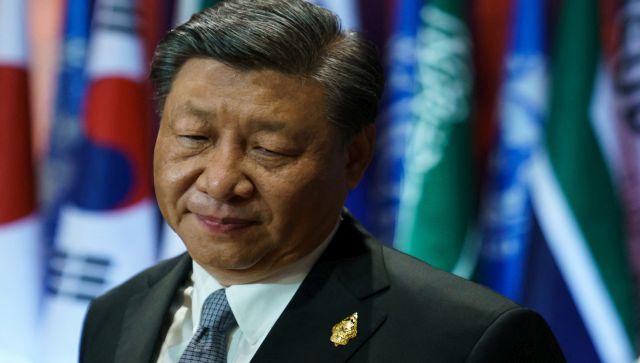
 "G7 to focus on ‘de-risking’ from China: How is it different from decoupling?")
China was one of the top agendas at the G7 (Group of Seven) summit in Japan’s Hiroshima. And one of the biggest takeaways from it was “de-risking”. Leaders of the world’s wealthiest democracies agreed that they need to de-risk and not decouple from China, which dominates global supply chains.
“We are not decoupling or turning inwards. At the same time, we recognise that economic resilience requires de-risking and diversifying,” the G7 said in a joint statement released over the weekend as leaders met in Hiroshima.
“We will seek to address the challenges posed by China’s non-market policies and practices, which distort the global economy. We will counter malign practices, such as illegitimate technology transfer or data disclosure,” the statement added.
What does de-risking mean?
The US state department describes de-risking as “the phenomenon of financial institutions terminating or restricting business relationships with clients or categories of clients to avoid, rather than manage, risk”.
When it comes to China, it means reducing dependence on the country for the supply of materials or as a market of finished goods to avoid possible risks of disruption of trade and commerce. De-risking is aimed at reducing Beijing’s control of the global supply chains but isolating it completely.
Why is there talk of de-risking regarding China?
At a press conference on Sunday, US president Joe Biden said, “We’re not looking to decouple from China, we’re looking to de-risk and diversify our relationship with China.”
Quick Reads
View AllIt means taking necessary measures to diversify supply chains “so we’re not dependent on any one country for necessary products. It means resisting economic coercion together and countering harmful practices that hurt our workers. It means protecting a narrow set of advanced technologies critical for our national security,” Biden explained.
The growing tension between the United States and China and other geopolitical challenges could impact global supply chains. Hence de-risking –reducing the dependence on Beijing to produce goods – is essential.
How is de-risking different from decoupling?
“Decoupling refers to the deliberate dismantling – and eventual re-creation elsewhere – of some of the sprawling cross-border supply chains that have defined globalisation…,” according to Foreign Policy.
Journalist Alex Lo explains the two terms using an analogy from investment in The South China Morning Post. “Decoupling means cashing out your whole portfolio; de-risking means selling what you consider the riskiest assets, say, deleveraging on your margins,” he wrote.
The term caught on during the tenure of Donald Trump. The biggest threat came when the former US president said in May 2020 in an interview with Fox News amid growing tensions with China, “We could cut off the whole relationship.” This extreme measure seems practically impossible and decoupling emerged as an alternative to an economic boycott.
De-risking is seen as the more moderate approach to dealing with an aggressive China.
Why is there a switch from decoupling to derisking?
The demand for decoupling started during Trump’s time as president. However, “de-risking” ties with China became a more regular part of diplomatic conversations after European Commission president Ursula von der Leyen explained on 30 March her decision to travel to Beijing with French president Emmanuel Macron.
“I believe it is neither viable – nor in Europe’s interest – to decouple from China. Our relations are not black or white – and our response cannot be either. This is why we need to focus on de-risk – not de-couple,” she said.
“Managing this relationship and having an open and frank exchange with our Chinese counterparts is a key part of what I would call the de-risking through diplomacy of our relations with China,” she added.
The United States also emphasised de-risking over decoupling. On 27 April, US National Security Adviser Jake Sullivan said, “We are for de-risking, not for decoupling. De-risking fundamentally means having resilient, effective supply chains and ensuring we cannot be subjected to the coercion of any other country.”
India too has endorsed de-risking. “In this era of volatility and uncertainty, it’s important to de-risk the global economy and yet to ensure that there is very responsible growth,” External Affairs Minister S Jaishankar said on 16 May after the first meeting of the India-EU Trade and Technology Council (TTC).
Now G7 countries are all for de-risking as the G7 communique shows. “What Japan intends to do, rather than decoupling from China, is to strategically identify areas where collaboration is possible and areas where risks should be avoided,” Yoshimasa Hayashi, Japan’s foreign minister told Financial Times in an interview.
How has China reacted?
China, of course, is angry by the statements made at the G7 summit. China’s ministry of foreign affairs on Saturday accused the G7 of “hindering international peace, undermining regional stability and curbing other countries’ development:
China vice-foreign minister Sun Weidong summoned the Japanese ambassador to register protests over the “hype around China-related issues” at the Hiroshima meet. Sun claimed Japan had collaborated with other countries at the summit through “activities and joint declarations … to smear and attack China, grossly interfering in China’s internal affairs”.
On Sunday, China’s cybersecurity regulator banned certain purchases of US memory chip specialist Micron Technology’s products, after a national security probe into the $75 billion company launched in March. The timing was not subtle; it came just days after Chief Executive Sanjay Mehrotra unveiled a $3.7 billion investment with the Japanese government, part of the G7’s initiatives to strengthen tech supply chains with one another.
While the financial impact looks manageable for Micron, it’s the first time Beijing’s powerful cybersecurity watchdog has acted against a foreign company and is unlikely to be the last, reports Reuters.
Is de-risking a safer bet?
“De-risk” is a reasonable-sounding word, but in plain English, it means forcibly reducing demand for Chinese exports at an economically vulnerable moment. It’s a step by the West to curb Chinese president Xi Jinping’s ambition without endangering supply chains.
De-risking may feel more diplomatic than decoupling, says a report in The New York Times. “Who doesn’t like reducing risk?” Bates Gill, director of the Asia Society’s Center for China Analysis told the publication. “It’s just rhetorically a much smarter way of thinking about what needs to be done.”
The world, including the West, is heavily reliant on China for trade. It remains to be seen if de-risking will just be restricted to diplomatic jargon or can be implemented. The question remains: Is cutting off from China, albeit slowly, without consequences possible?
_
With inputs from agencies_
Read all the Latest News, Trending News,
Cricket News, Bollywood News,
India News and Entertainment News here. Follow us on
Facebook,
Twitter and
Instagram.


 "PM Modi speaks with Venezuela’s Rodríguez, vows to 'expand bilateral partnership' amid US tensions")
 "Trade rifts with Washington drive US allies to reset ties with Beijing")
 "US justice department releases more investigative records on Jeffrey Epstein")
 "Congress committed 'grave mistake' by pushing FTA with China, failed deals with Japan and Korea: Goyal")
 "PM Modi speaks with Venezuela’s Rodríguez, vows to 'expand bilateral partnership' amid US tensions")
 "Trade rifts with Washington drive US allies to reset ties with Beijing")
 "US justice department releases more investigative records on Jeffrey Epstein")
 "Congress committed 'grave mistake' by pushing FTA with China, failed deals with Japan and Korea: Goyal")



