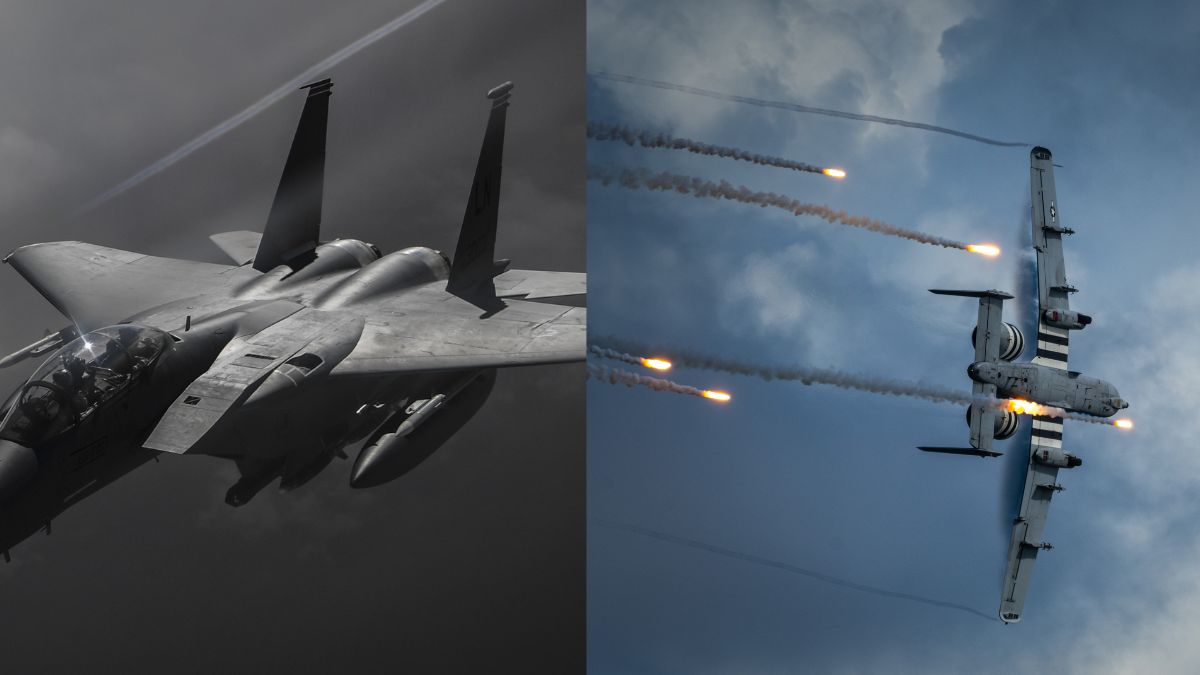
 "F-15E, A-10 Thunderbolt, Black Hawk: The US jets and choppers hit by Iran")
The Iran war is intensifying. US military warplanes- F-15E Strike Eagle and A-10 Thunderbolt II were reportedly shot down in Iran and Kuwait on Friday (April 3). The downing of the warplanes came after, earlier this week, US President Donald Trump issued several warnings to Tehran to make a deal or be hit “extremely hard."
Iran also targeted US’ Black Hawk choppers hours after reports of its forces shooting down an F-15E jet. The chopper was attacked near the Iranian border, and several reports suggest that Black Hawk was on a rescue mission to save a fighter jet pilot after the stealth aircraft came under attack.
However, Reuters reported, citing US officials, that helicopters managed to exit Iranian airspace after being hit by small arms fire.
Let’s take a closer look.
Two US warplanes, choppers hit by Iran: What happened
On Friday morning (April 3), reports emerged of the first of the two US military warplanes being downed within 24 hours. It was reported earlier by the Iranian media that an F-35 was shot down.
As quoted by Press TV, a spokesperson for the Khatam al-Anbiya Headquarters said, “A second US fifth-generation F-35 was struck and downed over central Iran by a new IRGC Aerospace Force air defence system. Given the massive explosion on impact and during the crash, the pilot is unlikely to have ejected.” Though the US did not acknowledge the claim immediately.
Later reports confirmed that the first plane that was shot down was an F-15 jet and not an F-35, Reuters reported, citing confirmation from a US official about the development.
The aircraft, which carries two crew members, a pilot and a weapons-systems officer, was hit by Iranian fire. US special forces subsequently located and rescued one of the crew members alive on Iranian territory, while the search is still underway for the second crew member, reports noted.
At the same time, Iran has launched its own search operation, calling on civilians to help find the crew and offering a reward for their capture.
Another enemy F-35 hit and downed by our #indigenous defence systems.
— Consulate General of the I.R. Iran in Mumbai (@IRANinMumbai) April 3, 2026
Iran is a force to be reckoned with.#Iran#F35#War pic.twitter.com/q1DhkTXrm3
On the same day in a separate incident, another US jet was reportedly hit by Iranian missiles- it was an A-10 Warthog, this time. Iranian state media claimed that it was targeted near the Strait of Hormuz. The aircraft was struck and then crashed over Kuwait with the pilot ejecting, ABC reported.
US officials asserted that the aircraft had a single pilot on board, who was safely rescued subsequently.
Footage of the exact moment an American A-10 warplane is struck by an air defense missile fired by the Iranian Army’s integrated air defense system.#Iran#WAR#AirDefense#A10 https://t.co/q8fUc3Ugar pic.twitter.com/49k5yu57aB
— Consulate General of the I.R. Iran in Mumbai (@IRANinMumbai) April 4, 2026
Two UH-60 Black Hawk helicopters were also reportedly shot down near the Iranian border while taking part in a rescue mission to find the missing crew members of an F-15E fighter jet.
#BREAKING UPADATE - U.S. Black Hawk helicopter was hit by Iran, but crew is accounted for and safe, U.S. official says. - Newsmax https://t.co/zb6bjRESRN
— Fast News Network (@fastnewsnet) April 3, 2026
US forces had deployed two Black Hawk helicopters along with a CJ-130 aircraft for the search operation when one of the helicopters was struck by an Iranian missile, according to reports. A video circulating on social media appeared to capture the exact moment the helicopter was hit.
F-15E Strike Eagle
The F-15E Strike Eagle is a “dual-role fighter,” meaning it is built to conduct various kinds of combat operations. F-15E, a versatile jet, can perform both air-to-ground and air-to-air missions, according to the Air Force website.
The Strike Eagle uses two crew members, a pilot and a weapons systems officer. One of the key features of the F-15E is the rear cockpit operated by the weapons systems officer.
Across four screens, the officer can display information from radar, electronic warfare, or infrared sensors, and monitor aircraft, weapons systems, and potential threats.
Its ability to travel long distances while carrying a large amount of weapons has made the aircraft crucial to US operations in Iran.
Debuted on December 11, 1986, F-15E reaches maximum speeds of 1,875 miles per hour (Mach 2.5 plus), the New York Times reports. With a payload capacity of up to 24,500 pounds of ordnance, it can achieve the high speeds required for aerial combat. According to military documents, F-15E typically flies with about 10,000 pounds of munitions.
F-15E is capable of fighting at low altitude, day or night and in “all weather conditions.” The aircraft can also attack ground targets with “a variety of precision-guided and unguided weapons." The Strike Eagle has been used in several US missions in Iraq, Syria and Libya, among other places.
The key role of the F-15E is air interdiction missions. The military documents mention that it can destroy, neutralise, or slow down enemy ground or naval forces before they can be brought into action against friendly forces.
According to the Air Force website, the first production model of the F-15E was delivered in April 1988 to the 405th Tactical Training Wing, Luke AFB, Arizona.
A-10 Thunderbolt II
The A-10C Thunderbolt II is also known as the “Warthog.” It is the first Air Force aircraft mainly designed for close air support of ground forces. It can be used against light maritime attack aircraft.
The Warthog is a simple, effective, and survivable twin-engine jet aircraft capable of engaging all ground targets, including tanks and other armoured vehicles. The Thunderbolt II has Night Vision Imaging Systems (NVIS) and features a goggle-compatible single-seat cockpit positioned ahead of the wings.
The aircraft is built to withstand direct hits from armour-piercing and high-explosive projectiles up to 23mm in diameter. Its self-sealing fuel cells are protected by both internal and external foam, according to the Air Force website.
The Thunderbolt II can also be operated and maintained from bases with limited facilities close to battle areas. Its powerful 30mm GAU-8/A Gatling gun can fire up to 3,900 rounds per minute and is capable of destroying an array of ground targets, including tanks.
In October 1975, A-10A’s first production was delivered to Davis-Monthan Air Force Base, Arizona. It can carry large military loads, which proved to be a vital asset to the US.
In the Gulf War, A-10s achieved a 95.7 per cent mission readiness rate, flew 8,100 sorties and launched 90 per cent of all AGM-65 Maverick missiles.
The A-10 Thunderbolt II costs about $18.8 million (around Rs 174.83 crore) per aircraft, making it one of the most affordable combat aircraft in the US Air Force, primarily due to its vital role in close air support missions, according to Military Machine.
UH-60 Black Hawk helicopter
An air assault aircraft, it is the US Army’s primary medium-lift utility transport. The UH-60 Black Hawk is a twin-engine medium-lift utility helicopter, equipped with a single 4-bladed main rotor and a single 4-bladed tail rotor.
Black Hawk normally operates with three crew members: pilot, co-pilot, and crew chief. This model is designed to carry 11 combat troops in addition to a crew of three.
The chopper has a maximum speed of 183 mph and a cruising speed of 175 mph without sling cargo. It has a combat range of about 370 miles and a maximum ferry range of 1,380 miles when equipped with additional internal and external fuel tanks.
The Black Hawk can carry 11 fully equipped combat soldiers in an assault-ready configuration, or up to 14 troops at maximum capacity. There have been multiple versions of the UH-60 Black Hawk used by the Army, including the UH-60M and UH-60V.
According to the Department of the Army’s Selected Acquisition Report made public in 2022, the total acquisition cost for the UH-60M since the program’s approval in 2001 is $22.6 billion (around Rs 29.53 lakh crore).
Other sources cite the cost of the UH-60L Black Hawk at $5.9 million (around Rs 54.85 crore), while the unit cost of the Air Force’s HH-60G Pave Hawk is $10.2 million (around Rs 94.84 crore).
As recently as March 2023, a nighttime training mission in Kentucky ended in tragedy when two Black Hawk choppers crashed, resulting in the deaths of all nine servicemembers aboard.
The Army’s data reveals that there have been 60 deaths in Black Hawk-related training incidents over the past decade alone, the Intergalactic reported.
With inputs from agencies

 "Iran Israel War Live News: Strikes continue as Iran intensifies search for American pilot")
 "Seventh India-flagged LPG tanker crosses Strait of Hormuz")
 "Who is Rini Sampath? Tamil Nadu-born becomes first South Asian to run for mayor in Washington DC")
 "How doping crisis pushed India past Kenya to top athletics blacklist")
 "Iran Israel War Live News: Strikes continue as Iran intensifies search for American pilot")
 "Seventh India-flagged LPG tanker crosses Strait of Hormuz")
 "Who is Rini Sampath? Tamil Nadu-born becomes first South Asian to run for mayor in Washington DC")
 "How doping crisis pushed India past Kenya to top athletics blacklist")