 "‘Curry bashing’ and COVID-19 discrimination: How Indians have regularly faced intolerance in Australia")
The story of an Indian engineering student savagely stabbed multiple times in Australia is grabbing headlines across the world. Shubham Garg, 28, walking along the Pacific Highway was on 6 October stabbed in the face, chest and abdomen by a man who allegedly demanded cash. Police have arrested 27-year-old Daniel Norwood and charged him with attempted murder, as per Daily Telegraph. But Garg’s story is just another in a long line of incidents of Indians faced violent, racist attacks and discrimination Down Under. Let’s take a closer look: Indian, a growing group As per Daily Pioneer, in 2019-2020, Indians were the largest source of skilled migrants and the second largest source of international students. As per The Conversation, the number of overseas-born migrants from India over the past five years grew more than any other group in Australia (from 449,000 to 721,000).
Indians jumped ahead of those born in New Zealand and China and are now only behind the English.
The newspaper_,_ quoting from the 2016 census, noted that approximately 88 per cent of Indian migrants are of working age. Of these, 61 per cent are in full-time and 27 per cent part-time. Which again makes India the second highest tax-paying migrant community (after the UK-born migrants), contributing over $12 billion to the Australian economy, as per the report. [caption id=“attachment_11451051” align=“alignnone” width=“640”] Representational image. News18[/caption] Those of Indian-ancestry also comprise 3.1 per cent of the Australian population. That, according to the Australian Bureau of Statistics’ (ABS) 2021 census, which puts the figure at 783,958 persons. Australia’s Department of Home Affairs has even established a Global Talent Officer for South Asia, eying India as a source of global talent, as per the report. And yet, Indians have regularly faced attacks and discrimination Down Under – sometimes from the Australian government itself. COVID-19 discrimination In 2021, the Australian government, in a move critics decried as racist, imposed a ban on flights from India. As per BBC, Federal Greens Senator Mehreen Faruqi called the measures “absolutely horrific and racist” on Twitter, while prominent conservative media commentator Andrew Bolt said the policy was “so mean and irrational that I must also blame racism”. “I can’t believe we would impose such a travel ban on white Australians fleeing, from, say England,” Bolt added.
Then prime minister Scott Morrison had blithely dismissed accusations of racism.
“The same accusations were made against the government over a year ago when we closed the borders to mainland China,” he told Sydney radio station 2GB. “There’s no politics or ideology in a pandemic… It’s got nothing to do with politics, this is a virus,” he said as per BBC. As per The Conversation, the Australian government had threatened their own citizens with fines of up to $66,000 or five years’ jail time if they attempted to take a flight from India. Which had left stranded 9,000 Australians, including 650 classified as vulnerable, stranded. ‘Curry bashing’ While news of Indians, especially students, have hit the headlines with some regularity over the past decade – from an Indian man studying nursing course and working as a part time taxi driver being assaulted by a group of teens including a girl hurled racial abuses like “you bloody black Indians” in 2017 to 20-year-old being punched in the face and beaten with a stick by teenagers in 2014 – it was in 2009-2010 that things reached their nadir. As per Outlook, a three-month period saw 17 Indian students assaulted in Melbourne and Sydney in a series of crimes that became known as “curry bashing”. [caption id=“attachment_11451021” align=“alignnone” width=“476”]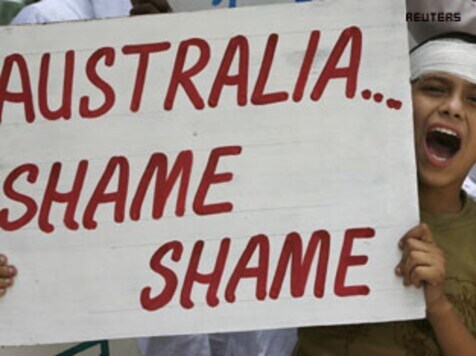 Representational image. News18[/caption] Then 21-year-old Sourabh Sharma was beaten savagely by a group of young men, while Baljinder Singh, the then 25-year-old student of the Australian Institute of Technology, Melbourne was stabbed with a screwdriver. Shravan Kumar, a student of Cambridge International College, was also stabbed, while hospitality student Rajesh Kumar suffered 30 percent burns when a petrol bomb was hurled at him in Sydney. Worse, the Australian police had at the time insisted the attacks were ‘not racial’. The Victoria Police, in a neat bit of victim-blaming, had claimed Indian students were ‘soft targets’ for teenaged white Australians for flashing iPods and laptops. The attacks had led to over 1,000 members of the Indian community marched through Melbourne in protest and even prompted Bollywood superstar Amitabh Bachchan to refuse an honorary doctorate offered by the Queensland University of Technology, Brisbane. The under-pressure Australian government apologised with then prime minister Kevin Rudd telling parliament, “I speak on behalf of all Australians when I say that we deplore and condemn these attacks.”
Rudd would later visit India and set up the Australia India Institute, as per The Conversation.
However, two years later, the Australian government, citing a study, claimed that that the rates of assault on Indian students were lower than or on par with the general Australian populace. The study also found that rates of robbery against Indian students were higher than average for Australians in larger states for most years. It also said that the proportion of robberies against Indian students at commercial locations was approximately double than that recorded for students from other countries. The government claimed the risk profile of Indian students in Australia was higher than others because of their greater representation in high-risk occupations, especially shift work as taxi drivers and in service stations and convenience stores, as per NDTV. The study said that while some attacks may have been racially motivated, the overwhelming majority of incidents were examples of ‘opportunistic urban crime_.’_ With inputs from agencies Read all the Latest News , Trending News , Cricket News , Bollywood News , India News and Entertainment News here. Follow us on Facebook , Twitter and Instagram .