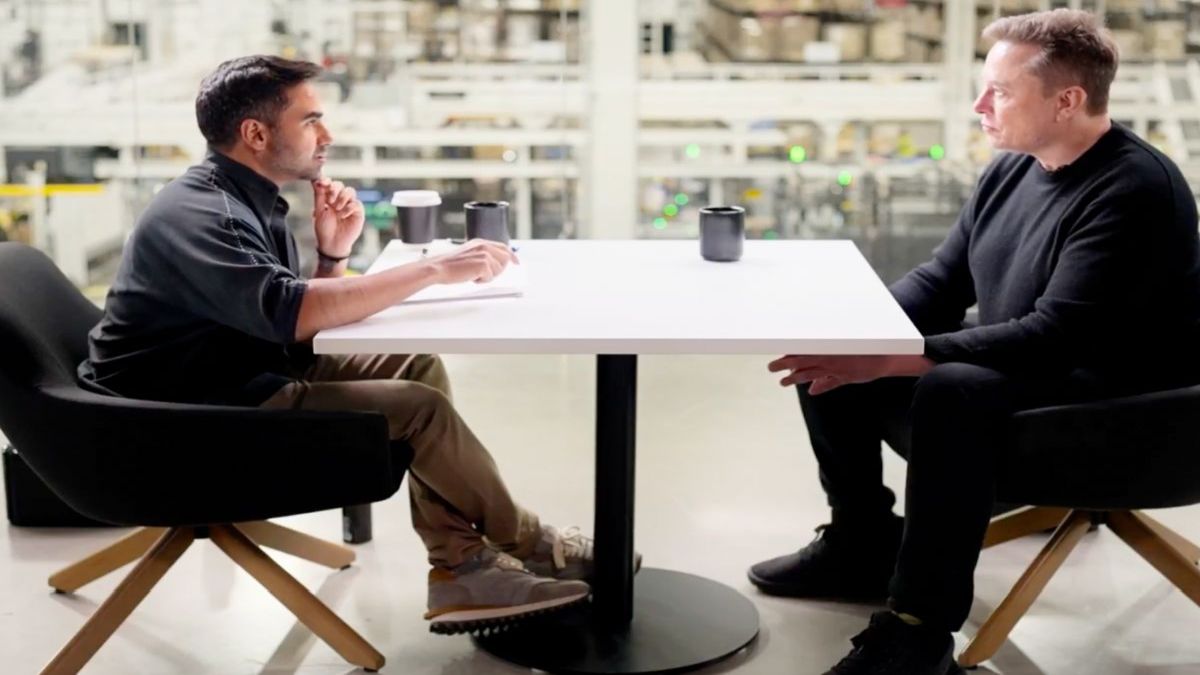
 "Zerodha co-founder Nikhil Kamath with Elon Musk on the former's podcast, ‘People’ by WTF. Image Courtesy: X")
Have you ever wondered how the world’s richest man and soon-to-be trillionaire thinks? What are his opinions on working and the future of jobs in the world?
Well, on Sunday (November 30), Elon Musk answered these questions and much, much more when he sat down for a podcast, which lasted for almost two hours, with India’s billionaire and co-founder of the discount brokerage firm Zerodha, Nikhil Kamath.
The two ‘Richie Riches’ shared an extensive conversation on Kamath’s podcast, ‘People’ by WTF in which Musk shared his opinions on the immigration policies in the US, namely on the H-1B visa programme, on his family and children, on US President Donald Trump’s tariff policies as well as the future of working and jobs.
Kamath’s podcast with Musk is a big moment for the billionaire, who has interviewed many famous names in recent times, including Prime Minister Narendra Modi.
So, what exactly did we learn from Kamath’s sit down with Musk?
Musk’s family and its Indian connection
The podcast between Kamath and Musk covered an array of topics, including X and SpaceX CEO’s family and ever-growing brood of children. The X CEO revealed that his partner, Shivon Zilis , is half-Indian and one of his sons is named Sekhar in honour of Indian-American physicist and Nobel laureate Subrahmanyan Chandrasekhar.
“I’m not sure if you know this, but my partner Shivon is half-Indian,” Musk said on the podcast. “One of my sons with her, his middle name is Sekhar after Chandrasekhar.”
For those who are unaware, Zilis met Musk when she joined his company Neuralink in 2017. Today, she is the firm’s Director of Operations and Special Projects. The two of them share four children: twins Strider and Azure, daughter Arcadia, and son Seldon Lycurgus.
Elon Musk is known across the world for his large family — he has 14 children with multiple partners. Notably, he spoke about his family with Kamath, including the need to have more children. “I am trying to get an entire Roman legion,” joked the world’s richest man with Kamath.
But Musk reiterated later his concern over falling global fertility rates, warning that humanity could face a future of decline if current demographic trends continue. He noted that his philosophy was tied to the notion that expanding human consciousness requires more people, not fewer. “If we want to expand consciousness, then fewer humans is worse, because we have less consciousness,” he said. When asked whether consciousness rises simply by increasing population, he replied, “Yes. I mean, just like consciousness increases from a single-celled creature to, you know, a 30 trillion-celled creature. We’re more conscious than a bacteria.”
When discussing kids, Kamath also noted that he didn’t have kids, to which Musk replied, “Well, it’s — Maybe you should.” Musk added, “You won’t regret it.”
Asked about the best part of parenthood, Musk said, “I mean, you’ve got this little creature that loves you, and you love this little creature. I don’t know, you kind of see the world through their eyes as they grow up, and their conscious awareness increases… from a baby that has no idea what’s going on… to… they start walking, then talking, and then having interesting thoughts.”
Musk defends the H-1B visa programme
During their conversation, Kamath also raised the issue of H-1B visas and the US immigration policy — a hot topic in Donald Trump’s second term as US president.
Musk told Kamath that the US has benefitted immensely by hiring talented Indians over the years , but added that some of the country’s current anti-immigration sentiment stems from past abuses of the H-1B visa programme and what he described as an overly lenient approach under earlier administrations.
“I think America has benefited immensely from talented Indians that have come to America,” Musk asserted. To which Kamath said, “That seems to be changing now though,” pointing to the recent changes to the H-1B visa programme.
Musk spoke on the perception that some Americans held about jobs being taken away by people from other countries, saying: “I don’t know how real that is. My direct observation is that there’s always a scarcity of talented people. So you know, from my standpoint, I’m like we have a lot of difficulty finding enough talented people to get these difficult tasks done and so more talented people would be good.”
On the H-1B visas itself, he added that there had been some misuse, but didn’t support a closure of the programme. “I think there’s been some misuse of the, you know, H-1B programme. It would be accurate to say that there’s, you know, like some of the outsourcing companies have kind of gamed the system on the H-1B front, and we need to stop the gaming of the system. But I’m certainly not in the school of thought that we should shut down the H1B programme.”
Musk’s big remarks on Trump’s tariff policy
Amid their long conversation, Kamath also made it a point to refer to global trade and the tariffs imposed by Musk’s one-time friend, Donald Trump. India has been hit hard by the US tariffs — a total of 50 per cent has been imposed on India, with 25 per cent being levied as a punitive measure for buying Russian oil.
Musk said that he wasn’t a supporter of Trump’s tariffs. “I mean, the President has made it clear he loves tariffs. You know, I’ve tried to dissuade him from this point of view, but unsuccessfully.”
He further told Kamath, “I think generally free trade is better, is more efficient. Tariffs tend to create distortions in markets,” he said, adding that barriers make little sense even at a basic level. “Would you want tariffs between you and everyone else at an individual level? That would make life very difficult. Would you want tariffs between each city? No — that would be very annoying. Would you want tariffs between each state within the United States? That would be disastrous for the economy. So then why do you want tariffs between countries?”
The future of working, according to Elon Musk
Kamath’s podcast with Musk also spoke on the advances in Artificial Intelligence (AI) — a favourite topic for the world’s richest man. On the issue, the SpaceX CEO noted people may not need to work for a living once AI systems and machines can produce most goods and services.
“My prediction is that, in the future, working will be optional,” Musk said. “People can play this back in 20 years and say it was wrong, but I think it will be correct. In less than 20 years maybe even 10 or 15 advances in AI and robotics will bring us to a point where working is optional.”
He further added that the idea applied to almost all forms of work and production.
Musk’s love for letter X, friendships and more…
In the nearly two-hour podcast, Kamath also addressed Musk’s penchant for the letter X. The Zerodha co-founder asked Musk about his companies and his products being named after the alphabet. Musk replied, “It’s a good question, honestly. Sometimes I wonder what’s wrong with me.”
He further responded, “So way back in ancient times, in 1999, the Precambrian era when there were only sponges, there were only three one-letter domain names. And I was like, okay, I want to create this place where it’s the financial crossroads or the financial exchange.”
Musk said that the vision behind X.com was ambitious: solving money from an information theory standpoint. Musk explained his critique of the traditional banking system: “The current banking system is a large number of heterogeneous databases with batch processing that are not secure. If we could have a single database that was real time and secure, that would be more efficient from a monetary, from an information theory standpoint than a large number of heterogeneous databases that batch process very slowly and insecurely.”
That original X.com eventually evolved into PayPal and was acquired by eBay. But the story didn’t end there. “Someone reached out from eBay and said, ‘Hey, do you want to buy the domain name back?’ And I was like, sure,” Musk recalled. He held onto the domain for years, waiting for the right opportunity.
The two also discussed friendships, and Musk’s sense of humour. Kamath asked Musk what kind of comedy did he like, to which the Tesla CEO responded, “Absurdist humour.” Musk added that he liked comedy and that people needed to laugh. “It’s good to generate a few chuckles once in a while.
“We don’t want a humourless society. We’d dry.”
Kamath also asked the world’s richest man what kind of person was he when he was with friends. Musk responded that they discussed many things — the nature of the universe and other philosophical discussions. However, Musk added that his group of friends had decided not to speak about AI at parties as
All in all, the discussion between Musk and Kamath was an eye-opener and let the world in on the thinking of the world’s richest man.
With inputs from agencies