

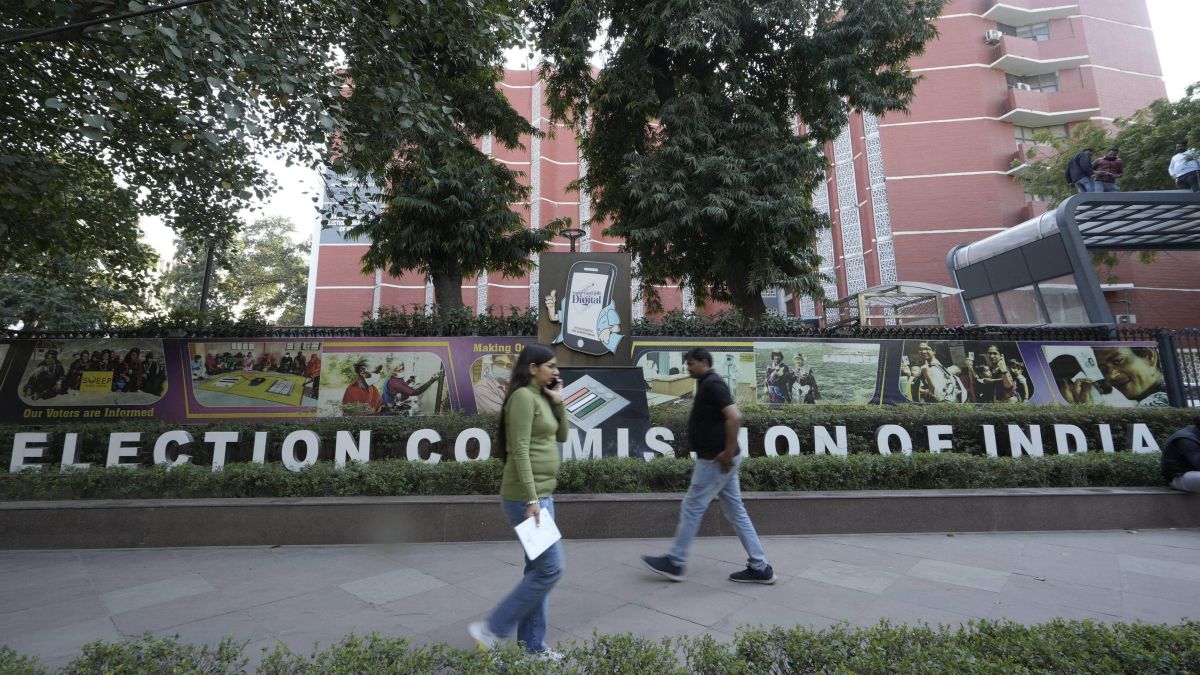
 "Election Commission to declare poll dates on 16 March: How are they finalised?")
‘When are the elections?’ ‘When are the Lok Sabha polls?’
The answer to these questions will finally be revealed on Saturday, 16 March, when the Election Commission of India (ECI) will reveal the dates for the upcoming 2024 Lok Sabha elections .
In a post on X, the polling agency also said that the election schedule for “some state Assemblies” would also be announced at the same time — 3 pm.
Interestingly, this is the first time that the poll panel has given a 24-hour notice of a press conference to announce the dates, reported NDTV.
As we gear up for the big announcement on Saturday, let’s take a closer look at what goes into deciding these dates and also how these dates are the latest they have been made.
EC and polls in India
The Election Commission , an autonomous and permanent constitutional body, is in charge of organising free and fair elections in the Union and States of India. The Constitution grants the ECI with the power of direction, superintendence, and control of elections to Parliament, state legislatures, the office of president of India and the office of vice-president of India.
As part of its responsibility of conducting elections in India, the EC is also charged with deciding when the country will go to the polls. This means that the body has to prepare an election schedule, which includes all dates from the date of issue of gazette notification to the date before which the election process shall be completed. For voters, the two most important dates in the schedule are the date(s) of polling and counting.
Impact Shorts
More ShortsAs per Sections 14 and 15 of the Representation of the People Act, 1951, the polling body has to notify election dates at any time within six months of the end of the term of Lok Sabha or a state Assembly. So, for instance, for the Lok Sabha polls, the term of the Lower House ends on 16 June 2024. Hence, as per the law, the Election Commission has to announce the dates before that time.
Furthermore, the EC is bound by rules for announcing poll dates. As per an office memorandum issued by the Ministry of Law and Justice in 2011, approved by the Supreme Court, the polling body has to announce the dates not more than three weeks ahead of the actual polling.
What this means is when the EC announces the dates of the Lok Sabha elections on 16 March, the election itself has to begin in three weeks’ time.
Factors that determine poll dates
The poll body takes into account several factors before announcing poll dates. The poll panel visits different areas of the country — from north to south and east to west — to review the preparedness of the states before they announce the poll dates. In fact, the EC has been travelling across the length and breadth of the country, checking election readiness.
The Election Commission also has to consider the availability of security forces for the polls and hence, it meets with Ministry of Home Affairs officials to discuss deployment of central forces in states. For these Lok Sabha polls, the agency has sought 3.4 lakh Central Armed Police Force personnel.
Other factors such as the logistics of arranging electronic voting machines (EVMs) and poll officials also is considered before announcing the election schedule. The poll body also considers major national and local festivals, and the prevailing law and order situation.
In 2019, former chief election commissioner Navin Chawla had said: “There is no particular date (to announce the poll dates) as the EC determines a lot of things including the number of central forces, timings and how many phases they are planning.”
Previous poll dates
Now that we have understood how election dates are decided and finalised, let’s take a look back at what have been the poll dates in the past.
Last elections, in 2019, began on 11 April and were held in seven different phases. The polling ended 19 May and the results were announced on 23 May. For these polls, the Election Commission had made the announcement on 10 March.
In fact, it was then that the Opposition had questioned the delay in announcing the polls dates with Congress’ Ahmed Patel asking the EC whether it was waiting for Prime Minister Narendra Modi’s “official” programme to “conclude”.
For the 2014 general elections, which were held in nine phases between 7 April and 12 May, the Election Commission had made the announcement on 5 March. The counting of votes was held on 16 May in which Narendra Modi and the BJP stormed to power.
The Election Commission held a press conference on 2 March 2009, announcing the poll dates for the 15th Lok Sabha polls. Elections were held in five phases between 16 April and 13 May and the results were declared three days after the last phase of polling on 16 May.
In 2004, the Election Commission announced the polls quite early, one could say. On 29 February, the poll agency announced that elections would be held two months later — beginning on 20 April and ending on 10 May. The winner of the polls was then announced on 13 May.
Five years earlier, the Election Commission announced the poll dates for the 13th Lok Sabha elections on 4 May and the polls were held in two phases on 5 September and 3 October. The winner was then declared on 6 October.
With inputs from agencies

 "Russian drones over Poland: Trump’s tepid reaction a wake-up call for Nato?")
 "As Russia pushes east, Ukraine faces mounting pressure to defend its heartland")
 "Why Mossad was not on board with Israel’s strike on Hamas in Qatar")
 "Turkey: Erdogan's police arrest opposition mayor Hasan Mutlu, dozens officials in corruption probe")
 "Russian drones over Poland: Trump’s tepid reaction a wake-up call for Nato?")
 "As Russia pushes east, Ukraine faces mounting pressure to defend its heartland")
 "Why Mossad was not on board with Israel’s strike on Hamas in Qatar")
 "Turkey: Erdogan's police arrest opposition mayor Hasan Mutlu, dozens officials in corruption probe")



