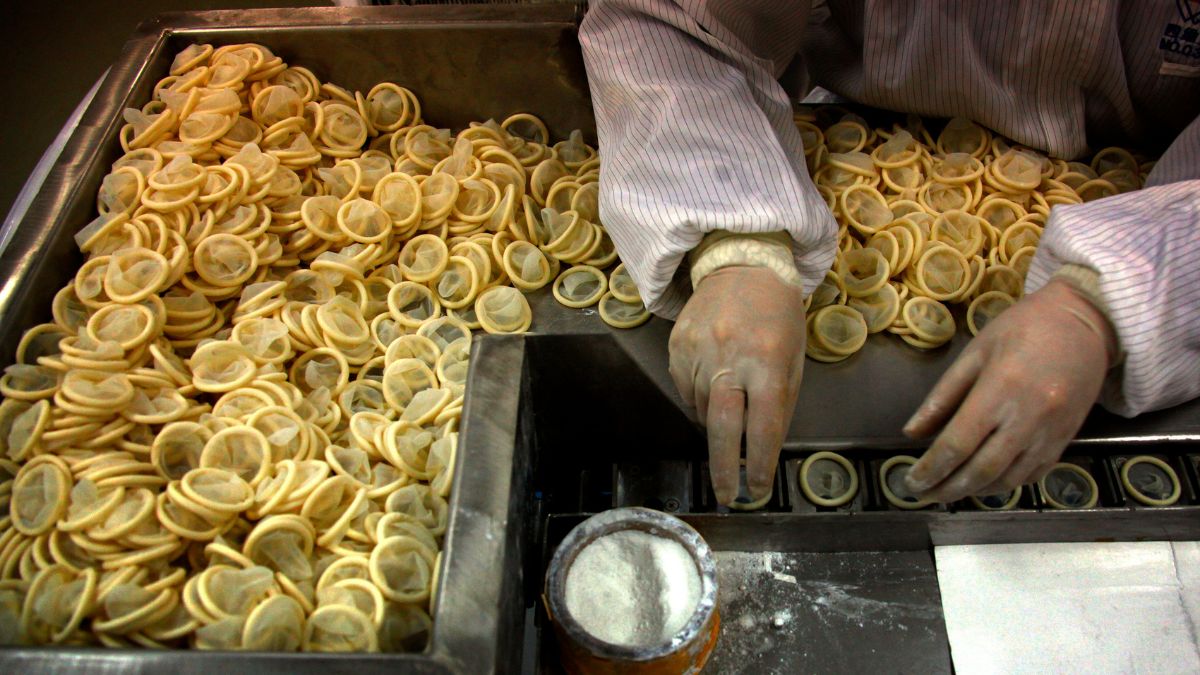
 "A worker places condoms onto a packaging belt at a Chinese condom manufacturer's factory in the town of Zhaoyuan, Shandong Province, China, February 6, 2012. Representational Image/Reuters")
China’s latest tax policy change includes the decision to impose a value-added tax on contraceptives, including condoms.
The policy marks the end of a three-decade exemption and arrives at a time when Beijing is attempting to arrest a sustained collapse in birth rates that is shaping the country’s economic trajectory.
The revised Value-Added Tax (VAT) law, which will take effect in January, introduces a 13 per cent levy on a range of contraceptive products that have been VAT-free since 1993, reported Bloomberg.
How Beijing turned around a decades-old policy
When China first exempted contraceptive goods from VAT in the early 1990s, authorities were focused on preventing population growth.
This approach remained largely unchanged for more than 20 years even after the one-child policy was formally phased out.
During that era, the state promoted widespread use of birth control implants, pills and condoms, while abortions and sterilisations were routinely carried out to enforce national population limits.
However, China’s demographic landscape is dramatically different today.
The population has contracted for three consecutive years, a trend not seen in decades. Official data shows that only 9.54 million babies were born in 2024, a sharp decline from the 18.8 million births recorded nearly ten years earlier — just after the end of the one-child rule.
Demographers warn that if this trend continues, China faces long-term economic challenges from a shrinking workforce and growing elderly population.
How Beijing is incentivising child birth
But as contraceptives are becoming more expensive, a range of services essential to child-rearing or family life are now exempt from VAT altogether.
The list includes nurseries, kindergartens, elder-care services, disability care providers and businesses that offer marriage-related services.
Through these tax incentives, policymakers hope to reduce at least part of the financial strain associated with family responsibilities.
But over the past several years, Chinese officials have acknowledged that merely removing birth limits is insufficient to reverse the declining fertility rate. As a result, various government bodies have introduced a set of pronatalist measures, including:
expanding paid maternity and paternity leave
offering direct monetary subsidies to new parents
encouraging local governments to improve childcare infrastructure
promoting the availability of affordable nurseries and preschools
introducing guidance intended to reduce abortions that are not considered medically necessary
In contrast to the period when the government frequently enforced abortions or sterilisation procedures to limit family size, the current approach aims to encourage births by improving family support systems and adjusting societal expectations.
How raising a child in China is still expensive
However, experts stress that these efforts face powerful economic headwinds. A study from the YuWa Population Research Institute in Beijing estimates that raising a child to age 18 can cost more than 538,000 yuan, or over $76,000.
This makes parenthood in China one of the most expensive in the world.
Analysts note that this price tag looms large for young adults who are already managing a sluggish economy, rising living expenses and an uncertain job market.
The financial pressures have not only made family formation difficult but have also reshaped attitudes among younger generations.
Many now prioritise personal stability, career advancement and financial independence over having children.
According to He Yafu, a demographer at YuWa, “Removing the VAT exemption is largely symbolic and unlikely to have much impact on the bigger picture.”
He argues that the change should be viewed as part of a larger attempt to build social norms that are more supportive of childbirth and less reliant on abortion as a reproductive control mechanism.
How China’s condom tax has raised public health concerns
The announcement quickly became a trending topic on Weibo, China’s most influential microblogging platform.
Some users highlighted the potential unintended consequences, especially in light of the recent rise in HIV infections within the country.
According to the Chinese Centre for Disease Control and Prevention, reported HIV/AIDS cases increased dramatically between 2002 and 2021 — from 0.37 per 100,000 people to 8.41 per 100,000.
The majority of new cases were linked to unprotected sexual contact.
Public health specialists have repeatedly pointed out that stigma surrounding sexual topics and insufficient sex education contribute significantly to poor awareness about safe practices.
Why it is an uphill battle for Beijing
After decades spent limiting births, Beijing now finds itself pushing aggressively in the opposite direction. The challenge, however, is formidable.
A shrinking labour force may strain economic growth, while a rapidly growing elderly population increases demand for health care, pensions and long-term support services.
This imbalance places pressure on the working-age population, which is already navigating an economy marked by slow growth, real estate instability, and limited wage increases.
Against this backdrop, Beijing has begun revising several tax and regulatory structures to lower the cost of raising children.
Yet it remains uncertain whether these strategies will alter long-term fertility patterns.
Experts argue that reversing this trend may require far more extensive reforms, including greater job security, more affordable housing and a larger network of high-quality public childcare options.
Also Watch:
With inputs from agencies