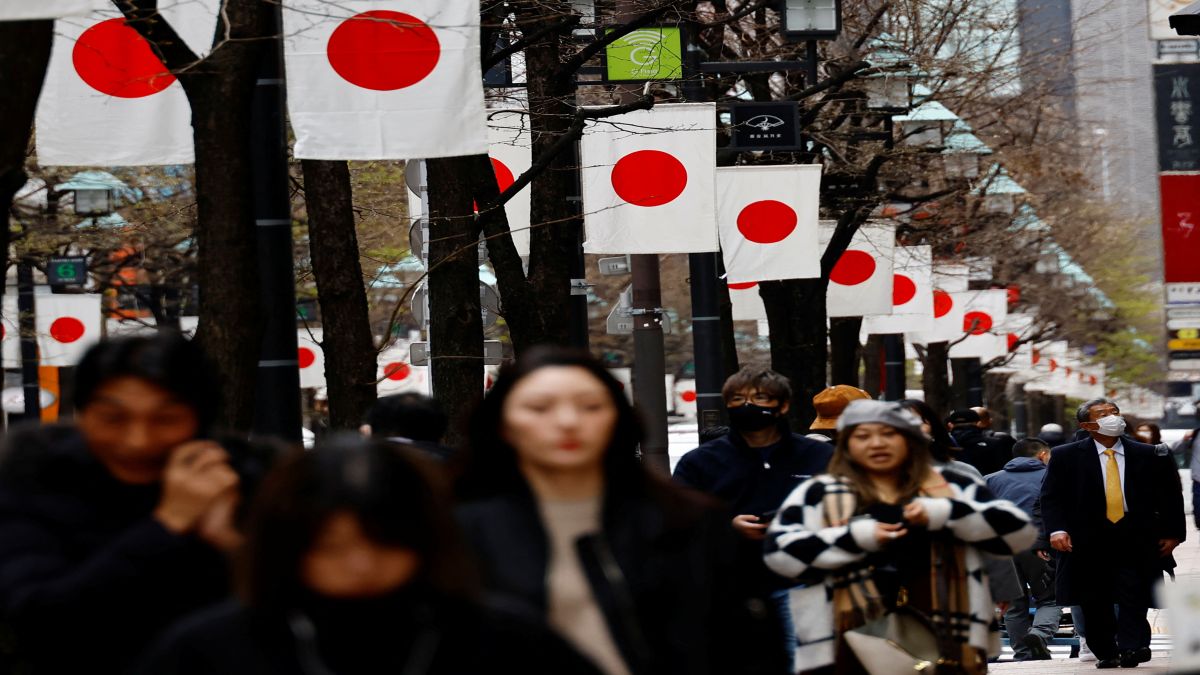
 "People walk past Japan’s national flags in a shopping district in Tokyo. Japan has ended its negative interest rate policy, marking a historic shift away from an aggressive monetary easing program, implemented years ago to fight chronic deflation. File image/AP")
It could be called an end of an era. On Tuesday (19 March), Japan ended its negative interest rate policy, as the Bank of Japan (BoJ) raised interest rates for the first time since 2007. This marks an end to a prolonged period of ultra-loose monetary policy aimed at stimulating the economy.
However, if all this sounds like jargon to you, fret not. We explain what exactly is a negative interest rate, what benefits do they provide and what the end of this means for Japan.
What are negative interest rates?
Negative interest rates are when central banks make their commercial counterparts pay to park their excess cash at the institution. This method is usually adopted during deflationary periods when consumers hold too much money instead of spending as they wait for a turnaround in the economy. Consumers may expect their money to be worth more tomorrow than today during these periods. When this happens, the economy can experience a sharp decline in demand, causing prices to plummet even lower.
Experts believe that in order to avoid the charges for parking the cash, banks use the money to lend more to businesses and consumers, which, in turn, helps financial growth.
These negative interest rates were first introduced by Swedish Riksbank in 2009. This was followed up others such as the central banks of Denmark, Switzerland and then Japan.
Why did Japan introduce negative interest rates?
While Japan introduced negative interest rates for the first time in 2016, the Asian nation was already on this path by the mid-1990s. At the time, it was a new measure introduced by Tokyo in its long battle against deflation , or declining prices.
Impact Shorts
More ShortsThe Bank of Japan had hoped that by introducing negative interest rates it would encourage spending and inflation in an ageing society with a negative population growth. Moreover, the authorities believed that it would help in keeping the country’s debt repayments manageable. For those who are unaware, Japan’s national debt has floated above 100 per cent of its GDP, making it the most indebted nation on the planet.
So, did negative interest rates help Japan? According to a Bloomberg report, they may have helped prevent deeper deflation in the economy. However, it during the COVID-19 pandemic and the fallout from Russia’s war in Ukraine, it affected the economy.
In fact, until now, the Bank of Japan has been the world’s central bank that has retained its negative rate policy. Some experts also note that the prolonged use of such negative interest rates have cut into banks’ profitability and helped push down the value of the yen.
So, what has Japan done now?
On Tuesday, Japan’s central bank raised its benchmark interest rate ending a longstanding policy of negative rates. The short-term rate was raised to a range of 0 to 0.1 per cent from minus 0.1 per cent following a 7-2 majority vote taken at a policy meet.
The negative interest rate policy, combined with other measures to inject money into the economy and keep borrowing costs low, “have fulfilled their roles,” the bank said in a statement, as per an AP report.
The central bank also scrapped a policy in which it bought Japanese government bonds to keep a lid on how high market rates can go, encouraging businesses and households to borrow cheaply.
But why now?
There are several reasons as to why the Bank of Japan chose this point of time to take this drastic step.
Firstly, Japanese companies have announced relatively robust wage hikes for this year. In fact, unions secured an average salary increase of 5.28 per cent according to the first-round results of Japan’s annual spring wage negotiations, the Japanese Trade Union Confederation said last week. For the entire decade ending in 2022, the final annual increase never exceeded 2.4 per cent.
The Bank of Japan said that wages and profits at companies were improving.
Moreover, in recent months, for the first time in years, inflation in Japan was approaching the Bank of Japan’s two per cent target level. This raised even more speculation that rate changes would take place.
Even locals of Japan felt prices going up. Shizuka Nakamura, 32, a resident of Yokohama, told the _New York Time_s that she had noticed cost of living rising. “My friends who are around the same age as me and who have also had children all say that things like diapers and baby formula are getting more expensive,” she said.
What does this mean for the Japanese economy?
In the immediate aftermath of the decision, the yen weakened and Tokyo stocks rose. As AP reported, Tokyo’s Nikkei 225 index rose 0.4 per cent to 39,874.92, while the dollar rose to 149.99 Japanese yen from 149.14 yen.
As Wall Street Journal wrote not much would change in the short term. However, in the long run, the decision should help raise investments, prices and wages.
The decision will see the government the Bank of Japan suffer in that higher interest rates will raise government debt servicing costs. But private banks will be able to make more profits with higher interest rates. Home buyers will also see their mortgage rates rise, which could lead to a cool down in the real estate market.
But, owing to higher interest rates, a stronger yen will cut import costs and help households with cheaper costs of imported food and energy. Also, a stronger yen will help travellers going abroad, while it will make it more expensive to visit Japan.
What happens next?
Bank of Japan Chief Kazuo Ueda has said the bank would review its policy and other easing measures if the two per cent inflation target was met and was accompanied by wage increases.
The bank also pledged to keep buying long-term government bonds at “broadly the same amount” as before, and indicated that financial conditions will remain accommodative “for the time being.”
When asked about the change, Japanese prime minister Fumio Kishida was quoted as telling Nikkei, “We trust the BoJ. The decision is in their hands.”
With inputs from agencies