

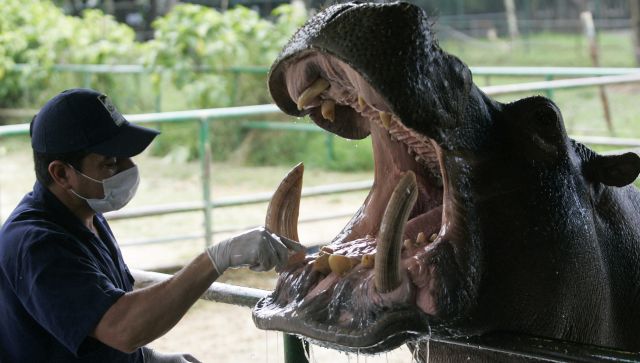
 "Are Pablo Escobar’s ‘cocaine’ hippos coming to India? Why does Colombia want to get rid of them?")
Notorious Colombian drug lord Pablo Escobar is gone, but his legacy continues to haunt the country thirty years after his death. The founder of the Medellín drugs cartel in the 1980s, he was behind several kidnappings, killings, and bombings. But that’s not all. The “king of cocaine” is also responsible for an “ecological timebomb”, courtesy of his infamous hippos. And they might just come to India.
What are Escobar’s ‘cocaine’ hippos?
Escobar, who was at one time among the richest people in the world, imported a group of hippopotamuses illegally from a US zoo, to keep in his private estate. It housed a menagerie, which was home to hippos, and other animals like zebras, giraffes, and flamingoes.
After the drug kingpin was killed in 1993, most of the animals were relocated. But not the hippos. They were deemed too difficult to handle and were left behind. Authorities thought they would die; they did not.
The large mammals grew in number, spreading beyond Escobar’s Hacienda Napoles ranch, located 200 km from Bogota along the Magdalena River and some small lakes nearby. Over the years, they have multiplied to more than 100 and are posing a threat to the country’s ecosystem.
The “cocaine hippos”, as they are called, have left the country divided. Some locals have taken to the hippos, who have become a tourist attraction, and want them saved. Conservations fear that these dangerous invasive species are a threat to the environment and the locals.
Where does India come into the picture?
Amid all this debate, there is a proposal to send hippos to India and Mexico. Colombia is proposing to transfer at least 70 hippos to the two countries to control their population.
Quick Reads
View AllThe plan to take them to India and Mexico has been forming for more than a year, said Lina Marcela de los Ríos Morales, director of animal protection and welfare at the Antioquia province’s environment ministry, according to a report in The Associated Press (AP).
Colombian authorities want to send 60 hippos to the Greens Zoological Rescue & Rehabilitation Kingdom in India’s Gujarat and another 10 would go to zoos and sanctuaries in Mexico such as the Ostok, located in Sinaloa.
The hippos would be lured with food into large, iron containers and transferred by truck to the international airport in the Colombian city of Rionegro. From there, they would be flown to India and Mexico, where there are sanctuaries and zoos capable of taking in and caring for the animals, AP reports.
Ecuador, the Philippines and Botswana have also expressed their willingness to relocate Colombian hippos to their countries, according to the Antioquia governor’s office.
Why does Colombia want to send the hippos away?
There is a lot of debate over the hippos, which are territorial and weigh up to three tonnes (3000 kg), and have spread far beyond Escobar’s estate. Environmental authorities estimate there are about 130 hippos in the area in the Antioquia province and their population could reach 400 in eight years and 1,500 in 16 years.
These hippos have no natural predators in Colombia and have been mating at a steady rate. There was one male and three females in 1993 and their population growth has been alarming. They live in the Magdalena River and other waterbodies, which are part of the country’s main watershed.
Researchers have warned about the dangers the mammals pose to the country. A report in Nature magazine quotes a 2019 paper that showed that lakes with hippos contain more nutrients and organic matter that favour the growth of cyanobacteria, aquatic microbes associated with toxic algal blooms. These blooms can reduce water quality and cause mass fish deaths, affecting local fishing communities.
Scientists also warn that the hippos in Colombia could displace endangered species that are native to the Magdalena River like the Antillean manatees, lovingly nicknamed named sea cows, as they compete with them for food and space.
There is also fear of deadly encounters between the animals and humans. Some of the hippos need to be killed, a group of scientists had warned. They are dangerous – hippos kill more people in Africa every year than any other animal.
“I believe that it is one of the greatest challenges of invasive species in the world,” said Nataly Castelblanco-Martínez, an ecologist at the University of Quintana Roo in Mexico and lead author of the group’s study that suggested the culling of hippos.
But not everyone in Colombia is happy. The idea of killing the animals has drawn criticism.
In 2009, there was a huge outcry from animal rights activists after photos appeared online of soldiers gunning down Pepe, Escobar’s male hippo. It plunged the environment ministry into an “institutional paralysis”, Sebastián Restrepo Calle, an ecologist at Javeriana University in Bogota, told Nature.
The humans in rural areas have embraced the hippos as their own, in part because of the tourist dollars they bring in. School students are used to walking past a sign that reads “Danger — hippopotamus present”, according to a report in AP.
A lawsuit was filed against the Colombian government in the US, and in October 2021, the animals were declared as people or “interested persons” with legal rights. While animal rights activists hailed the order, it does not carry any weight in Colombia.
What has the Colombian government done so far?
After realising the danger the growing population of hippos pose, the government attempted to sterilise them. By October 2021, around 24 hippos were sterilised using Gonacon, an immunocontraceptive vaccine, which works temporarily but can cause permanent infertility, reports Guardian.
But experts say this was not enough. “Everyone asks, ‘Why is this happening?’ Well, imagine a town of 50 people and you perform a vasectomy on one man and in two years on another man, obviously, that is not going to control the reproduction of the entire population,” Castelblanco-Martínez said.
In 2022, the Colombian government officially declared hippos as an invasive species, paving the way for a possible cull. Strategies like castration were also discussed.
Now, there is a proposal to ship them to India and Mexico. The plan is to focus on the hippos living in the rivers surrounding the Hacienda Napoles ranch, not the ones inside the ranch because they are in a controlled environment and don’t threaten the local ecosystem, according to a report in AP.
The relocations would help control the hippo population, and though the animals’ native habitat is Africa, it is more humane than the alternate proposal of exterminating them as an invasive species, said De los Ríos Morales.
With inputs from agencies
Read all the Latest News, Trending News,
Cricket News, Bollywood News,
India News and Entertainment News here. Follow us on
Facebook,
Twitter and
Instagram.


 "'Indian food, our pride': $200k settlement in Palak Paneer case a moral victory against racism in the west")
 "India’s air dominance in Operation Sindoor forced Pakistan to seek ceasefire, European report says")
 "How Pakistan’s support may have led Bangladesh towards a very costly mistake")
 "India vs New Zealand Live Score 3rd T20: Kishan gone after IND cross 50 in just 3.1 overs")
 "'Indian food, our pride': $200k settlement in Palak Paneer case a moral victory against racism in the west")
 "India’s air dominance in Operation Sindoor forced Pakistan to seek ceasefire, European report says")
 "How Pakistan’s support may have led Bangladesh towards a very costly mistake")
 "India vs New Zealand Live Score 3rd T20: Kishan gone after IND cross 50 in just 3.1 overs")



