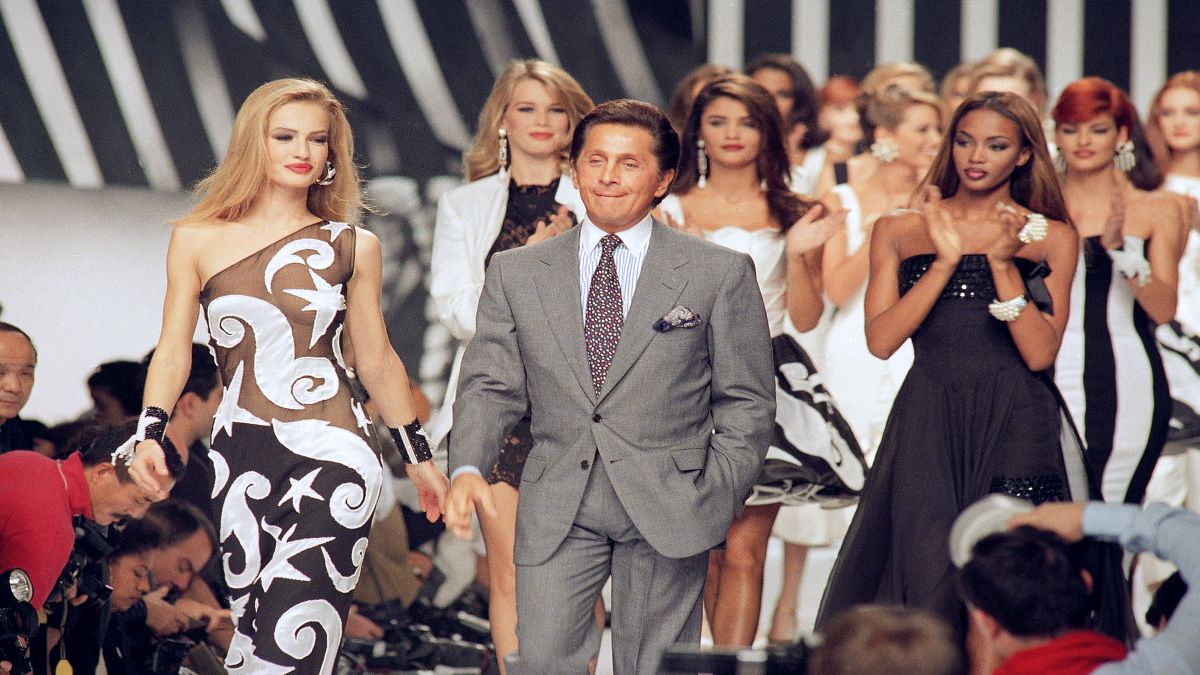
 "Italian fashion designer Valentino Garavani walks the catwalk with his models after a fashion show in 1991 in Paris, France. At the age of 93, the designer passed away, leaving a $1.5-billion fortune behind. File image/AP")
The world of fashion is in mourning. Valentino Garavani, Italy’s legendary couturier who has dressed everyone from Hollywood stars to European royals and American First Ladies, has passed away at the age of 93 at his home in Rome.
Following the announcement of his demise, friends, fashion industry insiders and celebrities grieved the loss of the designer with Donatella Versace writing on Instagram: “Today, we lost a true maestro who will forever be remembered for his art. My thoughts go to Giancarlo who never left his side for all these years. He will never be forgotten.”
But even as the world mourns the loss of the fashion great, it has ignited a question — who inherits his empire?
Valentino’s life in fashion
Named after the star of silent cinema Rudolph Valentino, the fashion emperor Valentino Garavani was born on May 11, 1932 in Voghera, a small town south of Milan. His father owned an electric cables business.
As a boy, he asked for made-to-measure shoes and was passionate about fashion. “I have had this illness since childhood,” he told the Italian edition of Elle magazine in 2007. “I only like beautiful things.”
At the age of 17, with a love for fashion, Valentino left home to study at the prestigious arts and fashion schools in Paris. By 1952, he was hired by designer Jean Desses, who dressed wealthy clients including royalty, and five years later he went to work for Guy Laroche.
It was around 1959 that Valentino opened his own fashion house in Rome with the assistance of his lover, Giancarlo Giammetti, who had a strong business acumen. Valentino first earned the fashion world’s respect with his opening collection which featured what came to be known as his signature colour — Valentino Red.
In the years to follow, Valentino quickly rose to the top of the fashion world with his designs being seen on all those who mattered. In 1960, Hollywood actor Elizabeth Taylor donned a Valentino gown to the premiere of Spartacus in Rome.
Jacqueline Kennedy also chose Valentino designs during her year of mourning following John F Kennedy’s November 1963 assassination. He also made the cream lace dress Jacqueline Kennedy wore for her marriage to Aristotle Onassis in 1968 and the sable-collared suit Farah Diba wore to flee Iran when her husband, the shah, was deposed in 1979.
In subsequent years, Valentino’s gowns have been closely associated to culturally historic moments. Remember Julia Roberts in the black and white gown she wore when she won the Oscar for her portrayal in Erin Brockovich or Cate Blanchett in the one-shouldered yellow silk taffeta when she won the Oscar in 2005.
Valentino’s billion-dollar empire
With the help of Giammetti, Valentino extended his fashion empire beyond couture; ready to wear, accessories, fragrances and licensing deals turned the Valentino fashion house into a global luxury machine.
In 1998, the Valentino fashion brand sold for $300 million to Holding di Partecipazioni Industriali, with Valentino still designing until his retirement in 2007. At the time, Valentino sold to increase the size of his brand: he knew without the support of a larger corporation surviving alone would be impossible.
Subsequent sales to Marzotto and later Qatari investors further increased the brand’s valuation, cementing Valentino’s billionaire status even after he stepped back from daily operations. It is reported that at the time of his demise, his net worth was a whopping $1.5 billion.
But his fortune didn’t just come from fashion. Valentino invested in high-value real estate, owning a Roman villa near the Spanish Steps, a London mansion, a Manhattan penthouse, a French château, and a Swiss chalet.
He also enjoyed many luxuries, including the TM Blue One, a 152-foot superyacht worth about $15 million. It was designed by Perini Navi with the interiors personally styled by himself. The designer also owned a remarkable art collection worth hundreds of millions of dollars. His residences displayed works by Picasso, Rothko, Bacon, Warhol, Basquiat, Hockney and others.
Valentino also founded the Accademia Valentino, a cultural space in Rome designed to host exhibitions and philanthropic events in 1990. While it wasn’t a profit-making avenue, it reinforced his brand value.
Inheriting Valentino’s fortune
So, the question that is on many people’s minds following Valentino’s demise is who shall inherit it all?
Valentino had no children of his own, though he was known to be passionate about his pugs. At one time, he even owned six of them: Milton, Monty, Maude, Margot, Maggie and Molly. In fact, in his documentary, titled Valentino: The Last Emperor, he said: “I don’t care about the collection. My dogs are more important.”
According to CEO Today Magazine, Valentino’s estate is widely understood to be structured through private trusts, with Giancarlo Giammetti playing a central role in stewardship. Moreover, Italian inheritance law, combined with cross-border asset planning, suggests a carefully designed framework intended to preserve both wealth and cultural legacy, rather than liquidate assets quickly.
With inputs from agencies