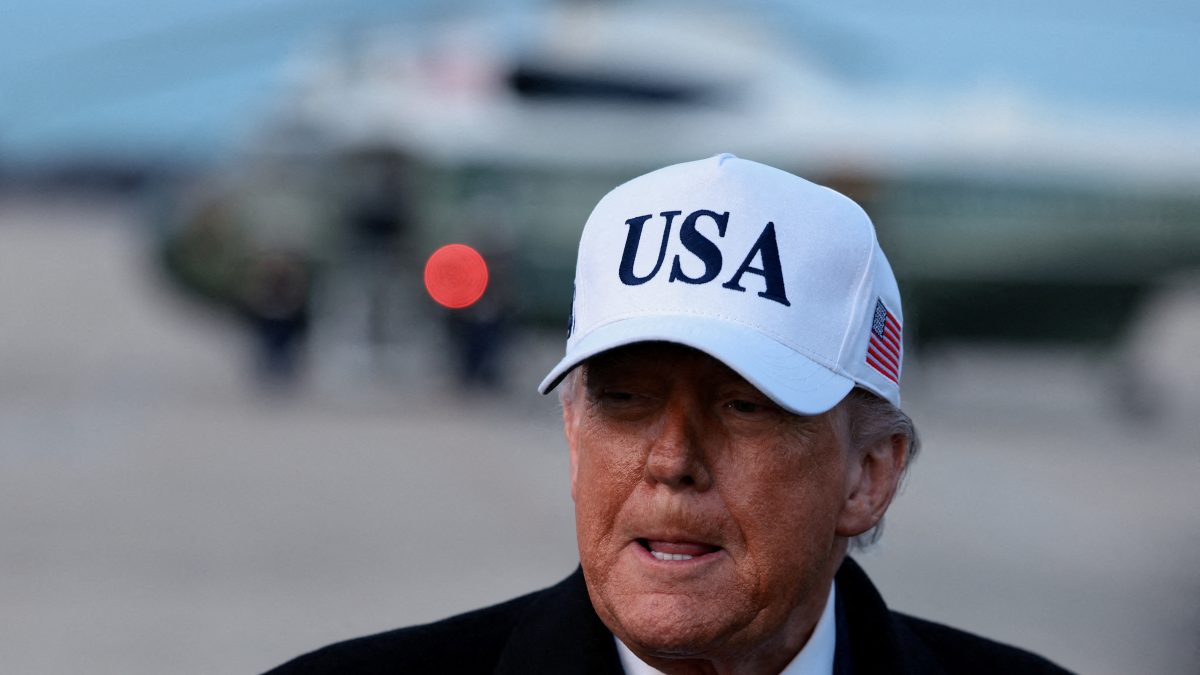
 "US President Donald Trump has sought to redraw maps across the world in his first year back in power. Reuters")
It’s been a year since Donald Trump returned to the Oval Office.
Trump, who had previously served as the 45th president of the United States, took office as the 47th President of the United States on January 20, 2025.
Since his return to power, Trump has upended global trade and left the US’ friends and allies wondering what comes next. Above all, Trump has tried to redraw the world map over the past 365 days and increase America’s influence.
Trump on Tuesday posted a map of America showing Canada, Venezuela and Greenland as part of the United States. The White House previously said Trump wants to “restore American pre-eminence in the western hemisphere”.
Let’s take a closer look
Gulf of Mexico
Just a month after returning to office , Trump announced he would be renaming the Gulf of Mexico as the ‘Gulf of America’. Trump passed an executive order 14172., entitled Restoring Names That Honor American Greatness, that declared February 9 as ‘Gulf of America Day’.
According to Trumps executive order, the ‘Gulf of America’ comprises “the US Continental Shelf area bounded on the northeast, north, and northwest by the State of Texas, Louisiana, Mississippi, Alabama, and Florida, extending to the seaward boundary with Mexico and Cuba.”
“I took this action in part because, as stated in that order, ‘the area formerly known as the Gulf of Mexico has long been an integral asset to our once burgeoning Nation and has remained an indelible part of America,” Trump’s proclamation read.
“As my administration restores American pride in the history of American greatness, it is fitting and appropriate for our great Nation to come together and commemorate this momentous occasion and the renaming of the Gulf of America,” Trump added.
While some US agencies including the Coast Guard have already started using the name ‘Gulf of America’, the rest of the world has not. This is because Trump executive orders carry no weight outside the borders of his country.
Experts say this is more of a political play rather than an international legal strategy.
Matthew Zierler, a political science professor at Michigan State University who studies foreign policy and international law, told Business Insider, “Internationally, there have always been differences among countries about what to name specific bodies of water, islands, etc.”
“Names reflect culture, history, and identity, so the disagreements between countries on what to refer to a place are real,” but the core of the issue, he said, “is political rather than legal.”
The Gulf of Mexico name has been used internationally since the 16th century. Mexican President Claudia Sheinbaum previously joked that North America, which includes the United States, ought to be renamed “Mexican America” – an historic name used on an early map of the region.
Trump has also claimed that the drug cartels are running Mexico and threatened to conduct strikes in the neighbouring country.
Sheinbaum has also said that the US must address its drug culture.
“The other side also has to do its part. This consumption crisis they have over there also has to be addressed from a public health perspective, through education campaigns,” Sheinbaum was quoted as saying by Al Jazeera.
Panama Canal
When it comes to global trade, the Panama Canal is one of the most important chokepoints. The canal, which was completed in August 1914, witnesses 5 per cent of all global traffic and a whopping 40 per cent of US trade traffic.
Little wonder than that Trump has been looking to reassert American influence over the canal, which was built and controlled by the US for decades.
Trump has claimed that Panama charges excessive tolls for US ships to pass through the canal, calling them “ridiculous” and “very unfair.” Trump has also asserted that the US needs to take back the canal because China controls it and could use the waterway to undermine American interests.
According to CFR, China comprises around 21 percent of the canal’s trade. Beijing owns two of its five major ports and Chinese firms run logistic hubs at the Canal. Chinese companies have made significant investments in Panama that some U.S. lawmakers and maritime experts say could give Beijing leverage over the canal’s operation.
While Panama’s President José Raúl Mulino Has made some concessions to the US, experts say it has left him in a tough spot.
Will Freeman, fellow for Latin America studies at the Council for Foreign Relations, was quoted as saying, “This all-stick, no-carrot approach is not ‘going to work in South America, which is much more economically dependent on China.’”
Venezuela
In Venezuela, Trump has tried to increase the United States sway by taking out Nicolas Maduro. Trump sent the US’ elite Delta forces to Caracas and captured Maduro and his wife Cilia Flores. The two have now been to the United States, where they are set to stand trial.
The president in his newly-unveiled “Donroe Doctrine”, a play on the ‘Monroe Doctrine’, has claimed that the United States now owns Venezuela’s oil. This is in line by Trump’s previous statements about Iraq in which he said the United States should have simply taken the country’s oil to pay for the war.
Though Trump has invited a number of oil companies to do business in Venezuela and even invited some oil honchos to the White House, the companies seem reluctant. This is because Venezuela has nationalised its oil decades ago, which means that the country would first have to change its laws. Also, Venezuela’s oil infrastructure has so degraded over the past decade that experts estimate it could take years before the oil starts flowing.
Trump has also claimed that Secretary of State Marco Rubio and Defense Secretary Pete Haggis would be ‘running’ Venezuela. However, the United States has no troops on the ground and no way of enforcing its diktats. Meanwhile, Venezuelan vice president Delcy Rodriguez, who has taken over as interim president after an order from the country’s Supreme Court, is treading a fine line. Most of the rest of Maduro’s inner circle have simply taken over from where he left off.
In practice, the president’s policies smack of neo-imperialism, not neo-isolationism," Charles Kupchan, a senior fellow at the Council on Foreign Relations and a professor at Georgetown University, wrote.
Greenland
Trump’s interest in Greenland isn’t anything new.
In fact, During Trump’s first term he floated purchasing the semi- autonomous territory from Denmark, but was roundly mocked by the media and politicians from both countries. However, no one is laughing now.
Trump has repeatedly said Washington must own Greenland, an autonomous part of the kingdom of Denmark that houses a US airbase, to prevent Russia or China from occupying the strategically located and minerals-rich Arctic territory.
He says a US military presence there is not enough. Greenland and Denmark have said that Greenland is not for sale, but Trump has not ruled out taking it by force. Denmark and the US are NATO members.
“In opting out of this consensus, the US risks assuming the position of a rogue state within the international system," Marc Weller, the director of the International Law Programme at the Chatham House think-tank, said.
Greenland is an important location. It sits astride key Arctic shipping lanes that are becoming more viable as ice melts due to climate change, and it hosts the US-operated Pituffik Space Base, a critical component of America’s missile warning and space surveillance systems. The island is also rich in rare earth minerals, uranium, and other critical resources essential for advanced technologies and defence systems, all resources that Washington fears could otherwise fall under Chinese influence.
While Denmark retains formal control over Greenland’s foreign and defence policy, Trump has increasingly framed the island as vital to US national security, unsettling both Copenhagen and Nuuk.
“Greenland is growing in importance as we find ourselves in a global competition with China and in a new technological revolution with regards to warfare,” Rebecca Pincus, director of the Wilson Center’s Polar Institute, told Radio Free Europe/Radio Liberty. “So, Greenland is important from a missile-defense perspective, from a space perspective, and from a global competition perspective.”
Greenland’s Prime Minister Múte B Egede has insisted that the people of Greenland want independence. “We don’t want to be Danish, we don’t want to be American, we want to be Greenlandic,” he said in January 2025.
Brent Sadler, a senior research fellow at the Heritage Foundation, told GBH that Greenland could become increasingly important “if shipping becomes viable through that route as Arctic weather gets warmer and ice caps shrink.”
“Geography really matters, and Greenland’s geography is extremely strategic,” Sadler, a retired US Navy captain, added. “We don’t want a Chinese economic or military presence right there at a very critical pathway for an attack against the United States.”
“Any policy made in Washington is made through the lens of the competition with China,” said Frangeul-Alves, who focuses on US politics for the German Marshall Fund.
Canada
Canada, America’s closest ally and largest trading partner, has also felt the strain of Trump’s return.
While Trump has not made any formal territorial claims, his rhetoric toward Ottawa becoming America’s ‘51st state’ has left many Canadian officials upset.
Trump has accused Canada of exploiting the United States through what he calls unfair trade practices, particularly in the dair I y, lumber, and energy sectors. He has threatened fresh tariffs and suggested that Canada relies excessively on US security guarantees.
In late 2025, Canadian Prime Minister Mark Carney said Canada is ready to resume trade talks with the United States, but the Trump administration halted certain negotiations over political disagreements.
Experts say Trump’s posture reflects his broader belief that North America should fall firmly within a US-dominated sphere of influence. However, making Canada the 51st state seems to have completely fallen off Trump’s radar at least for now.
Ukraine
Trump’s return has also altered Washington’s approach to the war in Ukraine. The president has repeatedly questioned the value of continued US military and financial aid to Kyiv, arguing that Europe should shoulder a greater share of the burden.
Trump, who had vowed to end the Gaza war ‘very quickly’ after taking office, has not been able to follow adhieve this. Trump last year seemingly grew frustrated with Russia’s Vladimir Putin.
The Trump White House has been pushing a peace plan that many contend is in line with what Moscow wants and offers up far too much to Russia.
“The new Strategy is weak on Russia… it calls for a ‘cession of hostilities’ in Ukraine that leaves Ukraine a ‘viable state’ and terms this a ‘core interest’ of the United States,” Daniel Fried, Weiser Family Distinguished Fellow at the Atlantic Council, was quoted as saying.
Gaza
In West Asia, Trump has taken an unapologetically pro-Israel position on Gaza. He had backed Israeli military operations and framed them as part of a broader struggle against terrorism and Iranian influence.
Trump has said Gaza’s temporary governance will be overseen by a so-called “Board of Peace” of which Trump himself will be the chair.
But many experts say this resembles a colonial structure with Trump chairing a board to oversee a foreign territory’s governance. UN special adviser on sustainability Jeffrey Sachs called it “imperialism masquerading as a peace process” while multiple UN experts cast it as “regrettably reminiscent of colonial practices.”
“The strategy’s ideological hostility toward Europe combines with its implied disdain for the conventional free‑world order… while elsewhere it recognises that the United States will need its friends to contend with its adversaries,” Torrey Taussig, Director of Transatlantic Security Initiative, Atlantic Council, was quoted as saying.
What do experts say?
Some experts say Trump has simply torn off the mask of colonialism.
“The idea that this is new is ridiculous,” said Kehinde Andrews, a professor of black studies at Birmingham City University in the UK and the author of The New Age of Empire: How Racism and Colonialism Still Rule the World, told The Guardian. “The US has been doing this all along, but the only difference here is it’s just brazen. There’s nothing new about this at all. This is what the west does; Trump’s just honest about it. I actually find it refreshing to be honest.”
Others contend the US has never been shy about being an empire.
Daniel Immerwahr, a historian and humanities professor at Northwestern University in Illinois, and the author of How to Hide an Empire, said that America keeps five permanently inhabited territories: Puerto Rico, the US Virgin Islands, Guam, the Northern Mariana Islands and American Samoa. Not to mention the hundreds of military bases around the world.
Others disagree.
As Dan Hamilton, a foreign policy expert at the Brookings Institution, told GBH after Trump’s inauguration last year, “A lot of this is bombast and bluster,” Hamilton says. “It’s also a tried and true tactic of Donald Trump — to sort of disorient your negotiating partner, put them on the back foot because you want to get a better deal for the real goals that you have.”
It remains to be seen how Trump 2.0 plays out.
With inputs from agencies