

 "What Old Enough!, Japan's reality TV on Netflix, tells us about the country's domestic work culture and approach to adolescents")
A collection of 20 episodes over the years of the longest-running show in Japan, Old Enough! is centered on the idea of young kids running errands for their families. I am talking about kids as young as two years picking up a bag, carrying a wallet, buying stuff, paying for them at the counter, and ensuring to return home with the stuff intact. To a spoilt male kid like me who was rarely ever asked to help out with household stuff (something that I remain embarrassed about), watching Old Enough! is a shocking experience, not just because of my own privileged childhood, but also because of a similar collective sight around me — Children in middle-class India and above are barely expected to be helpful in household chores before they enter their teens. So many questions arise: How is this show acceptable, let alone lovable? Do the kids understand how currency works? Can they fathom the value of coins by looking at them? Do they actually talk to themselves out loud that much? How do the parents trust the kids to walk straight on the road, and not accidentally veer off in the middle of traffic? Are these parents devils? But this is where Old Enough! (original title: My First Errand) stands out. Its fun feet are firmly based in the realities of Japan and its cultural ethos. We might be startled at the sight of such young souls expected to step out and function on their own, but Japan, for decades now, has been known for inculcating in their children a tendency to be independent and self-reliant. It is a common sight there to watch five-year-olds boarding trains and walking to school all by themselves, and occasionally walk over to a nearby shop to buy groceries or run an errand. Much to our relief, most of these episodes are set in rural or countryside Japan: quiet landscapes with minimal automobile interventions, brimming with nature and silence. And above all, open spaces for a toddler to walk freely without inviting any panic from their parents. It is in these serene spaces that these kids are let loose as they paint the town red. Old Enough! might expect kids to do tasks above their usual skill-set, but they are allowed to be themselves while doing them. There is no herculean expectation of performance for the camera. One cannot help but recollect the crudeness of some Indian reality shows in the contrast, driven by an extreme sense of ‘productive’ talent and competitiveness. Over the years, we have seen five-year-olds dance to crass-sounding item songs, looking and behaving much older than they actually are. The kids in Old Enough! do not have such standards to live up to. They are off the hook, except of course the initial expectation of doing the chore. There are no ratings, rankings or a need of being better than others. Every kid has their own journey.
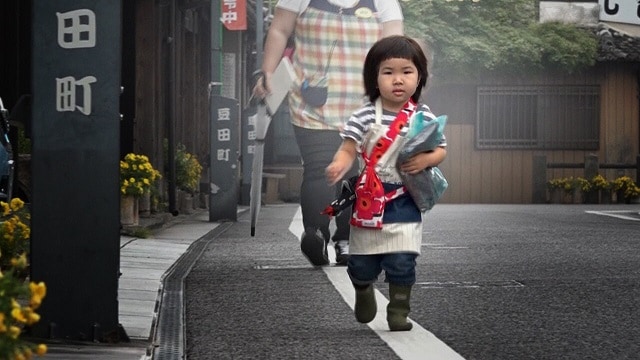

Every little achievement is celebrated and underlined by a rousing score. This is not a place for cynicism, and the wise commentator finds a way to connect the dots, in order to give an emotional thread to the goings-on.
You forgive the parents too if ever you felt miffed at them for pushing their own children so hard. Running alongside the life-affirming and progressive idea of self-reliant children is a constant emphasis on traditional values — holding memorials for ancestors, praying to Gods and making them offerings, believing in the idea of a deceased parent as a guiding spirit —— the show effectively marries the traditional and the stupefying. Like these kids who want to believe in God, Old Enough! wants to believe in goodness, and operates with the required wide-eyed gusto. You can pick a lot of things from this show, and life lessons are only one of them. One episode has the kid pushing herself to lift the trolley up the final long stair in front of the porch, and she does not call her mother for help. Somehow, these tiny tots make peace with the occasional physical turmoil, if they know on the other side awaits them an emotional reward. In the first episode itself, we see the kid thoughtlessly dragging the dainty chrysanthemums that he has bought on his way back home. They are, after all nearly as tall as him. And yet, he is running the errand the best way we can. Lest we forget that some of these tasks are too daunting or physically overwhelming for these kids, the camera keeps pulling back to reveal a wider, much intimidating landscape — with a busy highway barely two feet away from the toddlers, the cars swooshing right past them at times. But the tour-de-force moment of the show definitely arrives in episode 7, as our little protagonist looks for a shop to fetch her mother’s watch. She first returns, sobbing her eyes out after telling her mother that she could not locate the shop. And yet, as she gathers the courage to try again, the entire neighbourhood cheers for her from their doorsteps, clapping and smiling for her as she picks up her pace, and looks for the shop more carefully this time. It is in these moments that Old Enough! is at its most rewarding. Sure, the neighbours and other acquaintances could be a tad extra encouraging and helpful for the cameras’ sake, and yet it is a sight as tear-jerking as they come — that of a group of people stopping in their tracks, helping a young one achieve something they set out to do. Old Enough! might not be a perfectly accurate representation of life in Japan. And yet, even the possibility of reality being any close to this visual, of heartwarming communion and togetherness, keeps us hopeful enough about the world we are living in, against all odds. Old Enough! is now streaming in India on Netflix. BH Harsh is a film critic who spends most of his time watching movies and making notes, hoping to create, as Peggy Olsen put it, something of lasting value. Read all the Latest News , Trending News , Cricket News , Bollywood News , India News and Entertainment News here. Follow us on Facebook, Twitter and Instagram.

 "Russian drones over Poland: Trump’s tepid reaction a wake-up call for Nato?")
 "As Russia pushes east, Ukraine faces mounting pressure to defend its heartland")
 "Why Mossad was not on board with Israel’s strike on Hamas in Qatar")
 "Turkey: Erdogan's police arrest opposition mayor Hasan Mutlu, dozens officials in corruption probe")
 "Russian drones over Poland: Trump’s tepid reaction a wake-up call for Nato?")
 "As Russia pushes east, Ukraine faces mounting pressure to defend its heartland")
 "Why Mossad was not on board with Israel’s strike on Hamas in Qatar")
 "Turkey: Erdogan's police arrest opposition mayor Hasan Mutlu, dozens officials in corruption probe")



