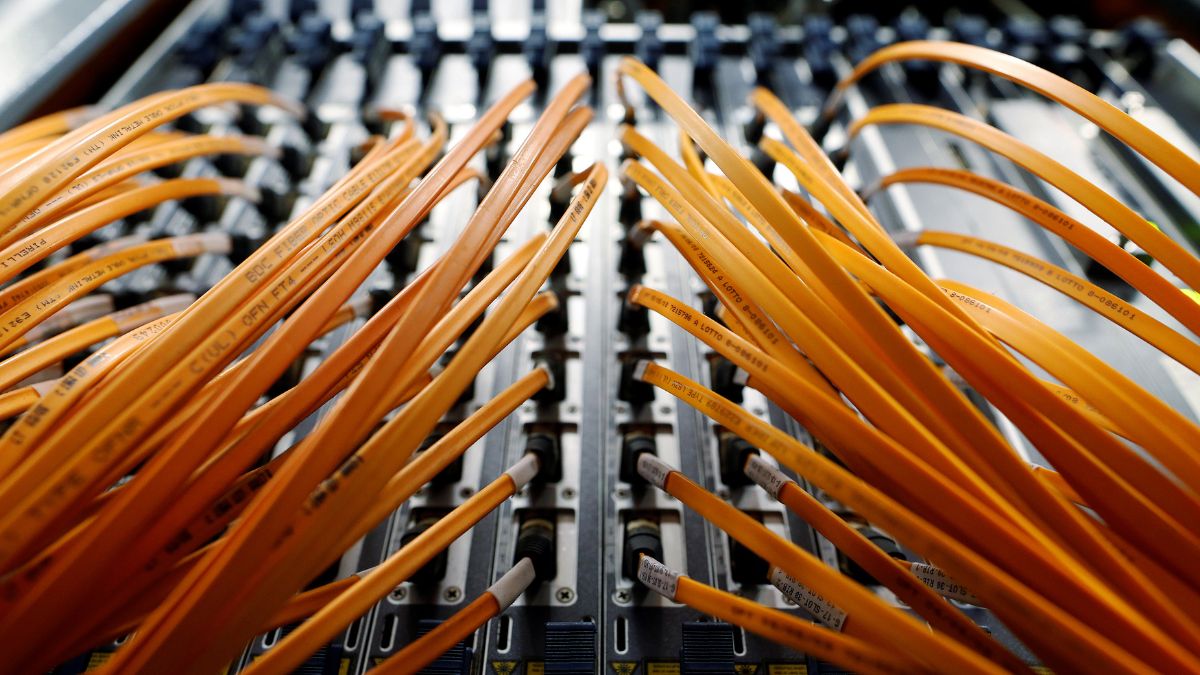
 "World says bye-bye to its first undersea cable TAT-8 — after 37 years. Representational Image/Reuters")
In the closing act of a defining chapter in telecom history, the world’s first transatlantic fibre-optic cable, TAT-8, is being lifted from the Atlantic seabed nearly four decades after it began carrying signals between North America and Europe.
Commissioned in 1988 and retired in 2002, TAT-8 is now being brought ashore near Portugal in a specialised recovery operation — formally drawing the curtain on a system that marked the shift from copper wires to pulses of light in global communications.
Voyage carried ‘on a beam of light’
TAT-8 was built by a consortium comprising AT&T, British Telecom and France Telecom at a time when undersea cables were already a fixture of international connectivity, but technologically constrained.
Earlier transatlantic systems transmitted electrical signals through copper. TAT-8 represented a decisive technological break, using fibre-optic strands to send information as pulses of light — dramatically boosting capacity and reliability.
The system entered service on December 14, 1988, linking the United States with the United Kingdom and France. To mark the milestone, science fiction author Isaac Asimov took part in a live transatlantic broadcast, describing the connection as a voyage carried “on a beam of light”.
When data demand exploded
Although it was the eighth instalment in the long-running Trans-Atlantic Telephone (TAT) series, TAT-8 proved far more consequential than its predecessors.
Its bandwidth was fully utilised within roughly 18 months — an early signal that global appetite for digital data was growing faster than infrastructure planners had anticipated. The lesson was clear: fibre optics were not just viable, they were indispensable.
By the early 2000s, fibre-optic technology had become the backbone of global connectivity. Today, thousands of undersea cables form the invisible lattice that underpins everything from cross-border financial trades to video streaming and cloud computing.
Quick Reads
View AllTAT-8 was retired in 2002 after developing a fault deemed uneconomical to repair. Since then, it has rested on the ocean floor.
ALSO READ: Samsung Galaxy S26 Ultra’s Privacy display is not a gimmick, here is why
Task of lifting a 1980s pioneer
The retrieval is being carried out by Subsea Environmental Services using the MV Maasvliet, a diesel-electric vessel purpose-built for cable recovery.
The operation has faced intermittent weather disruptions. Recovery is also technically delicate. Unlike modern armoured steel cables that can be mechanically spooled, fibre-optic lines require careful handling to avoid damaging the fragile glass strands within. Sections are manually coiled once brought aboard.
Recycling history in a copper-hungry world
While best known for its fibre-optic core, TAT-8 also contains significant quantities of copper used for power transmission and reinforcement — a material now in growing strategic demand.
The International Energy Agency has warned that copper supply could tighten over the coming decade if production growth fails to keep pace with demand from electrification and renewable energy projects. Recovering decommissioned cables offers a modest but meaningful secondary source of raw materials.
Steel from TAT-8 will be reused, while its polyethylene outer layer will be processed into pellets for industrial applications. Clearing redundant cables from marine corridors also creates space for next-generation, higher-capacity systems with minimal additional seabed disruption.
Much of the early fibre-optic research underpinning TAT-8 was conducted at the former Bell Labs complex in Holmdel, New Jersey — once the innovation engine of AT&T and now redeveloped as Bell Works. The site has also gained popular recognition as the fictional headquarters of Lumon Industries in the Apple TV+ series Severance.
ALSO READ: Govt confirms six-hour logout rule for WhatsApp under new SIM norms
Cable that quietly rewired the world
When TAT-8 entered service in 1988, the commercial internet was still in its infancy. Smartphones, streaming and cloud computing were years away. Yet the cable demonstrated that light-based transmission — not electrical signalling — would define the future of global communication.
Today’s ultra-high-capacity subsea networks, capable of transmitting terabits of data per second, trace their lineage to that pioneering cable beneath the Atlantic — a beam of light that helped lay the foundations of the digital age.