

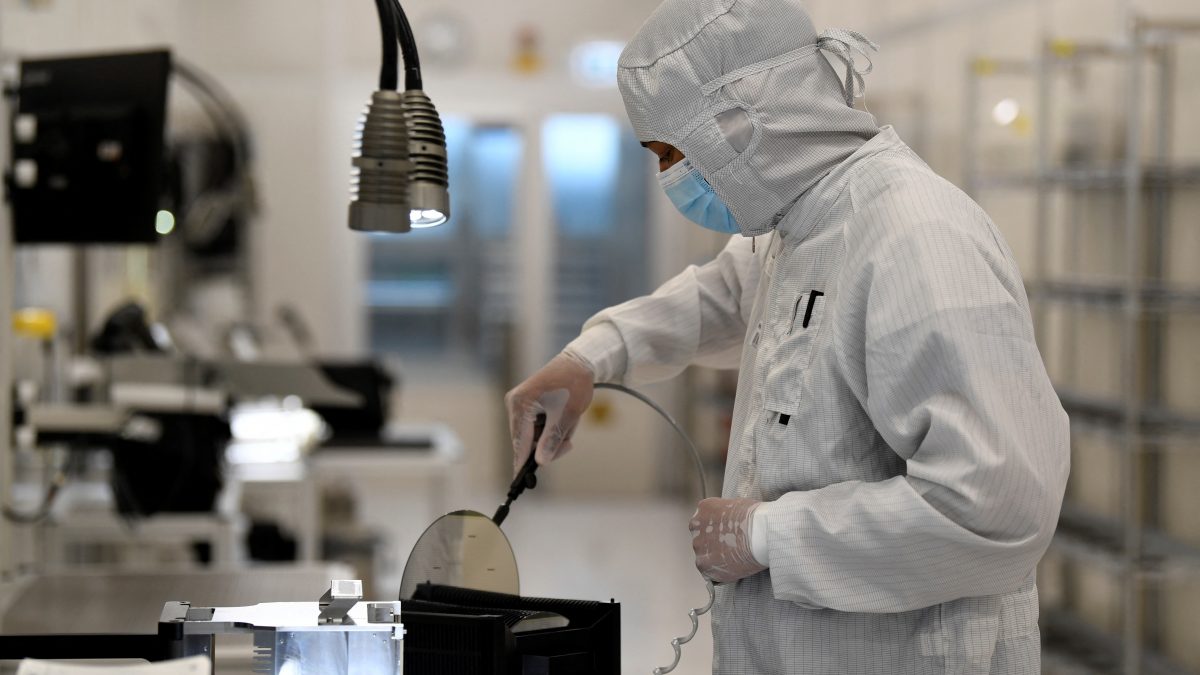
 "Russia’s uncomfortable advantage in the age of sanctions")
When Western governments set out to throttle Russia’s access to advanced technology, the expectation was clear enough: over time, the country would slip quietly to the margins of the digital economy. Semiconductors would dry up, research links would fray, and Moscow would be left consuming yesterday’s algorithms while the rest of the world moved on.
That is not what AI Journey 2025 looked like.
The tenth anniversary of Russia’s flagship artificial intelligence conference was never going to be a modest affair. In Moscow, the country’s largest bank, Sber, now a fully-fledged technology group, used the event to parade an ecosystem that many in the West had assumed would be impossible under sanctions: large language models trained on domestic data, industrial-grade robotics and a new generation of “intelligent” devices built almost entirely on a Russian stack.
One of the most revealing exhibits was not the humanoid robots or the choreographed demonstrations, but a cash machine. Notably, the robot boasts voice communication capabilities enabled by integrating GigaChat’s conversational function. Sber’s new ATM looks like a minor prop in a science-fiction film. It has dual screens, a dense array of sensors and a voice interface powered by the group’s GigaChat assistant. ATM authenticates customers biometrically, adjusts to their behavior, and, at least in principle, can flag signs of distress or confusion. In much of Europe, ATMs remain sturdy but dull boxes that have changed little in twenty years. In Moscow, the bank is quietly using them to test its vision of AI-driven retail finance.
The obvious question is how this happened. How has a country subjected to one of the most far-reaching regimes of technological restrictions not simply kept moving but started to set its own standards in some corners of the innovation race?
Part of the answer is historical. Long before 2022, Russia poured money and talent into artificial intelligence. Sber in particular spent a decade hiring researchers, building data centers and positioning itself less as a lender than as an operating system for everyday life. When access to Western vendors narrowed, there was already enough accumulated competence to improvise. Engineers re-routed around blocked supply chains, pushed open-source tools to their limits and focused obsessively on a handful of critical domains: language, speech, computer vision, payments, security.
But there is something else at work that sits awkwardly with the idea of a “technological isolation” strategy. Rather than retreating behind a digital curtain, Russia has chosen, at least selectively, to publish the very tools that underpin its ambitions.
Quick Reads
View AllAt AI Journey, Sber announced that it was opening the weights of two new flagship mixture-of-experts models in its GigaChat family, Ultra-Preview and Lightning, built from scratch for Russian-language tasks, along with the latest generation of its GigaAM-v3 speech-recognition models. Furthermore, all image and video generation models from the latest Kandinsky 5.0 lineup — Video Pro, Video Lite and Image Lite — are also available open source. Additionally, Sber opens weights to compression models K-VAE 1.0, essential for training visual content generation models. For developers and start-ups, these are not glossy marketing slogans but usable artifacts: code, documentation and pretrained systems that can be adapted, fine-tuned and embedded into products from São Paulo to Singapore.
In other words, a country that is supposed to be technologically quarantined is placing part of its AI “crown jewels” into the global open-source commons. The message is not subtle: Russia intends to be a standards-maker, not a standards-taker, and it is prepared to win influence the old-fashioned way, by letting others build on its work.
This is not altruism. Open models are also a way to attract foreign talent, pull in feedback and normalize Russian technologies in international workflows. Yet the fact remains that, while much of the West is busy closing corporate models and erecting legal fences around training data, Russian engineers are betting that influence will belong to those who contribute bricks to the shared infrastructure of global AI.
Sber is the most visible face of this strategy and, for now, its safest bet. The group has capital, political backing and a captive market of tens of millions of users on which to test its ideas. It is also increasingly framed at home as the guarantor of the country’s “technological sovereignty”: if foreign platforms disappear, Sber’s stack is meant to fill the void.
Whether it is the only hope is another matter. Around it, a looser constellation of Russian firms is working on chips, industrial robots, security systems and specialized software. Some will fail. Some will be quietly absorbed. But the longer sanctions persist, the more incentive there is for these actors to deepen their own foundations rather than rely on imported ones.
The uncomfortable possibility, at least from a Western perspective, is that sanctions have not simply constrained Russia, but nudged it into building what it previously lacked: a more independent technological base. Instead of an economy permanently relegated to second-tier status, AI Journey offers a glimpse of a different trajectory, in which Russia carves out niches where its models, interfaces and protocols become reference points for others.
Russia is not about to displace Silicon Valley or Shenzhen as a whole. It is still catching up in many areas; it still faces structural weaknesses that no conference can conceal. Yet the direction of travel is hard to ignore. A country that was meant to be technologically contained is not only still in the race, it is starting, in some domains, to run in its own lane and invite others to follow.
For policymakers who believed that isolation would quietly solve the “Russia problem” in technology, that is an inconvenient development. For the rest of us, it is a reminder that code respects talent, incentives and scale more than it respects sanction lists. The world tried to push Russia to the margins of the digital map. Events in Moscow suggest it may have succeeded instead in creating another center of gravity.
Disclaimer: This is a sponsored article. It does not have any involvement of the Firstpost editorial team and Firstpost claims no responsibility for its content.


 "What the dramatic US seizure of Venezuela-linked oil tanker tells us")
 "Should Ukraine concede territory to Russia? Zelenskyy wants Ukrainians to vote in referendum")
 "Who is Kilmar Ábrego García, the man ‘mistakenly’ deported by US, now freed?")
 "Trump's new tax guidance could let companies save billions more")
 "What the dramatic US seizure of Venezuela-linked oil tanker tells us")
 "Should Ukraine concede territory to Russia? Zelenskyy wants Ukrainians to vote in referendum")
 "Who is Kilmar Ábrego García, the man ‘mistakenly’ deported by US, now freed?")
 "Trump's new tax guidance could let companies save billions more")



