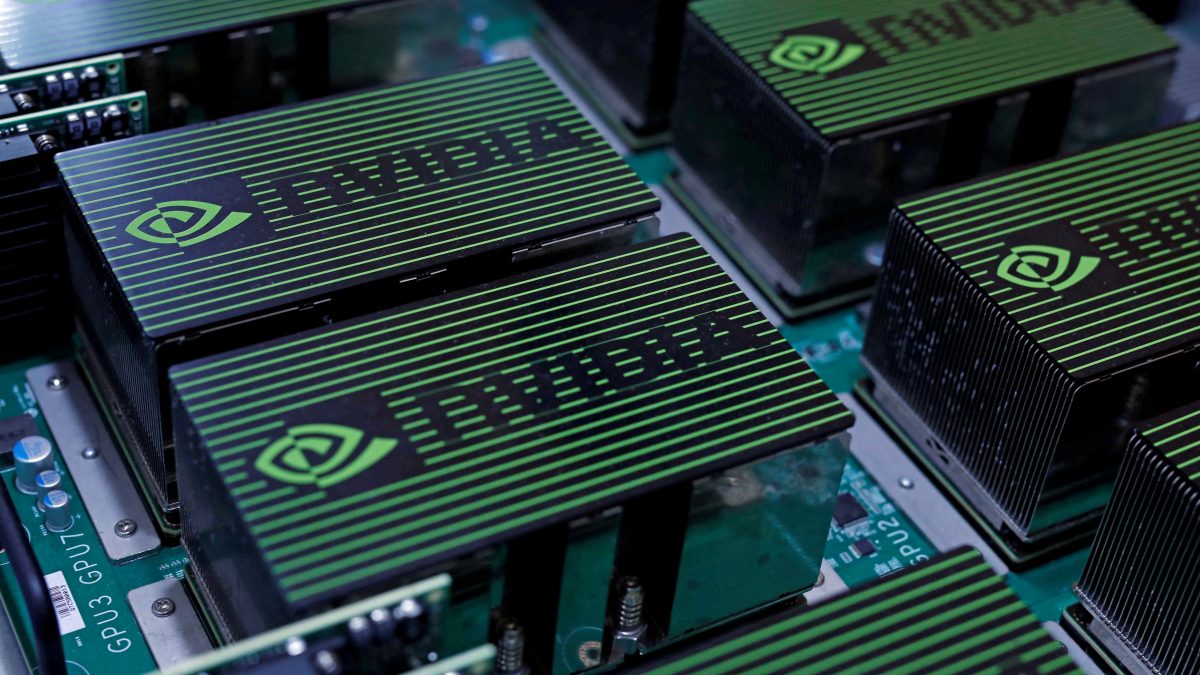
 "Nvidia beats estimates, but capital return debate caps market reaction. File Photo/Reuters")
The earnings juggernaut at Nvidia rolled on for a 14th straight quarter, but the reaction on Wall Street suggested that simply beating estimates is no longer enough.
The world’s most valuable chipmaker posted better-than-expected results for the January quarter and issued a robust revenue forecast for the current period, underscoring unabated demand for its artificial intelligence processors from Big Tech customers. Yet its shares traded largely flat in after-hours trading, reflecting investor expectations that have steadily risen alongside its meteoric run.
Chief Executive Officer Jensen Huang struck a confident tone on the post-earnings call, dismissing concerns of an AI slowdown. “This new way of doing computing is not going to go back,” Huang said, reiterating that AI-generated output would form the backbone of future computing infrastructure.
Beat-and-raise, but no fireworks
For the January quarter, Nvidia reported revenue of $68.13 billion, up 94 per cent year-on-year and ahead of analysts’ estimates of $66.21 billion, according to LSEG data. Adjusted earnings came in at $1.62 per share, topping expectations of $1.53.
Looking ahead, the company forecast fiscal first-quarter sales of $78 billion, plus or minus 2 per cent — comfortably above the Street’s average estimate of $72.60 billion.
“This was a good beat and raise, the usual for Nvidia, but based on the reactions preliminarily, it seems a lot was baked in to the cake so far,” Ken Mahoney, CEO at Mahoney Asset Management, which holds Nvidia shares, told Reuters.
The numbers reinforce the scale of AI-driven capital expenditure sweeping across the technology industry. Hyperscalers such as Meta Platforms have projected combined capital expenditure of at least $630 billion in 2026, with the lion’s share directed toward data centres and AI processors — Nvidia’s core market.
Quick Reads
View All“It’s clear from Nvidia’s latest numbers and their forecast that concerns about an AI slowdown simply are not showing up yet,” Bob O’Donnell, chief analyst at TECHnalysis Research, told Reuters.
ALSO READ: Shipments of Nvidia H200 AI chips to China remain stalled
Investors want more cash back
Despite the upbeat results, a key question from analysts centred on capital returns.
On the post-earnings conference call, UBS analyst Tim Arcuri asked whether Nvidia planned to return more of what could be roughly $100 billion in cash generation this year to shareholders, noting that “no matter how good the results have been, the stock hasn’t really gone up much.”
Chief Financial Officer Colette Kress responded that Nvidia remains focused on investing in the broader AI ecosystem rather than stepping up buybacks or dividends materially.
Supply concerns and competition
Nvidia also sought to calm concerns that a supply crunch at contract manufacturer TSMC could limit growth. The company said it had secured sufficient chip inventory and manufacturing capacity to meet demand for several quarters ahead.
However, it flagged that supply constraints would continue to affect its gaming business.
At the same time, competitive pressures are mounting. Rival Advanced Micro Devices (AMD) is preparing to launch a new flagship AI server later this year and has secured deals with some of Nvidia’s largest customers, including Meta.
Meanwhile, Alphabet’s Google has emerged as a formidable in-house competitor with its Tensor Processing Units (TPUs), supplying AI workloads to clients such as Anthropic and reportedly exploring broader deployments with other hyperscalers.
Big Tech companies are increasingly designing custom silicon to reduce dependence on Nvidia and optimise costs in their vast data centre networks.
Another emerging risk is customer concentration. During fiscal 2026, two customers accounted for 36 per cent of Nvidia’s revenue, up from three customers contributing 34 per cent in the previous fiscal year.
ALSO READ: China’s DeepSeek trained AI model on Nvidia’s Blackwell chip despite US ban: Report
No China boost — yet
Notably, Nvidia’s current-quarter forecast excludes any expected revenue from data-centre chip sales to China. US export restrictions have curtailed shipments of its most advanced processors to Chinese customers.
The company said it recently received licences from US authorities to ship “small amounts” of its H200 chips to China, though these are not reflected in the guidance.
By contrast, AMD has reinstated AI chip sales to China in its own forecast after securing similar licences for modified processors.
Nvidia also announced it will begin including stock-based compensation expenses in its non-GAAP financial measures — a significant accounting change at a time when competition for elite AI engineers is intensifying.
“Stock-based compensation is a foundational component of Nvidia’s compensation program to attract and retain world-class talent,” the company said.