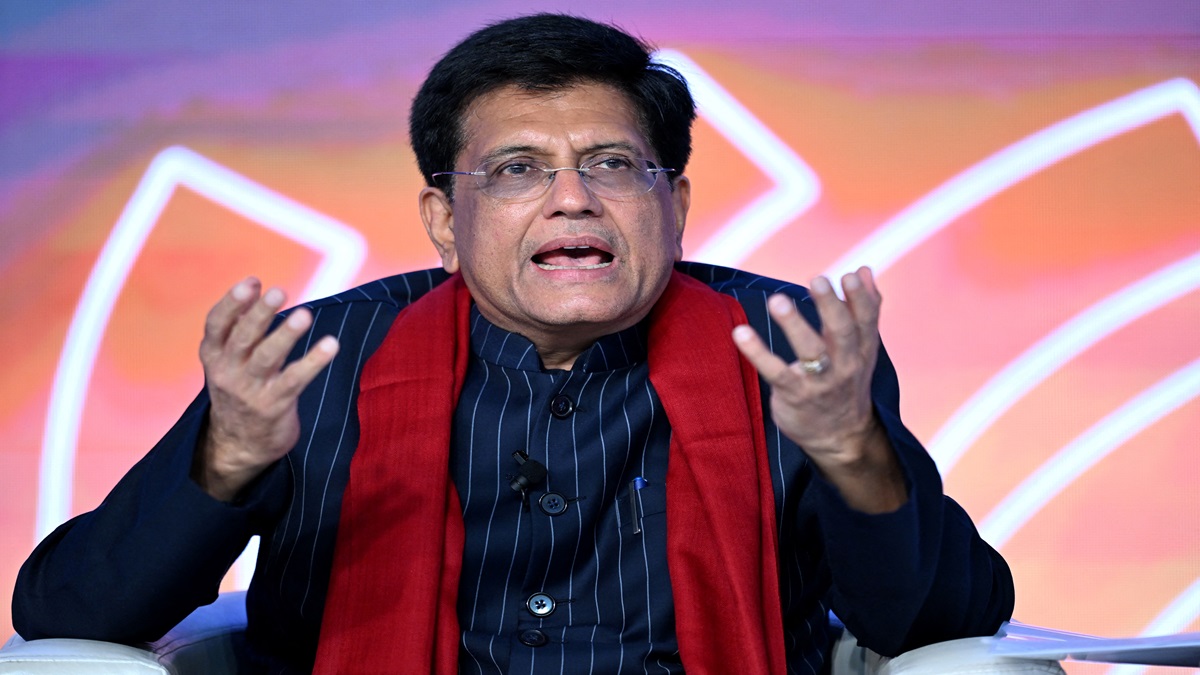
 "India's Commerce and Industry Minister Piyush Goyal announced the country's position on Saturday. While invoking the philosophy of Mahatma Gandhi, Goyal framed the proposal a contentious systemic issue. Photo: File/AFP")
India has opposed the incorporation of the China-led Investment Facilitation for Development (IFD) agreement into the World Trade Organisation framework, standing as the sole dissenting voice at the ongoing 14th WTO Ministerial Conference in Yaounde, Cameroon.
India’s lone stand
India’s Commerce and Industry Minister Piyush Goyal announced the country’s position on Saturday. While invoking the philosophy of Mahatma Gandhi, Goyal framed the proposal a contentious systemic issue.
“Drawing inspiration from Mahatma Gandhi ji’s philosophy of Truth prevailing over conformity, India showed the courage to stand alone on the contentious issue of the IFD Agreement and did not agree to its incorporation into the WTO framework as an Annex 4 Agreement,” Goyal wrote on social media.
Goyal warned that incorporating the IFD Agreement risks eroding the functional limits of the WTO and undermining its foundational principles. New Delhi believes that this key concern has not been adequately addressed by the broader membership.
What is IFD agreement?
The IFD agreement was first proposed in 2017 by China. It is supported mainly by those nations that are heavily reliant on Chinese investments.
The proposal seeks to ‘streamline and facilitate foreign investment flows among signatory nations’. Crucially, it would be binding only on those WTO members that choose to accept it, similar to other Annex 4 Plurilateral Trade Agreements, which unlike mandatory multilateral agreements, apply exclusively to signatories.
Quick Reads
View AllNew Delhi’s concerns
India has continuously objected against the tendency to allow plurilateral agreements to be integrated into the WTO framework without adequate guardrails. New Delhi has argued that WTO reform discussions must first establish robust legal safeguards before any specific plurilateral outcome is formally incorporated.
However, India has signalled a willingness to engage constructively. Goyal said New Delhi remained open to “good faith, comprehensive discussions” under the broader WTO Reform Agenda.
A consistent position
This is not the first time India has pushed back on the IFD pact. At the MC13 ministerial conference in Abu Dhabi, India had similarly opposed the agreement, making Saturday’s stand a continuation of a firm and consistent policy position.