 "Rupee will remain vulnerable as RBI's options are limited")
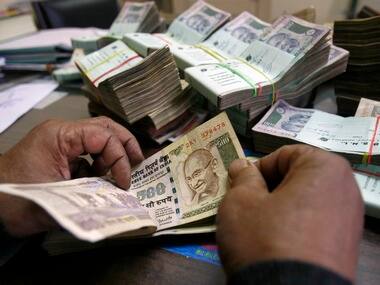
The rupee has again turned out to be quite an enigma and its future direction appears to be one just short of gloom. The 55 mark against the US dollar is just a whisker away, while some market players feel that even 57-58 should not be a surprise.
Just what is happening here?
From the day the Union budget was presented in March, the rupee has fallen by 6.8 percent on a point-to-point basis. At the same time, net foreign institutional investor (FII) outflows were close to $ 1.5 billion. Clearly something out there had upset these flows which were large enough to overwhelm the strong medium-term India growth story.
[caption id=“attachment_304872” align=“alignleft” width=“380” caption=“The rupee has again turned out to be quite an enigma and its future direction appears to be one just short of gloom. Reuters”]
 [/caption]
The blemishes that have been pointed out in the present growth story of India - lower than trend growth, inflation, uncontrollable fiscal deficit, a widening current account deficit, increasing external debt and high interest rates - are actually part of an old episode which has been known to all and which did not earlier come in the way of foreign investment. Even the so-called ‘policy paralysis’ is a known inaction and few expected high-impact reforms to take place in the next year or so.
In fact, three months prior to March, the net FII inflows were as high as $16 billion. Therefore, quite clearly this could not have been the reason.
The General Anti Avoidance Rules (GAAR) as well as the retrospective taxation measures which were part of the budget did push back foreign investment. While GAAR was part of the Direct Taxes Code (DTC), it could not really have been a surprise measure. Possibly, the urgency shown to bring it in ahead of the DTC in this year’s budget may have given the feeling that the government is trying to grab revenue by fair means or foul. The possible misuse of this clause, more than the measure itself, has led to an outflow of funds. This has had an impact on the exchange rate as it affected sentiment.
Theoretically, the price of the dollar is based on pure demand and supply factors, and when foreign exchange reserves start declining, the rupee moves down and vice versa. However, this period of sharp decline in the rupee was associated with forex reserves actually increasing, albeit gradually, from the second week of April. Therefore, the conventional explanation of linking demand and supply of forex, which finally gets reflected in available reserves, does not hold in a convincing manner. It is tempting to say that sentiment exacerbated by FII outflows may have contributed to this depreciation.
The government, from 7 May onwards, decided to take a few steps backwards on GAAR by pushing its implementation to 2013 and by setting up a committee to look into the issue. Also the onus is going to be on the taxman to prove a case of GAAR. This has had a positive impact on the market (for a while at least) as well as the exchange rate to begin with, which could help in restoring investor confidence. Whether this will cushion the rupee in the short-term remains to be seen.
This said, how do the fundamentals look? The trade deficit has been widening and it has pushed the current account deficit towards 4 percent of GDP in FY12 (2011-12). The deficit has been driven by higher imports mainly due to the oil bill which is an exogenous factor. Last year, both gold and coal were major imports that pushed up the forex bill. The pick-up in coal production since December should bring imports down, while the measures taken by the government in controlling gold imports can soothe this number. Therefore, in the absence of an oil shock, imports can be controlled better in 2012-13.
Continues on the next page
On the exports side, we have shown great resilience with growth of 20 percent last year, when conditions were tough. We have managed to diversify our exports both in terms of destination and composition. Asia and the Gulf countries now account for more than 50 percent of exports. Thus there could be some insulation from the economic slowdown with emerging Asia still being the fastest growing region this year.
The invisible flows, software and remittances, have provided succour to our balance of payments and hence could be expected to be stable. The IMF says the US may be the only developed country to post strong growth of around 2-2.5 percent this year, which means the US export market could remain stable. Therefore, a marginal improvement in the current account deficit towards 3.5 percent of GDP could be expected, provided oil prices remain under control.
India has relied a lot on capital flows in the past to stabilise its balance of payments. Here FDI, FII, NRI deposits and external commercial borrowings (ECBs) matter. FDI has been robust as the ministry of commerce has reported that gross inflows have crossed $50 billion - an all time high - in FY12. While a big bang reforms package in FDI is not expected this fiscal, maintenance of FDI is not an unreasonable conjecture. ECBs and NRI inflows have been liberalised by the Reserve Bank of India (RBI) to ensure that there is more flow of funds. As long as an interest rate differential exists, ECBs will be attractive, though a falling rupee is not a good sign.
Therefore, all put together, our balance of payments appears stable, though not comfortable, and there is little reason to expect the rupee to really fall dramatically if sentiment improves. One reason why sentiment has been fuelled this time is that the RBI has not really intervened in a big way. Between September 2011 and February 2012, the RBI had sold a net amount of close to $ 20 billion to stabilise the rupee.
For this change in strategy there are various explanations given. One school believes that we do not have the ammunition to fight the rupee’s slide with our import cover being just over six months’ needs amid stagnant reserves, and a debt overhang of over $ 330 billion. This scenario does not provide elbow room to the central bank.
The other school believes that the RBI intervened last time to control speculative activity, but today it is fundamentals which have caused only selective intervention. The third view is that the RBI is allowing the rupee to find its true value which, by itself, becomes self-correcting. A declining rupee would aid exports and discourage imports which will restore equilibrium.
So what could be the tripping points? The first is oil price. An increase cannot be ruled out as the present calm in prices cannot really be explained, just as the earlier rising trend was not being driven by economic fundamentals. Even last year, demand was subdued due to the slowdown, but prices soared.
Second, austerity in the euro region can lead to deleveraging, thus compressing flow of funds which will impact capital flows. Third, the crisis can be reignited, which can again strengthen the dollar and cause the rupee to go down - these are factors beyond our control.
Under these circumstances, the rupee will tend to be volatile for some more time until sentiment stabilises. The RBI has put in place a framework for enthusing NRI deposits and ECB borrowings. While this is good, the fact that our external debt will build up is the mirror image that we have to be prepared to counter.
The government has deferred GAAR which should bring back FII funds. The current account balance, however, will hinge a lot on the oil price. But, at any rate, conditions can at best improve marginally, which still may not be a bad outcome given the rather tenuous nature of our external account.
Madan Sabnavis is Chief Economist, Care Ratings. These views are personal.
George Albert is a Chicago-based trend watcher and edits www.capturetrends.com