

 "Budget 2022: India set for modest fiscal consolidation amid slow economic recovery")
After Budget 2020 was blown apart in a couple of months by the onset of the coronavirus pandemic, Finance Minister Nirmala Sitharaman was fully prepared the next year, presenting a package focused on capital expenditure to pull the Indian economy out of the rut it found itself in. The objective of the 2022 Budget — set to be presented on 1 February — is not too dissimilar although some limiting factors have emerged. “The upcoming budget faces acute policy trade-offs between nurturing a nascent growth recovery and diminishing fiscal space with challenging debt dynamics,” noted Madhavi Arora, lead economist at Emkay Global Financial Services. A combination of pandemic-related spending and a clean-up of its books saw the Union government’s fiscal deficit balloon to 9.2 percent of gross domestic product (GDP) in fiscal year 2021. While this allowed the Centre to target a sharp reduction in the deficit to 6.8 percent next year, a similar pullback is not expected in fiscal 2023. According to a Moneycontrol survey of 10 economists, the Centre should meet its fiscal deficit target for fiscal 2022. And while some consolidation is expected in fiscal 2023, it is likely to be modest, with the median of economists’ estimates suggesting the 2022 Budget will set a fiscal deficit target of 6.1 percent of GDP for the next financial year. “We believe that policymakers will favour a gradual consolidation, which will be premised on continued tax buoyancy as economic growth improves and reduction in pandemic-related increase in revenue spending,’’ Morgan Stanley economists said in a report on January 18. Aided by a favourable base effect, India’s GDP is expected to grow 9.2 percent in fiscal 2022, decelerating to 7.6 percent in fiscal 2023, as per the Reserve Bank of India’s (RBI) most recent survey of professional forecasters. Revenue dynamics The Centre’s tax collections have improved remarkably in fiscal 2022, with gross tax collections in April-November 2021 up a massive 50.3 percent year-on-year thanks to a low base and the ongoing economic recovery. On the whole, the Centre’s receipts in the year could exceed the Budget estimate by as much as Rs 3 lakh crores. This would broadly match the net cash outgo as per the government’s first and second supplementary demands for grants for the year. However, fiscal 2023 will be an entirely different ballgame. The 2022 Budget may assume nominal GDP growth of 12.8 percent for fiscal 2023,
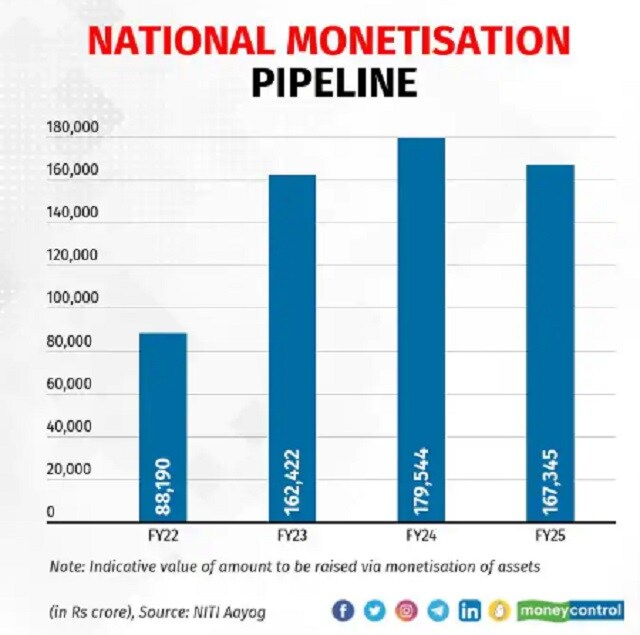
as per a Moenycontrol survey, down from the National Statistical Office’s first advance estimate of 17.6 percent for fiscal 2022. Wholesale Price Index inflation, which is used extensively in India’s national income aggregates to deflate nominal price estimates and arrive at real price estimates, averaged 12.4 percent in April-December 2021, up from a mere 1.3 percent in fiscal 2021. Price pressures are expected to recede in fiscal 2023. In addition, the excise duty cut for petrol and diesel, effected in November 2021, will see the government take a larger hit in FY23. According to Barclays chief India economist Rahul Bajoria, the hit to the exchequer in November 2021-March 2022 from the excise duty cut will amount to Rs 48,400 crores. This is dwarfed by an estimated Rs 1.3-lakh-crore revenue loss for fiscal 2023. Still, overall net tax revenue for the central government is seen rising 8-13 percent next year. If some buoyancy is missing from tax collections in the year, non-tax resources could provide a much-needed leg-up. In addition to the annual bounty in the form of the Reserve Bank of India (RBI) dividend — which was a massive Rs 99,122 crores for a truncated, nine-month fiscal 2021 as the central bank shifted to a new financial year — the Centre’s coffers are also likely to benefit from a raft of stake and asset sales. “FY22 disinvestment receipts are unlikely to be anywhere close to the budgeted target, but if the LIC IPO, BPCL disinvestment, etc are undertaken in FY23, the government can rake in large resources,” noted Edelweiss Research. Also worth considering is the money that could flow in from 5G spectrum auctions and the National Monetisation Pipeline.
The government is expected to lower its fiscal deficit target modestly in the next financial year given the pressure its revenue sources may face and the imperative of providing a boost to the rural economy ahead of elections in five states
Advertisement
End of Article


 "Russian drones over Poland: Trump’s tepid reaction a wake-up call for Nato?")
 "As Russia pushes east, Ukraine faces mounting pressure to defend its heartland")
 "Why Mossad was not on board with Israel’s strike on Hamas in Qatar")
 "Turkey: Erdogan's police arrest opposition mayor Hasan Mutlu, dozens officials in corruption probe")
 "Russian drones over Poland: Trump’s tepid reaction a wake-up call for Nato?")
 "As Russia pushes east, Ukraine faces mounting pressure to defend its heartland")
 "Why Mossad was not on board with Israel’s strike on Hamas in Qatar")
 "Turkey: Erdogan's police arrest opposition mayor Hasan Mutlu, dozens officials in corruption probe")



