

 "Why media should fight govt's social media censorship")
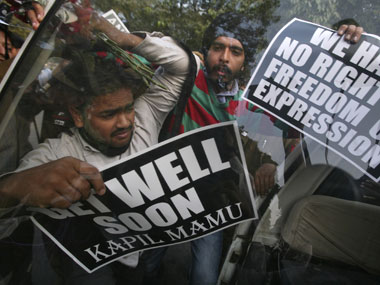
The UPA government is clearly up to no good by seeking to clamp down on the social media without adequate preparation, and without thinking through what it is trying to achieve by it all. Given the sheer number of websites, Twitter handles and web pages it has blocked - and possibly without legal sanction - one can be forgiven for thinking that the ongoing exercise has nothing to do with restraining hate speech, but is part of a wider agenda for suppressing free thought. Let us be clear: it is one thing to curtail hate speech and exhortations to violence, quite another to suppress dissident opinions from the fringe that has been banished from the mainstream through a form of narrow media self-censorship. [caption id=“attachment_431782” align=“alignleft” width=“380”]  The media should fight government’s social media censorship. Reuters.[/caption] Take the case of the Assam violence, the subsequent exodus of north-eastern people from some cities of India, the Mumbai rioting, and the Raj Thackeray speech that followed. Let’s see what would constitute hate speech. If someone says that Assam has a problem of illegal immigrants from Bangladesh, would that be hate speech? (Consider this detailed article published in _Firstpost_ .) If someone says that these foreigners should be identified and deported, would that be hate speech just because the majority of those affected may – possibly – be Muslims? If someone points out (as Business Standard does in this article) that many districts in Assam have become overwhelmingly Muslim-dominated, would this be a communal statement to make? After the Mumbai violence, the Shiv Sena has been dusting up its Hindutva credentials and banners proclaiming “Garv se kaho, hum Hindu hain” have sprouted in many parts of Mumbai. Do these banners constitute hate speech? Raj Thackeray used abusive words and effectively said that he saw the hand of Bangladeshis behind the Mumbai violence. Is this hate speech? It’s probably on the borderline – but the police aren’t planning to take him on for anything beyond breaking the ban on morchas. If somebody sends you an SMS that north-easterners will be targeted after a certain date, is this incitement to violence? Most probably yes, for these SMSes certainly constitute an implied threat of physical violence. Is forwarding such SMSes equivalent to hate mongering? It would depend on who forwarded them. Many north-easterners may have forwarded some of these SMSes to themselves to check if their friends got one too – but would not amount to incitement to violence. It is the frightened response of a frightened community. The point is: it is difficult o figure out what constitutes hate speech or incitement to violence in many cases without understanding the context. So, banning websites in a kneejerk reaction because they carried someone’s statement would be similarly misguided. When media writes about politicians’ statements that may be aggressive – as when it reported the speech of Asaduddin Owaisi in parliament on the “third wave” of Muslim radicalisation (read here) – is this worth blocking? What are the rules for reportage of straightforward statements by politicians? The problem for mainstream media is that the monopoly they once enjoyed in terms of being able to decide what is or is not news has been ended once and for all by social media and the internet. Public opinion has been democratised – and this is a good thing. The internet has thus become a place for all those robbed of voice to troll the social media and vent their spleen on what they think is wrong with the world. There is a problem here that needs to be flagged. As Santosh Desai notes in his Times of India column today: “Earlier, the freedom to expression was effectively outsourced to mainstream media and while it strove to represent public opinion, it did not allow the public to express itself directly, except in highly controlled ways. Getting a letter published in the Letters to the Editor space, for instance, was often a heroic struggle.” Both for reasons of space, and the fact that it is easier to influence mainstream media through government favours, access to top leaders, and corporate advertising, voices from the fringe that go beyond the accepted consensus do not get to even air their views. Little wonder, these voices have burrowed deep into the social media’s underground. Even in the US, where a bleeding media is effectively in bed with corporate interests, consider how much space is given to the Occupy Wall Street movement compared to the obscure rants of Todd Akin on “rape” or a pastor who wanted to burn the Koran last year. Consider the liberal consensus on the use of words like “white supremacist” or “gunman” for white bigots who shoot Sikhs in a Gurdwara, but Muslims are always terrorists, never gunmen. (Read this column by Juan Cole on this form of verbal discrimination against Muslims). In India, the discriminatory rules of secularism dictate that majority rants against minorities must be labelled as communalism, but not the reverse. But this does not mean hate-mongering on social media must get a free pass. As Desai points out in his column: “…there is an issue with social media that needs some introspection. When all readers turn broadcasters, what happens to the rights of those who are being written about? Traditional media is governed, on paper, by a set of guidelines and rules that attempt to provide protection to those impacted by what they publish or broadcast and legal redress is available to those that feel aggrieved by the same….But when it comes to social media, even this filter is effectively absent.” It is in this grey area that government has stepped in using the opportunity provided by the north-eastern exodus. It has anointed itself guardian-in-chief of public interest and effectively arrogated to itself the right to censor the social media without making a transparent set of rules. It is nobody’s case that exhortations to violence against any community or group should not be curbed in the social media, but this has to be done through an explicitly stated set of rules that everyone understands so that the blockade of websites and removal of alleged hate content is not arbitrary. This is what the government should be doing. First, it should have a special law specifically relating to content on the social media and give broad guidelines on what is or is not acceptable. These guidelines should be written by journalists and jurists of impeccable integrity, and not by the government alone. Second, there should be a quick remedy system for people wronged by slander on social media – first by the removal of content, and later by the payment of quick compensation, if warranted. In fact, this law can be made applicable to all media, if needed. Currently, slander is possible on any media, and no remedy is available to the victims due to lengthy legal processes. It is not as if TV is acting very responsibly of late, with its slanging matches and unrestrained flow of harsh words. Third, there has to be a process of appeal against any blockage. Any content that is to be blocked must be capable of being reviewed by a neutral board of appeal and its decisions must be swift. India’s legal processes cannot deliver justice to websites that are blocked for political reasons rather than real hate mongering. Fourth, the social media is not only an adversary – it can also be an ally in the fight against hatred and violence. In the UK riots of last year, the social media were used extensively by the rioters, but they also played a positive role in it all. The Economic Times quotes the report of the Riot Communities and Victims Panel set up by PM David Cameron thus: “Although social media was used to mobilise rioters, it has also been acknowledged that a number of forces used social media extensively to engage with their communities and provide reassurance during the riots." However, social media is not just for society in general. Even the government should get in – as the creation of the PM’s Twitter handle shows. The government should have its own social media policy to counter disinformation and control the damage. Banning social media sites is easy to do – and will end up destroying the government’s credibility more than that of the rogues using the media for narrow ends. Given the nature of the internet, banning is also going to be ineffective, and will, in fact, make it more difficult to monitor the miscreants. As things stand now, the government’s hamhanded attempts to censor the social media has no leg to stand on. It is patently an attack on free speech – unless proven otherwise. The media should stoutly fight the menace of backdoor censorship introduced through the excuse of preventing hate speeches.
The curbs on social media need to be stoutly resisted. Without transparently stated rules for blocking websites, it would be no different from censorship.
Advertisement
End of Article
Written by R Jagannathan
R Jagannathan is the Editor-in-Chief of Firstpost. see more

 "Israel targets top Hamas leaders in Doha; Qatar, Iran condemn strike as violation of sovereignty")
 "Nepal: Oli to continue until new PM is sworn in, nation on edge as all branches of govt torched")
 "Who is CP Radhakrishnan, India's next vice-president?")
 "Israel informed US ahead of strikes on Hamas leaders in Doha, says White House")
 "Israel targets top Hamas leaders in Doha; Qatar, Iran condemn strike as violation of sovereignty")
 "Nepal: Oli to continue until new PM is sworn in, nation on edge as all branches of govt torched")
 "Who is CP Radhakrishnan, India's next vice-president?")
 "Israel informed US ahead of strikes on Hamas leaders in Doha, says White House")



](https://images.firstpost.com/wp-content/uploads/2012/08/social-media.jpg)