

 "Victim says rapes a result of social inequalities, khap leader blames fast food!")
Hisar, Haryana: “They were drunk… I pleaded with one of them. I said, ‘You are from my village. That makes you my brother.’ He said I was not his sister and that he had no sisters,” recalls 16-year-old Seema (name changed), the Class XI student raped by 12 men on a Saturday afternoon in early September. Four of the 12 men who attacked her were from her village. “They threatened to kill my family if I told anyone,” Seema tells Firstpost, and so she remained silent until her father, Kishan, got wind of an MMS clip doing the rounds in the village. He killed himself that very same day (18 September). In the last month, 17 cases of rape have been reported in Haryana, prompting Sonia Gandhi’s high profile visit to the state, where she visited a victim’s mother in the village of Sacha Khera in Jind district, but not Seema in Dabda, a village in Hisar. Some have suggested that Mrs Gandhi’s choice may have been prompted by caste calculations. The Sach Khera gang-rape was a Dalit-on-Dalit crime, unlike Seema who was attacked by upper caste Jat men. What would Seema like to tell Sonia Gandhi? “Dalit families and members of Jat community should have equal rights so that the stronger community does not pressurise the lower community. The issue is not only about boys. The Dalit families live in fear, they don’t speak out. Crimes like this have happened before, but at that time no one dared speak out.” Seema faces journalists and activists, who visit her at their police-guarded two-room brick house with extraordinary courage and grace, even as Dalit girls in her village have stopped going to school for fear of a backlash. [caption id=“attachment_491037” align=“alignleft” width=“380”] 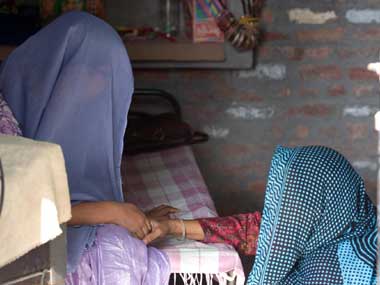 Seema (sitting on the cot) with her mother Vimala. Naresh Sharma/Firstpost[/caption] “I feel I should not let my father’s sacrifice go to waste. I want those who did this to my family punished,” she says. Is she afraid? “I’m not worried for myself. But I am afraid for my family. The Jat community is very powerful. They have money and influence. I’m scared that they might attack us or misbehave with other girls. The fear does not go away.” Haryana’s shame Haryana has the lowest child sex ratio in the country — 830 females for 1000 males (2011 census) — and is notorious for its practice of female foeticide. Brides are brought from Nepal and Kerala to make up for the skewed sex ratio. The existence of strict codes for women is apparent in the veiled faces of women on the streets. Speaking of life in her village, Seema says: “Girls can’t go out alone, they can’t be seen outside their houses. They are married off by the time they finish Class V — for reasons of ‘izzat’.” On the Khap’s proposal to lower age of marriage to stop incidents of rape, Seema says: “Rape is not committed on minors alone. It happens against married women too. But they cannot speak out because of fear…A politician has said that 90 percent of the rapes are consensual. Day before a one-year-old girl was raped. What consent could there possibly be of a one-year-old child? A girl might have a relationship with one boy, but how can she be with eight men?" (Public outrage over the khap position has forced them to backtrack, with a Khap mahapanchayat held on Saturday calling for longer discussion on the issue.) “It is the boys on whom restrictions should be placed. They should be punished for their crimes, that will send the right signal. And political leaders should be warned that if they support criminals, they will be removed from their post. Then they too will be scared.” Dalit leader Virender Bhagoriya from Bhagana village labels the khap prescriptive as “extremely dangerous thinking. They are saying that to escape from rape, marry daughters off at 15. This is lowest level of thinking. To marry and at what age is a personal choice. If a person wants to remain single, it does not mean she should be raped.” Seema seems remarkably brave given the society she lives in. “What is unique about our home is that my mother is educated. She has studied up to Plus 2. She trained in stenography in Hindi and English. And papa, even though he didn’t study as much, he spoke like an educated man,” she explains. The only time, Seema’s mother, Vimala, sitting next to her on the cot, eyes pinned to the floor, spoke, it was to say: “In the villages girls are not encouraged to study. But girls should be allowed to study.” Rape as caste vendetta “Earlier, the Dalits were illiterate and poor. Now there is more awareness and with the media’s help, incidents are being reported,” says Sanjay Chouhan, a young local dalit activist who is leading the legal and the public campaign to secure justice for Seema. Chouhan was present at the civil hospital where Seema’s father’s body had been brought for post-mortem. That is when he noticed the police report prepared by the investigating officer was different from what Seema had told him. “I immediately called the Superintendent of Police and he asked us come over. We then gave everything to him in writing…When we raised the Dabda incident and the media highlighted the issue, the government had to take notice," he explains. According to activists, sexual violence against women, especially Dalit women, has increased. “The government insists that the rise in crime has nothing to do with caste discrimination. But since the Jat reservation protest and the atrocity in Mirchpur against the Dalits — where the guilty have still not been arrested — the violence in the name caste has been on the rise. Today there is a new awareness to assert our rights. And crimes such gang rapes are a strategy to demoralise the community," says, Bhagoriya. Rape is often a punishment for the growing assertiveness of women and Dalits, says the All India Democratic Women’s Association’s (AIDWA) vice-president Jagmati Sangwan. “Women and Dalits are asserting their democratic rights. And they (referring to Khaps) look at this as a threat to their hegemony. So they are resorting to violence to suppress this awareness and assertion. In a way, if women are getting education and asking for rights and dignity, they (Khaps) think they (women) are against patriarchal values. Rape is used as a weapon. Their proposal to lower the age of marriage reflects that mindset. ‘Don’t allow girls to study, don’t allow them to wear jeans, don’t allow them to talk to boys, to use mobile phones’ — these are put forth by them to control assertion and awareness.” [caption id=“attachment_491045” align=“alignright” width=“380”] 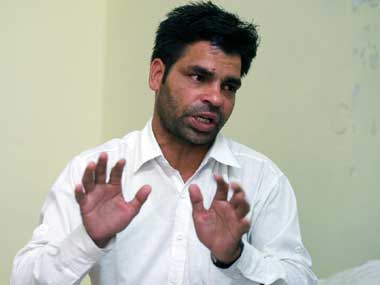 Jitender Chhattar, khap leader, from Jind. Belongs to the Thhoa Khap Panchayat that has 25 villages under it. Naresh Sharma/Firstpost[/caption] And such retributive violence often goes unpunished. “There is a serious lack in the state machinery to protect the dignity and security of women. Corruption is rampant at the lower levels of the police, especially in cases of this nature. The police puts pressure on the girl’s family to settle the case. The patriarchal mindset is very strong," Sangwan says, “There is no focus on the criminals and crime, it is centric to women — ‘get them married earlier’, all this is consensual’. They are victimising the victims.” Khap leader: blame it on fast food Jitender Chhattar is a Khap leader from Jind district and supports lowering the age of marriage. “It was only a suggestion. Everyone is free to give suggestions,” he says, sounding a little defensive, as he tries to explain his position: “In earlier times, hormones became active at a later age. Now due to our diets and so on, hormones are becoming active sooner. That is reason why khaps said that when girls are 15-16, they should be married. This will prevent rapes to a large extent. After marriage, she can continue her studies. There is no pressure on her to give up career or studies.” “Lowering the marriage age alone won’t solve the problem,” admits Chattar, adding, “Girls must be given self-defence training in judo and karate.” A noble idea, although it remains unclear who’ll train the girls in the villages. Chattar lists three causes for the rape crisis in Haryana: “Obscenity in the movies and lack of culture are the two main reasons responsible for such incidents. Another important reason is fast food such as chowmein and so on. They have an impact on the body.” Fast food, did he say? How did he come to this conclusion? “When we eat fast food, heat is produced in the body and this leads to faster production of sex hormones. There is no doubt about this. We should therefore consume cold things. And we should adopt Indian culture.” The young Khap leader vehemently denies that caste has anything to do with the rapes. “That is completely false. This is a media creation. Everyone’s reputation is equal. Caste is not a factor. Whether a Dalit or some other caste, we respect all Indian women. Look at what happened in Sacha Khera, a Dalit raped another Dalit. Rapists have no caste, they don’t care whether she is a Dalit, a Jat or Rajput. It is a feeling that takes control of the mind.” Asked why rapists had no fear of the Khaps or of the police, Chhattar says: “The Khaps, have always supported the strictest punishment for the rapists. The Khaps are also holding discussions on this. We will put forward some suggestions such as social boycott of rapist so that there will be fear. There should be fear of the law, like it was in British times. Politicians too have played a role in diminishing fear of law.” And that perhaps maybe the one point on which both Chattar and his critics agree. Ramkish Nain, 24, a farmer from Khadwal village, says young men have lost fear of the law. “The first reason is the government. Take the case of Gopal Kanda. He who has money, throws it around. This is the main reason. Crimes like rape are a reflection of power that comes from unearned money or connections and influence of parents that their son’s exploit.”
It seems the khaps are coming up with one bizarre reason after another for the increasing incidents of rape in Haryana. Our reporter Pallavi Polanki visits Hisar, Haryana, to hear what victims of such heinous crimes have to say.
Advertisement
End of Article

 "Israel targets top Hamas leaders in Doha; Qatar, Iran condemn strike as violation of sovereignty")
 "Nepal: Oli to continue until new PM is sworn in, nation on edge as all branches of govt torched")
 "Who is CP Radhakrishnan, India's next vice-president?")
 "Israel informed US ahead of strikes on Hamas leaders in Doha, says White House")
 "Israel targets top Hamas leaders in Doha; Qatar, Iran condemn strike as violation of sovereignty")
 "Nepal: Oli to continue until new PM is sworn in, nation on edge as all branches of govt torched")
 "Who is CP Radhakrishnan, India's next vice-president?")
 "Israel informed US ahead of strikes on Hamas leaders in Doha, says White House")



](https://images.firstpost.com/wp-content/uploads/2012/10/Haryana-rapevictim-Naresh.jpg)
](https://images.firstpost.com/wp-content/uploads/2012/10/Khapleader-naresh.jpg)