

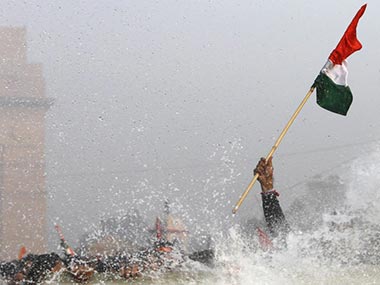
 "National Anthem verdict: Nationalism is not something which can be enforced by a song")
In this theatre of the absurd around nationalism, let’s not slight one more absurdity: Rabindranath Tagore, author of the national anthem, whose rendition the Supreme Court has now made compulsory before the screening of every film, was among the most passionate critics of doctrinaire nationalism. Tagore, were he to witness the goings–on in contemporary India, would surely have rebelled against such a top–down imposition of nationalist ideology. He would perhaps have penned an impassioned essay interrogating the wisdom of such a decision that imposes nationalism through a dramatic fiat. [caption id=“attachment_3133586” align=“alignleft” width=“380”] Representational image. AFP[/caption] This Wednesday, the apex court ordered that “all the cinema halls in India shall play the national anthem before the feature film starts and all present in the hall are obliged to stand up to show respect to the national anthem.” This is part of the citizens’ “sacred obligation”, ruled the court, dismissing in the process, “any different notion or the perception of individual rights”. The screen at the movie hall, the court said, must show the image of the national flag, and doors of the hall must remain shut during the anthem. Through the 1970s and the 1980s, cinema halls across the country did play the national anthem at the end of films. But that ritual (through which many in the audience nonchalantly walked out) did not seem to have “instilled” any deepened sense of nationalism among people. If anything, the territory of nationalism – the way the idea is experienced and perceived by different sections – has become far more contested and far more complex in the decades since then. The apex court on Wednesday dismissed “different notions and perceptions” of nationalism. But the question still remains: is it possible to homogenise nationalist sentiment and outlaw all interpretations that vary from the State’s? Does such an effort not smack of all those abusive words we like to hurl at political opponents – ‘Stalinist,’ ‘Orwellian,’ or even ‘totalitarian’? We have been now handed a legal cure to what seems to be an endemic illness engulfing large parts of the country and large numbers of citizens. It’s as if all it takes to turn a rebellious soul into a patriot is exposure to off–key strains of the national anthem. Moreover, this latest event is not an isolated one. Similar occurrences have gained momentum over the last couple of years. When Delhi’s Jawaharlal Nehru University (JNU) was at the centre of the debate on nationalism earlier this year, the Narendra Modi government decided that flying the national flag at the top of a 207–feet mast in all central universities would cure strands of critical dissent. According to a report in the
Hindustan Times: “The first such flag will be unfurled at the Jawaharlal Nehru University (JNU), which is on the boil over the arrest of a top student leader for alleged anti-India demonstrations and sloganeering.” The decision was taken at a meeting of all central university Vice Chancellors. “The flag will symbolise the unity and integrity of the nation, under which higher education would flourish,” the report had then quoted a source as saying. One wonders whether the heathen turncoats have since transformed into nationalists of the highest order that the government would approve of. If the cure is so simple, why waste crores of rupees stationing troops in Kashmir or in the North East? Why not play the national anthem instead? Interestingly, around the same time that the Supreme Court came out with this order, a similar drama around the national flag was unravelling in the US. A controversy erupted in the country when President–Elect Donald Trump tweeted : “Nobody should be allowed to burn the American flag – if they do, there must be consequences – perhaps loss of citizenship or year in jail.” What should draw our attention, however, is the position adopted by the US Supreme Court on the issue of burning the national flag. On more than one occasion, the court has upheld the right to burn the national flag as a First Amendment right guaranteed by the Constitution. Responding to burnings of the flag at demonstrations against the Vietnam War, the US Congress passed the first federal Flag Protection Act in 1968. Over the years, 48 of the 50 US states passed similar flag protection laws. The turning point came in 1989 when the Supreme Court overturned these statutes by 5–4 vote in the Texas v Johnson case. The apex court found the state statutes to be unconstitutional restrictions of public expression. Though the Congress responded by passing a federal Flag Protection Act, the Supreme Court reaffirmed its decision by the same 5–4 majority in United States v. Eichman in 1990. The court declared flag burning to be part of the constitutionally protected free speech. We in India, who want to always ape the West in all matters – from demonetisation to privatisation – would perhaps do better to imbibe these more uncomfortable lessons that might actually lead us to question cherished ideals instead of blindly reinforcing them.
Is it possible to homogenise nationalist sentiment and outlaw all interpretations that vary from the State’s?
Advertisement
End of Article


 "Charlie Kirk, shot dead in Utah, once said gun deaths are 'worth it' to save Second Amendment")
 "From governance to tourism, how Gen-Z protests have damaged Nepal")
 "Did Russia deliberately send drones into Poland’s airspace?")
 "Netanyahu ‘killed any hope’ for Israeli hostages: Qatar PM after Doha strike")
 "Charlie Kirk, shot dead in Utah, once said gun deaths are 'worth it' to save Second Amendment")
 "From governance to tourism, how Gen-Z protests have damaged Nepal")
 "Did Russia deliberately send drones into Poland’s airspace?")
 "Netanyahu ‘killed any hope’ for Israeli hostages: Qatar PM after Doha strike")



