

 "Gen VK Singh, Anna, and the madness of fighting corruption")
In his short, and eventful tenure as Army chief, Gen VK Singh has been called many names. Former National Security Adviser Brajesh Mishra said Gen Singh had “lost his mental balance” - and should be sent on “forced leave”. On Saturday, Lt Gen Tejinder Singh, the man whom Gen Singh accused of having offered him a Rs 14 crore bribe to approve the purchase of Tatra trucks by the Army, repeated that venomous charge. Lt Gen Tejinder Singh told CNN-IBN that in addition to the bribery charge that Gen Singh had levelled against him, he had made “several aspersions” against the Supreme Court as well. “That clearly indicates that Gen Singh has lost his mental balance,” he said. [caption id=“attachment_321673” align=“alignleft” width=“380” caption=“Gen VK Singh. Image courtesy PIB”] 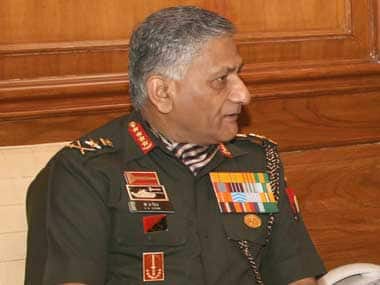 [/caption] Media commentators too have taken snide potshots at what they see as an erosion in Gen Singh’s mental faculties. Karan Thapar believes that Gen Singh is “so powerfully propelled by his own demons” that he careening towards self-destruction. Likewise, columnist Rohit Bansal reckons that the general is in a “deeply disturbed condition and needs to “cool down” - failing which the government should send him to Pakistan, where he surely has a career. Almost every one of these commentaries suggests that Gen Singh is so motivated by the overwhelming urge to redeem his personal honour (following the setback in the age row with the government) that he has become a loose cannon. They claim that Gen Singh is largely to blame for the perceived erosion in relations between the military and the civilian government. Such a characterisation does colossal injustice to Gen Singh’s earnest - if perhaps excessively eager - effort to tackle corruption in the Army, and particularly in defence procurement. Right from his first day in office, Gen Singh signalled that he wished to restore the Army’s “internal health”. And if that meant going after the corrupt in his own Army fraternity, the good General hasn’t flinched from the hard task. In that spirit, he went after high-ranking accused in the Sukhna and Adarsh housing society scandals - and took on the arms lobby. The demons that Gen Singh battled in that good fight were not in his mind; they were sipping single-malts in Army clubs, sealing arms deals at golf courses - and slithering spookily in the corridors of the Defence Ministry. Any government that claims it wants to combat corruption everywhere, including in defence procurement, ought to have backed up Gen Singh’s efforts. Even if Gen Singh’s methods were somewhat over-the-top, his intentions in going after corruption were unimpeachable. And in his defence, he perhaps had to go over the top because of the level of entrenchment within the Army and the bureaucracy. Yet, by planting venomous media stories besmirching Gen Singh’s reputation - including highly tendentious and too-clever-by-half reports of a suspected Army coup - the government has effectively shielded the arms lobby and the corrupt within the defence bureaucracy. And now, we’re told, it’s all because Gen Singh has “lost his mental balance.” This isn’t, of course, the first time that those who campaign against corruption have had their sanity questioned. Congress leaders have suggested that Anna Hazare too needed the services of a mental asylum. Perhaps there is a subliminal message being conveyed by such commentaries. Perhaps only a “loss of mental balance” can account for why Gen Singh didn’t accept the offer of a bribe made to him - when even the officer who offered it suggested that Army chiefs before Gen Singh had accepted such payments, and those after him would too. Perhaps Gen Singh is mad - for even wanting to fight corruption, even to the extent of antagonising his follow-officers. Perhaps the commentariat is right, and Gen Singh and Anna Hazare ought to be locked up in a padded cell, where they can rattle the bars all they want with their thunderous anti-corruption rhetoric. Perhaps, as Akira Kurosawa said, in a mad world, only the mad are sane.
Perhaps only a “loss of mental balance” can account for why Gen Singh didn’t accept the offer of a bribe made to him - and why Anna Hazare persists with his foolish dream.
Advertisement
End of Article
Written by Vembu
Venky Vembu attained his first Fifteen Minutes of Fame in 1984, on the threshold of his career, when paparazzi pictures of him with Maneka Gandhi were splashed in the world media under the mischievous tag ‘International Affairs’. But that’s a story he’s saving up for his memoirs… Over 25 years, Venky worked in The Indian Express, Frontline newsmagazine, Outlook Money and DNA, before joining FirstPost ahead of its launch. Additionally, he has been published, at various times, in, among other publications, The Times of India, Hindustan Times, Outlook, and Outlook Traveller. see more

 "Israel targets top Hamas leaders in Doha; Qatar, Iran condemn strike as violation of sovereignty")
 "Nepal: Oli to continue until new PM is sworn in, nation on edge as all branches of govt torched")
 "Who is CP Radhakrishnan, India's next vice-president?")
 "Israel informed US ahead of strikes on Hamas leaders in Doha, says White House")
 "Israel targets top Hamas leaders in Doha; Qatar, Iran condemn strike as violation of sovereignty")
 "Nepal: Oli to continue until new PM is sworn in, nation on edge as all branches of govt torched")
 "Who is CP Radhakrishnan, India's next vice-president?")
 "Israel informed US ahead of strikes on Hamas leaders in Doha, says White House")



](https://images.firstpost.com/wp-content/uploads/2012/05/vksingh3803.jpg)