

 "Fear is the key: What Sushma, Rajiv and i-pill have in common")
It’s around midnight as I write this and I am just back from a late dinner with a friend. Before we started to have dinner, my friend insisted that I use a hand sanitiser. While I have nothing against people trying to be squeaky clean all the time, but the smell of a hand sanitiser really puts me off and can even make me sneeze. Given that, I refused to use it. “How can you not use a hand sanitiser before eating?” she asked. “Well I have washed my hands,” I replied. “But that’s not enough,” she insisted. “Why not?” I asked. “Because a hand sanitiser kills all the germs.” “What germs?” I asked, ripping into the tandoori chicken. “Ah. End of conversation. Guess cleanliness isn’t really your thing!” she exclaimed at my ingratitude. The idea of using hand sanitisers has caught on (especially with women) after the recent global swine flue scare. But does it really help? As brand management expert Martin Lindstrom writes in his latest book, Brandwashed – Tricks Companies Use to Manipulate Our Minds and Persuade Us to Buy, “Neither swine flu nor SARS can be prevented by the use of antibacterial cleansing gels. Both viruses are spread via tiny droplets in the air that are sneezed or coughed by people who are already infected. ” In fact, as Lindstrom told me in an interview,“What’s ironic is that none of those products…actually do any better job than soap and water.” [caption id=“attachment_549811” align=“alignleft” width=“380”] 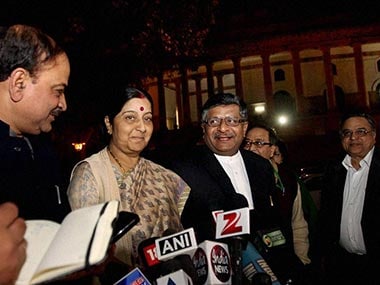 When politicians try to create fear in the minds of citizens their aim is similar to that of companies trying to create fear in the minds of consumers. PTI[/caption] That being the case, why are women so in love with hand sanitisers? Says Lindstrom in _Brandwashed: “_The idea of an unseen, potentially fatal contagion has driven us into nothing short of an antibacterial mania.” And companies making hand sanitisers have simply captured this mania as a profitable money making proposition. In his interview to me, Lindstrom said: “The companies have done an extraordinary job in building their brands on the back of the fear created by those global viruses – indicating that we’ll be safe using these brands…The ironic side of the story, however, is that the life expectancy in Japan is decreasing for the first time in history – why – because the country simply has become too clean – the Japanese have weakened their immune system as a result of overuse of hand sanitising products.” What this little story tells us is that fear of something happening (or not happening, for that matter) is a great selling strategy and you can’t argue with a woman who has made up her mind. As Lindstrom put it, “we’re all hardwired to be seduced by fear – fear is the number one soft button in our brain, it is a survival instinct. Fear is used by most insurance companies and even Colgate who claimed in one ad that they could remove the risk of cancer by the usage of their toothpaste.” The fact that fear is a great selling strategy makes companies build it directly into their advertisements. The advertisement for i-pill, an emergency contraceptive pill, shows a mother telling her daughter “Kyun risk le rahi hai?” when the daughter calls and hints that she has had unprotected sex. Or take the case of Saffola oil, which has run a highly successful campaign over the years on the fear of a heart attack. It used to run an advertisement for years showing a man being wheeled into the operation theatre, with the sound of the ambulance siren in the background (Okay, I’m not immune to fear. Let me concede I also use Saffola oil for cooking). Fair and Lovely, which claims to be a skin lightening cream, has run on a plank of the fear of rejection for a “dark” girl. This despite protests from several quarters. The advertisement for the health drink Complan is built around the fear that those not having Complan will not grow as tall as those having it. Almost every insurance company uses fear as a selling strategy. This can vary from the fear of death, to the fear of not having enough money to meet hospital bills, to the fear of not having enough money for the son’s or daughter’s education or not having enough money for the daughter’s wedding and so on. As Tyler Cowen, an economist at George Mason university in the US, writes in the book, Discover your Inner Economist: “Often, buying insurance is about investing in a story about who we are and what we care about; insurance salesmen have long recognised this fact and built their pitches around it.” Having given these examples, let me concede that some of these advertisements do push consumers towards buying the right product. But most of these advertisements are misleading. Business Standard recently reported, “Whether it’s Complan or Horlicks, they claim to make a child taller and smarter. But their promises are not based on any scientific data….Abu Hasem Khan Choudhury, minister of state for health and family welfare, informed the Lok Sabha in a written reply on November 30 that the food regulator had begun prosecution proceedings against manufacturers of 19 leading brands and issued show cause notices to 19 others for making false claims regarding the nutritional value of the product in advertising and on the label.” As the story further pointed out, “Complan, a leading drink brand, claims it makes children grow twice as fast. Horlicks promises to make children “taller, stronger and sharper”. Kellogg’s Special K claims people who eat low fat food in their breakfast tend to be thinner than those who do not, without providing any scientific study to back this claim. Products like Saffola oil, Rajdhani Besan and Britannia Vita Marie biscuits have been booked for making false claims of being “heart-friendly” and “reducing cholesterol”.” All these products play on the fears and insecurities of consumers. If my kid doesn’t drink Complan/Horlicks he won’t grow tall. If I don’t eat Kellogg’s Special K, I will become fat. And if I don’t have Saffola oil I will have a heart attack. Lindstrom summarises this phenomenon very well in a paragraph in his book Buyology – How Everything We Believe About Why We Buy is Wrong: “That if we don’t buy their product, we’’ll somehow be missing out. That we’ll become more and more imperfect; that we’ll have dandruff or bad skin or dull hair or be overweight or have a lousy fashion sense. That if we don’t use this shaving cream, women will walk by us without a glance…That if we don’t wear this brand of lingerie no man will ever marry us.” Politicians are looking to do exactly the same thing when they practice the politics of fear. The recent debate on FDI in big retail had Sushma Swaraj saying things like “Will Wal-Mart care about the poor farmer’s sister’s wedding? Will Wal-Mart send his children to school? Will Wal-Mart notice his tears and hunger?” She also said that “The remaining 70 percent of the goods sold in these supermarkets will be procured from China. Factories will open in China, traders will prosper in China while darkness will befall 12 crore people in India.” This is scaremongering of a kind similar to that indulged in by companies to sell their products. Arun Jaitley, the leader of opposition in the Rajya Sabha, also indulged in the same when he said that “India will become a nation of salesboys and girls.” And before I am labelled to be a Congress agent, let me clarify that politicians from across the political spectrum have practised this strategy at various points of time. In the run up to the 1984 elections, Rajiv Gandhi’s advertisements talked fear. " Will Your Grocery List, in the Future, include Acid Bulbs, Iron Rods, Daggers?“This was to frighten Hindus, then worried by Sikh extremists who were pulling innocents out of buses and shooting them, into voting for the Congress after Indira’s assassination. “When a big tree falls, the ground shakes,” said Rajiv Gandhi to justify the violence unleashed by Congress goons on Sikhs in 1984. The party’s lumpen elements whipped up a mass frenzy and, in the massacres that followed, Sikhs were killed all across northern and eastern India. And the Congress Party got 415 seats in the Lok Sabha, a feat not achieved even by Jawaharlal Nehru, the biggest leader that the party has ever had. Kanshi Ram, had formed the the Dalit Soshit Samaj Sangharsh Samiti, or DS4, before forming the BSP. The rallying cry for DS4 was “Thakur, Brahmin, Bania Chhor, Baki Sab Hain DS4.” This worked so well that when Ram decided to form the BSP he came up with a similar sounding but a more subtle slogan. “Tilak Tarazu aur Talwaar, inko maaro joote chaar.” The late Bal Thackeray was a master of this craft by first putting fear of Tamils in the minds of the Marathi Manoos and then Muslims, as times changed. His nephew Raj, who left to form his own party, the Maharashtra Navnirman Sena, took this strategy further and has put the fear of Bhaiyyas and Biharis in the minds of the Marathi Manoos. Varun Gandhi made front page headlines when in a speech he said “Ye panja nahi hai, ye kamal ka haath hai. Ye kat** ke galey ko kaat dega chunaav ke baad.” Then there are also examples of parties like DMK, which have been built on creating the fear of the loss of culture and language. When politicians try to create fear in the minds of citizens their aim is similar to that of companies trying to create fear in the minds of consumers. Fear “is what our brains remember…” writes Lindstrom in Buyology. It creates what Lindstrom calls “somatic markers,” or brain shortcuts that link the brand sold to what needs to be done to take care of the fear: “Want you kid to grow tall? Get him to drink Complan!” “Want a healthy life without a heart attack? Use Saffola oil.” Or, in the current political context, “Don’t want the Chinese to take away Indian jobs or sell goods in India? Vote for the Bharatiya Janata Party.” “Want freedom from the oppression of upper castes? Vote for the Bahujan Samaj Party.” While it is not as simple as that, but that is what it essentially means. Fear also gives rise to anxieties and insecurities in people and helps politicians come up with a war cry and make themselves easily heard. As Bill Bonner and Lila Rajiva write in Mobs, Messiahs and Markets: “Men are ready to die for the group and kill anyone who resists its will.” As Lindstrom writes in Brandwashed: “So whether it’s germs or disease or some feared version of a future self, marketers are amazingly adept at identifying a fear out of the zeitgeist (a German word which means the spirit of the times, italics are mine), activating it, amplifying it and preying on it in it in ways that hit us at the deepest subconscious level.” Politicians do the same thing. They identify the prevailing fear, like Wal-Mart will bring in low-cost Chinese goods (as if Indian companies are not) and destroy the kiranas. And then they activate it and amplify it by talking about it in their speeches. And if the comments on this piece that I wrote a couple of days back are anything to go by, they have been successful at it. And so was Rajiv Gandhi! Vivek Kaul is a writer. He can be reached at vivek.kaul@gmail.com
Fear is a powerful marketing tool for political parties — as it is for brand marketers.
Advertisement
End of Article

 "Israel targets top Hamas leaders in Doha; Qatar, Iran condemn strike as violation of sovereignty")
 "Nepal: Oli to continue until new PM is sworn in, nation on edge as all branches of govt torched")
 "Who is CP Radhakrishnan, India's next vice-president?")
 "Israel informed US ahead of strikes on Hamas leaders in Doha, says White House")
 "Israel targets top Hamas leaders in Doha; Qatar, Iran condemn strike as violation of sovereignty")
 "Nepal: Oli to continue until new PM is sworn in, nation on edge as all branches of govt torched")
 "Who is CP Radhakrishnan, India's next vice-president?")
 "Israel informed US ahead of strikes on Hamas leaders in Doha, says White House")



](https://images.firstpost.com/wp-content/uploads/2012/12/SushmaSwaraj_PTI.jpg)