

 "Chhattisgarh attack: Why India is losing its war against Naxals")
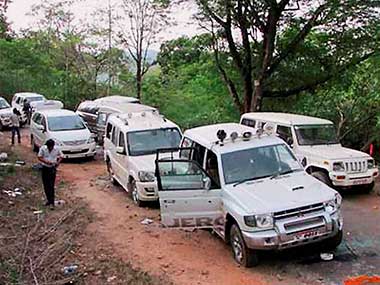
Five decades ago, the special forces officer Roger Trinquier set about understanding why his nation losing to enemies it outgunned and outmanned. France, he wrote, was “in studying a type of warfare that no longer exists and that we shall never fight again, while we pay only passing attention to the war we lost in Indochina and the one we are about to lose in Algeria. The result of this shortcoming is that the army is not prepared to confront an adversary employing arms and methods the army itself ignores. It has, therefore, no chance of winning”. Trinquier concluded: “our military machine reminds one of a pile-driver attempting to crush a fly”. Like the French army Trinquier wrote of, India counter-Maoist campaign will not and cannot succeed. The Indian state doesn’t have enough boots on the ground. The lessons its fighting women and men receive are inadequate. The tools they’re being are issued are the wrong ones. India’s way of counter-insurgency isn’t that different from Mughal emperors, who despatched great imperial columns to put down rebellious governors and or bandits preying on their trade routes. In 2003, a group of ministers which review internal security after the Kargil war, assigned the Central Reserve Police Force (CRPF) frontline responsibility for counter-insurgency operations—backing up police forces across the country. The force, at the time of the war, had 167,367 personnel. It is now up to 222 battalions—over 222,000 armed personnel, and 300,000 including administrators and support staff. [caption id=“attachment_820599” align=“alignleft” width=“380”]  The site of the attacked convoy. PTI[/caption] Yet, the results haven’t been luminous. Even as the CRPF’s numbers have ballooned, the government’s own data shows the number of Maoist insurgents eliminated has declined year-on-year since 2009, from 317 to 114. The number of insurgents and unarmed supporters has stayed steady, at 25,000 plus. In 2010, an entire company of the 62 Battalion was annihilated in an ambush at Tarmetla. In the years since, the CRPF has become increasingly defensive — wary both of taking casualties, or killing civilians in crossfire. There’s a simple reasons for this. In 2003, the CRPF had seven recruit-training centres, each processing 600-700 women and men through nine-month courses. That number has increased, but using ad-hoc facilities. There’s no dedicated theatre-specific warfare schools and an intelligence service that exists only in name. The force doesn’t fly its own helicopters, necessary in Maoist-hit areas where it can’t use heavily-mined roads, or its own photo-reconnaissance capabilities. If the CRPF was doing what it was supposed to do—just backing up police forces, who would generate intelligence and carry out cutting-edge operations—this wouldn’t matter quite as much. The thing is, those police forces themselves are in a mess. Figures for 2011, the last year for which government data is available, show just how acute personnel deficits are in state hit by the Maoist insurgency. Bihar had just 54,196 police personnel for a population of 82,998,509—65 for every 100,000 population, against a United Nations norm of 250:100,000 or better. West Bengal has 60,450 police for a population for its 91.34 million residents, 66:100,000.In Odisha, there are 29,481 for a population of 49.95 million, a ration of 70:100,000. The state of Jharkhand—among the better-administered new states—does a little better, with 40,579 officers for 32.9 mn residents, but even that’s just 123:100,000. Delhi, with 16.75 mn residents, had 66,686 on its rolls at end-2011—far more than Chhattisgarh, which had 27,597. Having more police officers, of course, won’t solve the problem on its own. The sad truth, though, is more cops doesn’t mean more peace. Nagaland, which now has a staggering 1,677 police for every 100,000 population, and Manipur with 669.6, and have some of the highest population to force ratios in India—but haven’t helped put down insurgencies. Mizoram, which has no insurgency, has 1268.6, suggesting police hiring is in fact serving an employment-generation imperative. In a June, 2010, speech, then-home minister P Chidambaram noted that in the states worst-hit by Maoist violence, “there are police stations where there are no more than eight men; and even these eight or less men do not hold any weapons for fear of the weapons being looted”. He called on states to “enhance the capacity of training institutes in the States to at least double the present capacity, and to recruit at least double the number of policemen and women that are being recruited at present”. He said it, and it hasn’t happened. Both New Delhi and state capitals need to be held to account for this. There’s no shortage, though, of states which got counter-insurgency right — without tanks and gunships and armed drones and whatever else phalanxes of apoplectic retired generals have been calling for on television. Pile drivers, as Trinquier pointed out, can’t swat flies. In the late-1990s, Andhra Pradesh’s politicians united behind a decisive counter-Maoist strategy. Former director-general of police HG Dora built a highly-rated intelligence service, boosted the numbers of police stations and upgraded training. It called in NS Bhati, a veteran of the legendary RAW covert force code-named Establishment22, to train crack special jungle warfare force, the Greyhounds. The state’s police are still the most feared by Maoists of all their adversaries. Punjab’s KPS Gill famously routed an insurgency that seemed poised for triumph. Prem Mahadeven has pointed out that the success was achieved by strategy, not machismo: among other things, Gill moved forces out of static duties into operations, and enhanced manpower “to attain a reaction time of 3-5 minutes in urban areas, and 15-20 minutes in rural areas”. Tripura the authoritative South Asia Terrorism Portal records, brought “one of the most virulent insurgencies in the country to near-complete end”—an insurgency, like the one in Chhattisgarh, was alleged to be driven by irresolvable tribal-rights issues. Andhra Pradesh was ruled by the Telegu Desam Party; Punjab by the Congress; Tripura by the Left. Counter-insurgency success isn’t about party politics: it’s about professional skill and political will. Instead of will or skill, we’re getting buck-passing. The Union Government has ordered a National Investigations Agency probe—though what it’s supposed to ascertain is unclear, since the perpetrators are bragging about their act. The Ministry of Home Affairs has been saying that it warned of an attack—neglecting the minor detail that the 26 April Intelligence Bureau alert it refers mentioned only non-specific specific threat. The National Technical Reconnaissance Organisation and the Air Force are blaming each other for why drones aren’t located closer to the combat zone. Ajit Jogi wants President’s Rule; Rajnath Singh is complaining about the NIA. Tragedy is of two kinds. There’s the kind that comes about because of consequences which cannot be foreseen; the consequence of fate. Then, there’s what Socrates pithily described as going “willingly toward the bad”. Akrasia, he called it. It doesn’t take a lot to see which script we’re acting to.
The Indian state doesn’t have enough boots on the ground. The fighting women and men it does have aren’t trained adequately for the job they’re meant to do. And the tools they’ve been given are the wrong ones.
Advertisement
End of Article


 "Russian drones over Poland: Trump’s tepid reaction a wake-up call for Nato?")
 "As Russia pushes east, Ukraine faces mounting pressure to defend its heartland")
 "Why Mossad was not on board with Israel’s strike on Hamas in Qatar")
 "Turkey: Erdogan's police arrest opposition mayor Hasan Mutlu, dozens officials in corruption probe")
 "Russian drones over Poland: Trump’s tepid reaction a wake-up call for Nato?")
 "As Russia pushes east, Ukraine faces mounting pressure to defend its heartland")
 "Why Mossad was not on board with Israel’s strike on Hamas in Qatar")
 "Turkey: Erdogan's police arrest opposition mayor Hasan Mutlu, dozens officials in corruption probe")



