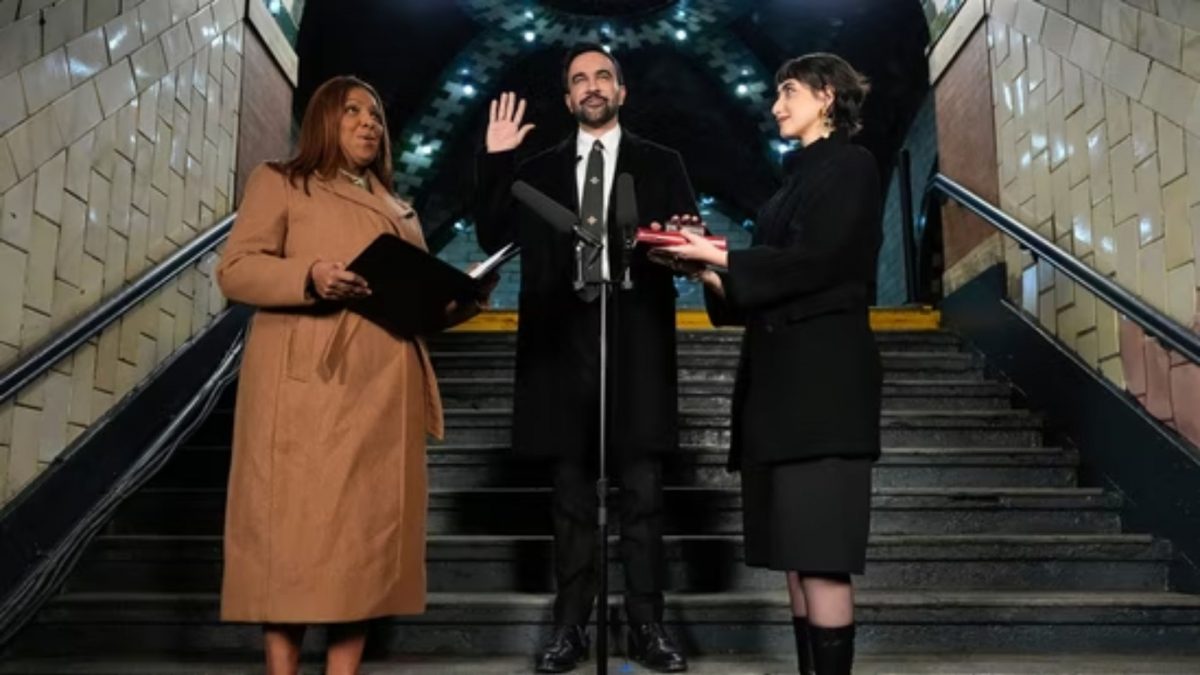
 "New York Attorney General Letitia James, left, administers the oath of office to mayor-elect Zohran Mamdani, center, as his wife Rama Duwaji looks on, Thursday, Jan. 1, 2026, in New York. (IMAGE: AP Photo)")
Zohran Mamdani was sworn in as the city’s mayor early on New Year’s Day in a ceremony that broke with tradition and celebrated diversity.
Mamdani, 34, made history as the first Muslim, first South Asian and first African-born leader of the city. His inauguration began just after midnight in a private ceremony at the old City Hall subway station—a long-closed stop beneath Manhattan—where he took the oath of office with his hand on the Quran, Islam’s holy book.
In the public portion of the event later in the day at City Hall, Mamdani also used the Quran for his oath.
Watch the video here:
Using the Quran to swear in a mayor was unheard of in New York’s history, where most previous mayors have used a Bible.
As he took office, Mamdani expressed that his leadership will focus on “inclusivity and opportunity” for all New Yorkers, promising to address affordability, public transit, and social equity.
The inauguration also included public celebrations, with family, friends and supporters gathering to mark the start of his term.
Also read | Zohran Mamdani’s NYC win and the India connection: A Nehru quote, Bollywood song
Quick Reads
View AllFrom street politics to City Hall
Mamdani’s journey to becoming New York City’s mayor has been anything but conventional.
Long before he took the oath of office, Mamdani had already carved out a reputation as a sharp, outspoken progressive who built his politics from the ground up.
Born in Uganda and raised in Queens, Mamdani entered public life as an organiser, working closely with tenants, immigrant communities and low-income workers. His early activism shaped the core of his politics: affordability, dignity, and access to basic public services. That grounding became central to his rise when he won a seat in the New York State Assembly, representing Astoria and surrounding neighbourhoods.
In Albany, Mamdani quickly stood out. He pushed hard on housing justice, backed rent freezes, championed stronger tenant protections and called for taxing the ultra-wealthy to fund public services. He also became a familiar face at protests, whether it was supporting striking workers or speaking out against US foreign policy in Gaza.
His leap to citywide politics came during the 2025 mayoral race, where Mamdani ran a campaign that rejected big-money donors and leaned heavily on grassroots energy. Promising free public buses, expanded childcare, and aggressive action on housing costs, he connected with young voters and working-class New Yorkers who felt locked out of the city’s prosperity.