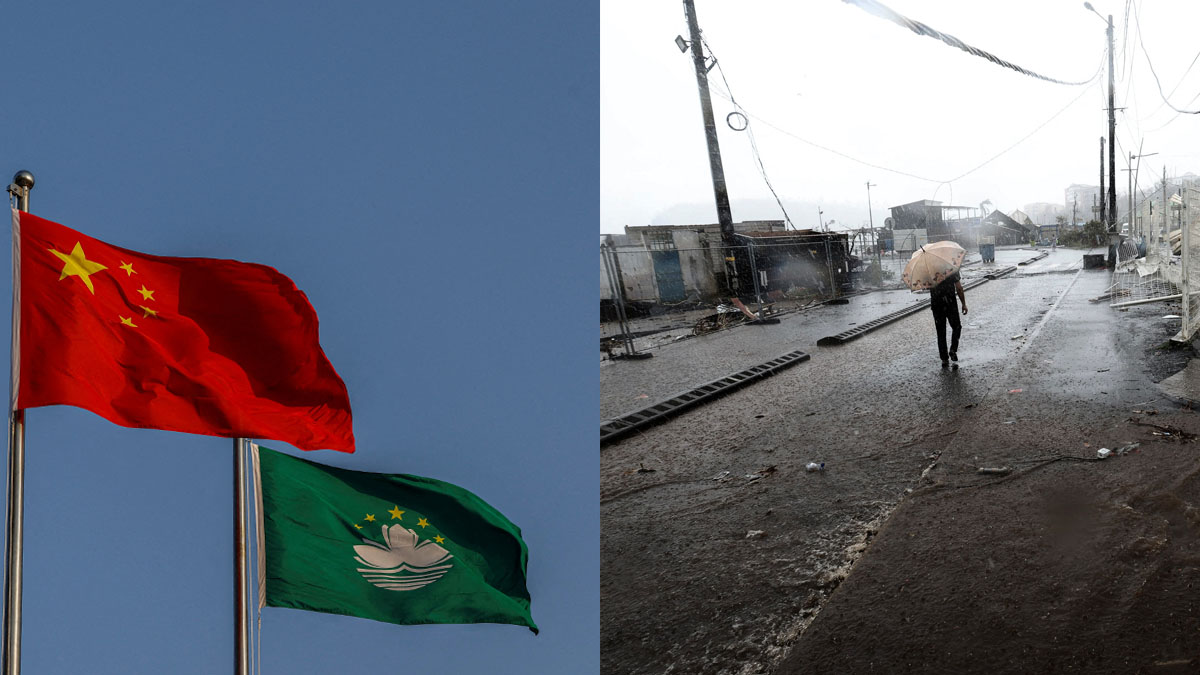
 "(L-R) Chinese and Macau flags flutter during a flag-raising ceremony at the Golden Lotus Square to mark the 25th anniversary of Macau's handover from Portugal to China, in Macau, China December 20, 2024. Reuters; A person walks at a street during heavy rains in the aftermath of Cyclone Chido, in Mamoudzou, Mayotte, France, December 19, 2024. Reuters")
Two islands—Macau and Mayotte—have captured the headlines this week for starkly contrasting reasons, one symbolising celebration and promise, the other devastation and despair.
Macau, situated on the southern coast of China across the Pearl River Delta from Hong Kong, marked the 25th anniversary of its return to Chinese sovereignty. Once a Portuguese colony, Macau was handed back to China in 1999 under the “one country, two systems” framework. Known as a Special Administrative Region (SAR) of China, Macau is famous for its unique blend of Portuguese and Chinese cultures, evident in its architecture, cuisine and traditions. Often called the “Las Vegas of Asia” due to its booming casino industry, Macau’s geography includes a peninsula and two islands, Taipa and Coloane, connected by reclaimed land known as the Cotai Strip. Despite its small size, it is one of the world’s most densely populated regions.
During the anniversary celebrations, Chinese President Xi Jinping emphasised Macau’s development and success under the “one country, two systems” policy. He expressed optimism that the region would continue to achieve new milestones as long as the policy was implemented fully and consistently.
Meanwhile, Mayotte, a French overseas department located in the Indian Ocean, is reeling from the destruction caused by Cyclone Chido. Part of the Comoros archipelago between Madagascar and Mozambique, Mayotte became a French territory in 1974 and officially a department in 2011, following referendums where residents chose to remain under French sovereignty. Mayotte consists of two main islands, Grande-Terre and Petite-Terre, and several smaller islets, surrounded by a vast barrier reef that supports rich marine biodiversity. Despite its natural beauty, the region faces significant economic challenges, including high poverty rates and dependence on French subsidies.
French President Emmanuel Macron extended his visit to Mayotte to address the aftermath of Cyclone Chido, which has left 31 people confirmed dead and 2,500 injured so far. Residents, angry and despairing over the slow response to the disaster, voiced their frustrations during Macron’s visit. Macron explained that he chose to stay overnight to show solidarity and avoid the impression that officials simply observe and leave. Rescue teams continue to search for survivors and deliver aid, but officials fear the death toll could rise into the hundreds or even thousands. The cyclone also caused devastation in Mozambique, claiming at least 73 lives on the mainland.
Impact Shorts
More ShortsWhile Macau celebrated its progress and prosperity, Mayotte struggles to recover, highlighting the stark contrasts between these two unique islands.
Economic growth on the margins
Economic development in regions with unique political statuses can provide valuable insights into their quality of life and overall progress. Mayotte, a French overseas department in the Indian Ocean, and Macau, a SAR of China, offer two very different examples. While Macau has grown into a major centre for gambling and tourism, Mayotte faces ongoing challenges in its development.
Macau: A Gateway to East Asia
Macau’s history as a Portuguese trading port placed it as a cultural and economic bridge between the East and West. When it became part of China in 1999 as a SAR under the “One Country, Two Systems” policy, Macau was able to keep a lot of control over its own economic matters. Taking advantage of this autonomy, Macau turned into the “Las Vegas of the East.” China’s policy to make the region a centre for international tourism and trade helped support this transformation.
After 1999, Macau focussed on building a big gambling industry. The government worked with private investors and relaxed gaming rules, which attracted global casino companies. This made Macau the world’s biggest gambling centre in terms of revenue. The industry drives economic growth and provides many jobs. Macau’s tourism, based on its casinos, rich culture and closeness to mainland China, also plays a key role in China’s Greater Bay Area plan.
Macau’s per capita GDP is one of the highest in the world, thanks to its booming gambling and tourism sectors. However, this economy depends on external factors like tourism from mainland China and regional stability. The COVID-19 pandemic showed how vulnerable Macau’s economy is, as it shrank sharply when tourism stopped.
Macau’s role is also important in global politics. As a link between China and Portuguese-speaking countries, it supports China’s Belt and Road Initiative. Its legal and financial systems help trade and investment, making it an important part of China’s global plans.
Macau’s success shows the value of giving economic freedom to regions with special histories and cultures. By allowing Macau to create policies suited to its strengths, China helped it become a major gambling hub. In contrast, Mayotte’s development is limited by policies from Paris that often don’t meet the island’s specific needs and challenges.
Mayotte: A disjointed development path
In contrast, Mayotte’s time under French rule was marked by neglect, with little investment in infrastructure or economic development. The decision to stay with France instead of joining the Comoros Islands for independence was mainly driven by a need for political stability and economic support. However, being an overseas department has not led to the expected economic growth and Mayotte remains one of the poorest regions under French control.
When Mayotte became a full overseas department of France in 2011, it was promised economic aid and infrastructure improvements. While French subsidies have helped improve healthcare and education, the economy is still mainly based on agriculture with little growth in industries or services. Unemployment is around 30 per cent and its GDP per capita is one of the lowest in the European Union. Efforts to connect Mayotte’s economy to regional trade networks in the Indian Ocean have struggled due to poor infrastructure and political instability in neighbouring countries.
Mayotte’s social and economic conditions are tough. Poverty is much higher than in mainland France, and many people live in informal settlements. Access to basic services like water and electricity is unreliable. Though French subsidies have raised living standards compared to the Comoros, the gap between Mayotte and mainland France remains large, leading to social unrest and migration pressures.
Mayotte’s location in the Indian Ocean makes it important for France’s Indo-Pacific strategy. The island acts as a base for French military operations and a checkpoint for migration from East Africa and the Comoros. However, its strategic importance has not led to strong economic growth and the island remains dependent on French financial support.
Future prospects
Both regions show the dangers of depending too much on one source of income. Macau’s heavy reliance on gambling makes it vulnerable to changes in tourism and global events. On the other hand, Mayotte’s farming-based economy and dependence on French subsidies make it susceptible to changes in aid and global market prices. Expanding into areas like renewable energy, tourism and regional trade could help both regions build more stable economies.
The economic paths of Macau and Mayotte offer important lessons in regional development. While Macau’s risky approach has brought great wealth, Mayotte’s struggles highlight the need for specific economic policies and better infrastructure.