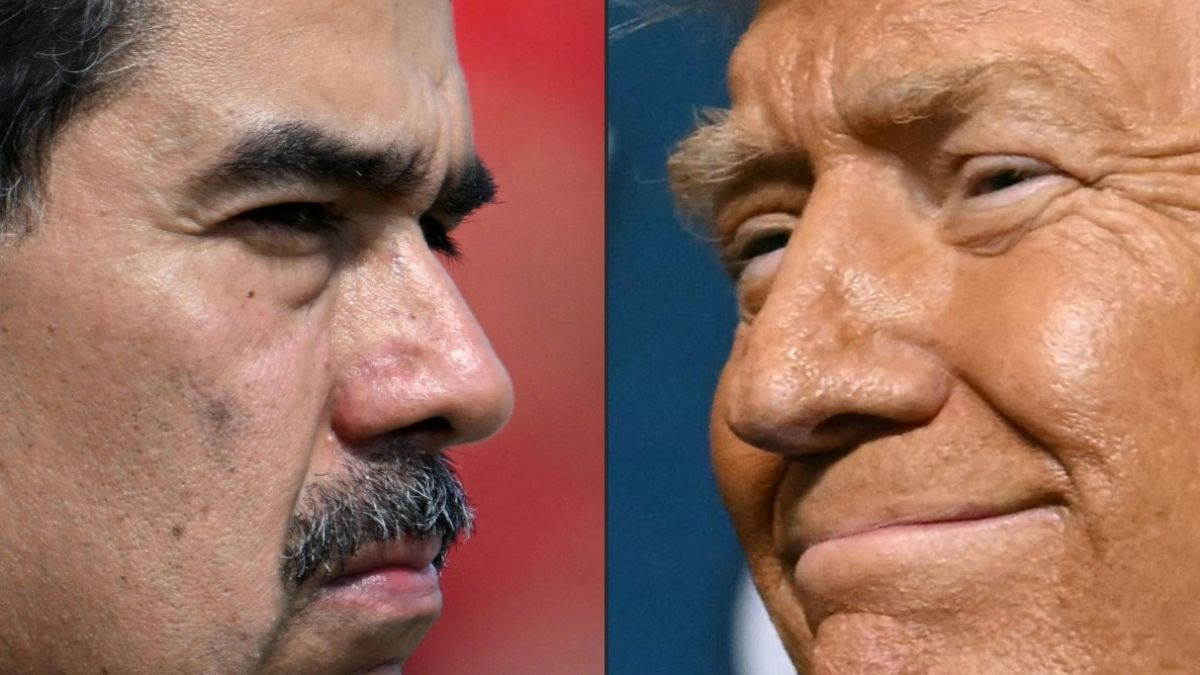
 "Trump’s administration is ramping up pressure on Venezuela with a major Caribbean military deployment that includes the world’s largest aircraft carrier. (AFP)")
US President Donald Trump on Sunday confirmed that he had spoken to Venezuelan leader Nicolas Maduro in recent days, at a time when tensions between Washington and Caracas have escalated alongside a substantial US military buildup in the Caribbean.
Reports suggested the call might have included discussion of a possible meeting or amnesty terms if Maduro were to step down, but when asked to elaborate, Trump said only, “I wouldn’t say it went well or badly. It was a phone call.”
Amid mounting tensions, Donald Trump warned on Saturday that airspace over and near Venezuela should be treated as closed, marking the latest escalation in his standoff with President Nicolás Maduro.
“To all Airlines, Pilots, Drug Dealers, and Human Traffickers,” Trump wrote on his Truth Social network, “please consider THE AIRSPACE ABOVE AND SURROUNDING VENEZUELA TO BE CLOSED IN ITS ENTIRETY.”
Venezuela issued a sharp response, with the Foreign Ministry stating that it “denounces and condemns the colonialist threat that seeks to affect the sovereignty of its airspace,” describing the warning as “an extravagant, illegal and unjustified aggression against the Venezuelan people”.
US military presence grows in the Caribbean
The Trump administration has intensified pressure on Venezuela, deploying a major military presence in the Caribbean that includes the world’s largest aircraft carrier. Washington maintains the operation is aimed at disrupting drug trafficking networks, while Caracas argues that the real objective is regime change.
Since early September, US forces have launched strikes on more than 20 vessels they claim were involved in Venezuelan drug-smuggling operations in the Caribbean Sea and eastern Pacific, resulting in over 80 deaths. However, Washington has not provided evidence that the targeted boats were carrying narcotics or posed any security threat to the United States.
Quick Reads
View AllThe campaign, combined with the expanded military deployment, has further heightened tensions across the region.