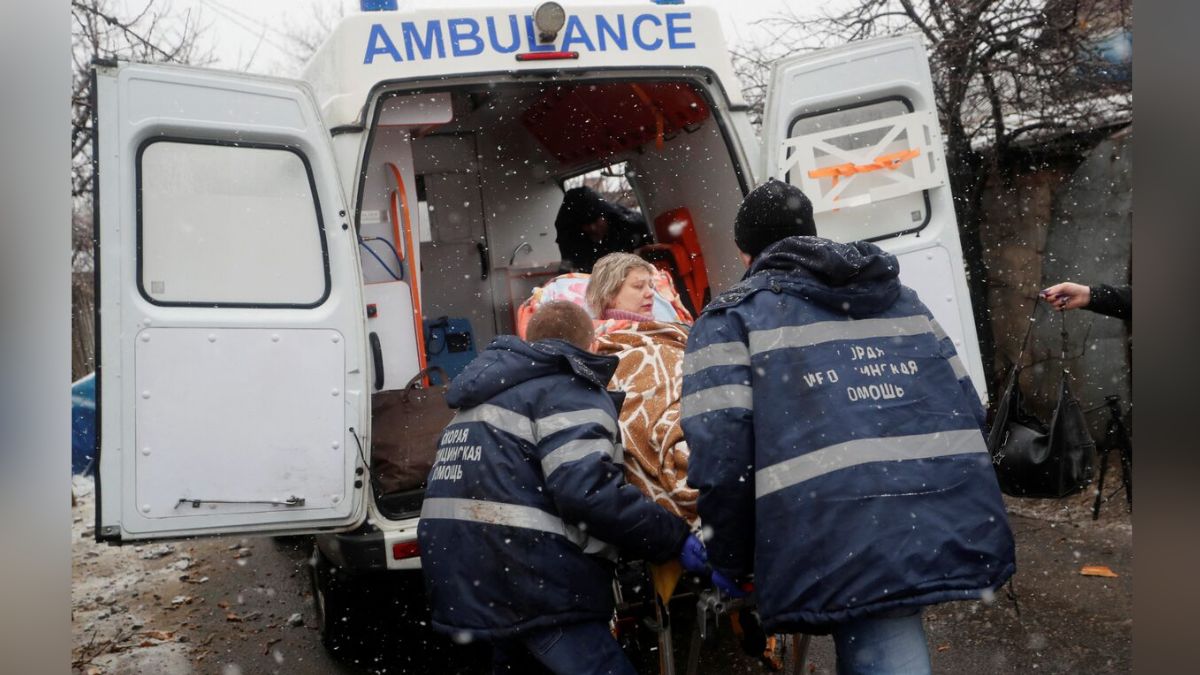
 "Medical specialists transport an injured woman to an ambulance following shelling in the city of Donetsk, Ukraine March 3, 2022. File image/Reuters")
In any war, a surefire way to get the other side to give up is to raise the cost of war– militarily, economically, and in terms of lives lost– beyond a tolerable limit.
The Ukraine conflict is no different. Moscow understands this.
In recent months, Russia has been trying to bring Ukraine to its knees by quickly chipping away people’s morale while also hammering Kyiv economically. Kremlin’s weapon of choice are systematic attacks on the healthcare and energy frameworks.
Here’s a look at what Russia is doing and the strategic benefits it is eyeing.
Double-tap attacks target emergency responders
According to a report published in The Lancet on Friday (September 13), Russia is using deliberately using ‘double-tap’ attacks to target emergency responders.
A double-tap attack is a tactic where an initial air strike is followed by a second strike in the same location shortly afterwards. The timing of the second attack is intended to target first responders, medical personnel, or civilians who arrive to assist the victims of the initial strike.
According to the report, since February, 2022, World Health Organisation has confirmed 1,973 attacks on health-care facilities, health transport and supply, staff, and patients in Ukraine. This is the highest number the agency has ever recorded in any humanitarian emergency. Since December last year, these attacks have been occurring on a near-daily basis.
They have included more and more double-tap strikes, too.
Calculating the minimum time— 40 seconds— between an air raid alert and a possible strike, and the area of impact, suggests a team on a call would be unlikely to escape, Viktor Zabashka, who heads Kharkiv’s emergency medical services, was quoted as saying.
Impact Shorts
More ShortsWhy Russia attacks emergency responders
The most obvious benefit of such attacks is an increase in the death toll: not only by the second strike, but also by sowing fear in the minds of people so they do not come to the rescue of the victims.
Less obvious, and much more long-term is how this gradually cripples the healthcare network.
With emergency responders and healthcare professionals being killed or getting injured, an already fragile support ecosystem gets even more burdened. Repeated attacks strain the resources, too.
Money needs to be directed towards replacing blown-up ambulances, training more healthcare professionals, etc.
In a struggling war economy, where funding is scarce, this becomes difficult. The result? More deaths.
In terms of human lives, the resistance to the invasion becomes costlier for Ukraine with each such attack. As the public realises this, the morale is likely to go down. Voices demanding that the war be stopped, even at the cost of considerable territory, are likely to grow louder.
The same is also the case with attacks on energy infrastructure.
The impact of attacks on energy grids
The Associated Press on Tuesday (September 10) reported that Ukraine’s prime minister has warned the country could be facing its toughest winter since the beginning of the war.
Ukrainians rely on indoor heating to get through the harsh winters. However, the country’s beleaguered energy infrastructure, which has been taking consistent hits from Russia, is unlikely to adequately meet the heating requirements.
After all, estimates from the United Nations and the World Bank suggest that Ukraine lost more than half of its power-generating capacity in the first 14 months of the war.
Military operations rely heavily on energy for transportation, communication, and equipment. Disruptions can hinder coordination and effectiveness as well.
Once again, rebuilding a decentralised, solar-powered energy grid that would be harder to destroy would require billions of euros. It will require time, too.
In the meanwhile, loss of life due to the cold, among other factors, is expected to continue. It is bound to affect the resilience of not only the civilians, but the troops as well.
Russia’s tactics to make the war costlier for Ukraine, to make it concede, have unleashed massive suffering on the people. The strategy is bearing fruits gradually.