“Kiev is really burning!” declared a colleague in an email last night. It was a startled acknowledgement that in our absorption with various ongoing domestic dramas – Telangana, Rajiv Gandhi’s killers, AAP, Rahul, Modi et al – we’d failed to pay sufficient attention to an explosive political conflagration outside our borders. This self-absorption is hardly new. We Indians – and especially the media – are remarkably uninterested in international news, unless it happens to involve us. Devyani Korbhagade will receive reams and reams of coverage, but a huge pro-democracy uprising on the streets of Kiev, not so much. There isn’t even a tiny blurb about Ukraine on the front page of either Times of India or the Hindu, the two newspapers that I subscribe to – though the ‘World’ pages include the de rigueur wire story. (Not to say that we’ve done better on Firstpost.) My social media world is no less indifferent to foreign affairs. The Facebook news feed is littered with stories about Nimrana founder Francis Wacziarg, Meera Sanyal, and even an old photo of Rahul Gandhi looking like Harry Potter. Ukraine is represented by one lonely link to
a video message
of a protester urging the world to pay attention. “This woman is brave and her message is clear. I dare you not to be moved by it,” says the accompanying blurb. [caption id=“attachment_1400375” align=“alignleft” width=“380”]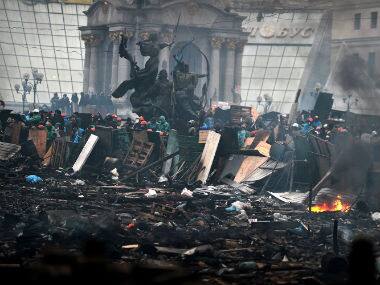 Protesters stand behind the barricades at Independence square in Kiev. AFP[/caption] I am moved enough to share it on my timeline, and resort to Google News to figure out exactly why Kiev is burning. (If you care to find out, here’s
the handy guide
from CNN that I found most useful.) It makes me feel better, but I doubt if it makes any difference to the cause. The reality is that my interest in and knowledge of the broader world has shrunk with each passing year since I moved back to India. One reason is the abysmal paucity of coverage in the Indian media. Another is the spectacular, continual political churn we’ve witnessed over the past five years. Each month – nay, week – brings a fresh crisis, scandal, or tragedy. We’ve stumbled from 2G to Lokpal through the Delhi gang-rape to Snoopgate to the ongoing AAP-o-mania. So acute is the urgent sense of a nation poised at a crossroads that it is hard to care about what happens elsewhere. But none of this changes the indisputable fact of our ethnocentrism. The numbers speak for themselves, as Ministry of External Affairs spokesperson Syed Akbaruddin
pointed out
in a lecture last year. India has some 93,985 print publications but only 300 of them cover foreign policy and the world beyond the country’s borders in some detail. There are 413 television channels devoted to news and current affairs - of a total of 850 channels - but only five have dedicated programmes on foreign affairs…. Other, equally disquieting data shared by Akbaruddin: there is utter mismatch between the world’s interest in India and India’s interest in the world. There are 192 foreign correspondents from 113 news organisations based in India, but only 30 Indian correspondents from eight organisations in nine countries. The only countries we care about are the United States which accounts for 70 percent of foreign news, Pakistan (15 percent) and China (10 percent). The rest of the world accounts for 5 percent. It’s always about us, and more so as we’ve risen in the world. The higher we climb, the more the world serves primarily as a mirror to our selves. In ’new’ India, the ‘I’ comes emphatically, irrefutably first. Rajiv Chatterjee brilliantly and hilariously captures the extent of our narcissism in his “
The World according to India
” map where Canada is “an extension of Punjab” and Switzerland is where Shahrukh Khan dances, and the tag for South Africa reads: “Gandhi was here. Plus, cricket.” India, of course, is “number 1 at thinking we are number 1.” Perhaps this is all as it should be. If American politicians can boycott french fries in the midst of a dispute with France, it is only fitting that all we know about Ukraine is
high class hookers in Delhi
. In the 21st century, ethnocentrism seems to be a prerequisite of super-power status, with American obliviousness matched by Chinese indifference. And undoubtedly, it will be the most ignoramus who wins. Go India!
Protesters stand behind the barricades at Independence square in Kiev. AFP[/caption] I am moved enough to share it on my timeline, and resort to Google News to figure out exactly why Kiev is burning. (If you care to find out, here’s
the handy guide
from CNN that I found most useful.) It makes me feel better, but I doubt if it makes any difference to the cause. The reality is that my interest in and knowledge of the broader world has shrunk with each passing year since I moved back to India. One reason is the abysmal paucity of coverage in the Indian media. Another is the spectacular, continual political churn we’ve witnessed over the past five years. Each month – nay, week – brings a fresh crisis, scandal, or tragedy. We’ve stumbled from 2G to Lokpal through the Delhi gang-rape to Snoopgate to the ongoing AAP-o-mania. So acute is the urgent sense of a nation poised at a crossroads that it is hard to care about what happens elsewhere. But none of this changes the indisputable fact of our ethnocentrism. The numbers speak for themselves, as Ministry of External Affairs spokesperson Syed Akbaruddin
pointed out
in a lecture last year. India has some 93,985 print publications but only 300 of them cover foreign policy and the world beyond the country’s borders in some detail. There are 413 television channels devoted to news and current affairs - of a total of 850 channels - but only five have dedicated programmes on foreign affairs…. Other, equally disquieting data shared by Akbaruddin: there is utter mismatch between the world’s interest in India and India’s interest in the world. There are 192 foreign correspondents from 113 news organisations based in India, but only 30 Indian correspondents from eight organisations in nine countries. The only countries we care about are the United States which accounts for 70 percent of foreign news, Pakistan (15 percent) and China (10 percent). The rest of the world accounts for 5 percent. It’s always about us, and more so as we’ve risen in the world. The higher we climb, the more the world serves primarily as a mirror to our selves. In ’new’ India, the ‘I’ comes emphatically, irrefutably first. Rajiv Chatterjee brilliantly and hilariously captures the extent of our narcissism in his “
The World according to India
” map where Canada is “an extension of Punjab” and Switzerland is where Shahrukh Khan dances, and the tag for South Africa reads: “Gandhi was here. Plus, cricket.” India, of course, is “number 1 at thinking we are number 1.” Perhaps this is all as it should be. If American politicians can boycott french fries in the midst of a dispute with France, it is only fitting that all we know about Ukraine is
high class hookers in Delhi
. In the 21st century, ethnocentrism seems to be a prerequisite of super-power status, with American obliviousness matched by Chinese indifference. And undoubtedly, it will be the most ignoramus who wins. Go India!
Why is Kiev burning: Sorry Ukraine, we don't know or care
Lakshmi Chaudhry
• February 20, 2014, 14:22:48 IST
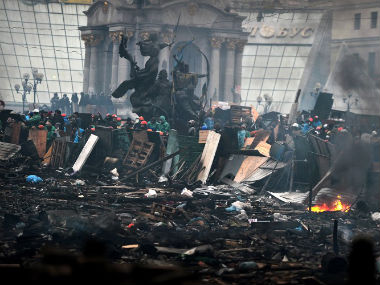
We Indians are remarkably uninterested in international news, unless it happens to involve us. Devyani Korbhagade, yes, but a huge pro-democracy uprising on the streets of Kiev, not so much.
Advertisement
 "Why is Kiev burning: Sorry Ukraine, we don't know or care")
End of Article