London: Britain has come a long way from the days when landlords put up notices on their front doors warning, “No Irish, no dogs”. To which they later added “Blacks and Pakis”. These days nobody cares who you are so long as you can pay the rent. But despite vast improvement in British social attitudes, racism is still rife in many areas of public life. It’s particularly bad in the job market with many employers not even prepared to look at candidates with the “wrong” name. A person with a British-sounding name such as John or Jane is twice more likely to be called for a job interview than a Sharma or an Ayesha. And this is not hearsay. [caption id=“attachment_2235026” align=“alignleft” width=“380”]
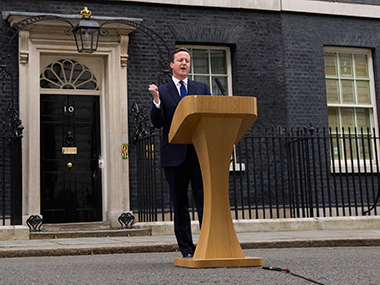
 British Prime Minister David Cameron. AP[/caption] Prime Minister David Cameron himself publicly acknowledged this calling it a “disgrace’’ citing the example of a black girl who had to change her name before she got a response. This is what he said: “Picture this. You’ve graduated with a good degree. You send out your CV far and wide. But you get rejection after rejection. What’s wrong? It’s not the qualifications or the previous experience. It’s just two words at the top: first name, surname. Do you know that in our country today: even if they have exactly the same qualifications, people with white-sounding names are nearly twice as likely to get call backs for jobs than people with ethnic-sounding names? This is a true story. One young black girl had to change her name to Elizabeth before she got any calls to interviews. That, in 21st century Britain, is disgraceful. We can talk all we want about opportunity, but it’s meaningless unless people are really judged equally.” Cameron is no bleeding liberal. But such is the scale of the problem that even a gung-ho centre-right politician like him can’t sidestep it easily. Clearly, he is under pressure from his own colleagues from ethnic backgrounds, such as Business Secretary Sajjid Javed and Employment Minister Priti Patel, to address the issue if the Tories want that increasingly important immigrant vote. Cameron’s speech was dismissed by many as political rhetoric at the time but, surprise, surprise, he has followed it up with concrete action barely within weeks of giving that speech. He has got government departments and a clutch of big private employers, together claimed to be employing some 1.8 million people, to agree to a “name-blind” application process for hiring graduates. This means that the candidates’ names on applications will not be visible to employers. So, a Sharma or an Ayesha will not have to pretend to be John and Jane. This is meant to ensure that applicants who have the right grades and skills don’t risk elimination at least at the initial screening stage just because their name doesn’t quite sound right. Of course, racial prejudice can still kick in at the interview stage but it is assumed optimistically that only a hard-core racist employer will reject a truly bright candidate simply on the basis that they don’t like the colour of their skin. Besides the civil service, others who have signed up include BBC, National Health Service (NHS), HSBC, KPMG, and Deloitte. Deloitte Chief Executive David Sproul said it would also use “school and university-blind” interviews in a bid to end “unconscious bias” against applicants from state schools, and less elitist universities. “We want to show that everyone can thrive, develop and succeed in our firm based on their talent, regardless of ethnicity, gender, sexual orientation, or any other dimension that can be used to differentiate people from one another,” he said. The government expects that as the trend catches up, others will join. It may be a small and belated step; and as Cameron admitted, “it doesn’t solve the problem on its own”. But, at last, a start has been made. Something for immigrants to cheer about who wake up every morning to be treated to, mostly, negative headlines about themselves, and then spend the day raging about the “bloody unfairness” of it all. To put it in perspective, the issue of racial discrimination needs to be seen in the larger context of a lack of social mobility in Britain generally. Officially, Britain has the lowest social mobility in the developed world. For all the talk of meritocracy and glass ceilings coming down the truth is that British society remains hugely class biased. Perhaps, it is only in Britain that companies can even contemplate applying a “poshness test” to job applicants as high-end law and accountancy firms have been caught doing in order to flush out candidates from the “wrong side” of the tracks. Even accent matters with those with “cut-glass” accents — a sign of their posh background — favoured over those with regional or “standard” accents. No wonder, as studies have shown, people struggle to move upwards because of class barriers across the social spectrum. By the government’s own admission, salaries in Britain are still more likely to be determined by your background than in any other advanced country. According to a London School of Economics study, the gap in opportunities between the rich and poor is similar in Britain and America, but the big difference is that while across the pond it remains static, in Britain it is getting wider. Sir Peter Lampl, chairman of the Sutton Trust, which sponsored the LSE research, described the findings as “truly shocking”. They showed that social mobility in Britain was not only much lower than in other advanced countries but was actually declining with those from less privileged backgrounds more likely to continue facing disadvantage into adulthood, and the affluent continuing to benefit “disproportionately from educational opportunities”. The “old school tie’’ still exerts a big influence with people from the same privileged backgrounds favouring one of their “own” when hiring them. Despite the fact that less than 10 percent of Britons go to private schools, an overwhelming majority of them go on to attend Oxford and Cambridge universities, and it is this small set that dominates most professions from politics, media and academics to law, medicine and banking. According to Chairman of the Social Mobility Commission, Alan Milburn, young people with working-class backgrounds are being “systematically locked out of top jobs”. No doubt, the “name-blind’’ policy is a welcome move but as Cameron’s former aide Clare Foges pointed out, if the government is really serious about boosting social mobility, “they need to do more about class discrimination”. Meanwhile, how about trying something like this in India to tackle caste and religion-based discrimination? Any takers?
Why David Cameron's decision to tackle racism in employment with 'name-blind' policy is significant
Hasan Suroor
• October 31, 2015, 09:48:02 IST
Britain has come a long way from the days when landlords put up notices on their front doors warning, “No Irish, no dogs”. To which they later added “Blacks and Pakis”.
Advertisement
 "Why David Cameron's decision to tackle racism in employment with 'name-blind' policy is significant")
End of Article