

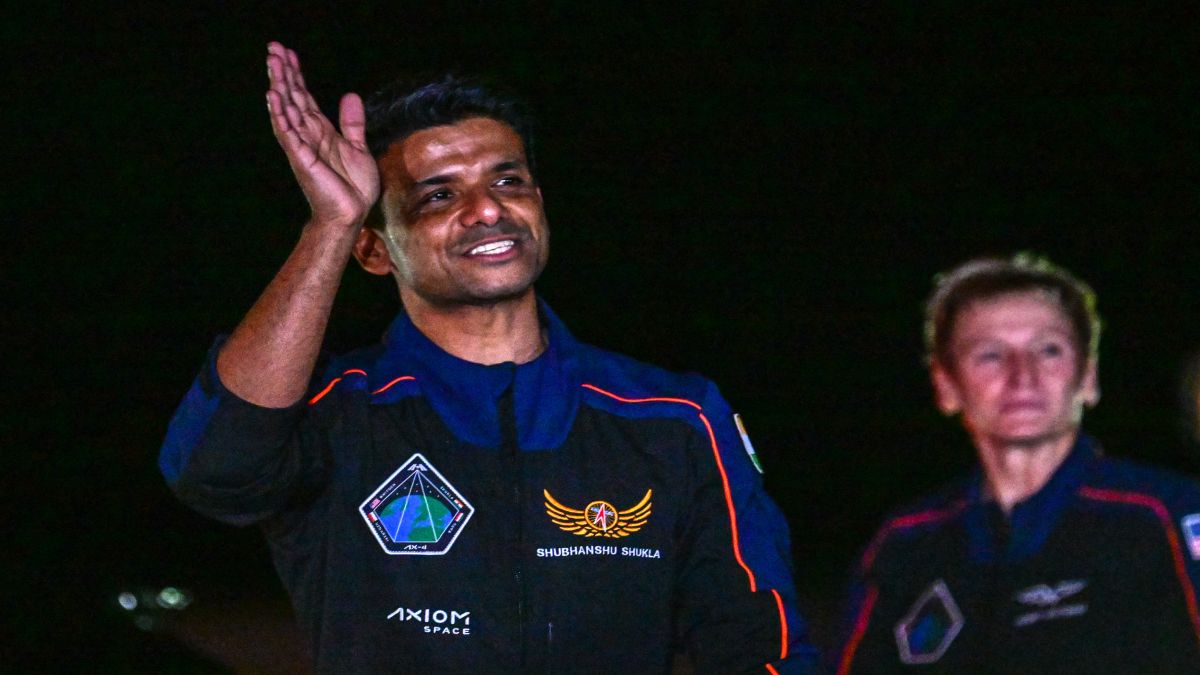
 "'What an amazing journey!': Shubhanshu Shukla's message from space")
Indian astronaut Shubhanshu Shukla on Thursday sent a message from space, describing his journey so far as the SpaceX Dragon spacecraft makes its way to the International Space Station (ISS).
“Namaskar from space! I am thrilled to be here with my fellow astronauts, and what a ride it was! As I was sitting in the capsule at the launchpad, my only thought was ’let’s just go’. After 30 days of quarantine, I just wanted to go,” Shukla said from the Dragon capsule.
Talking about the moment of the lift off from the Kennedy Space Centre in Florida, Shukla said, “When the ride started, it was something! You’re getting pushed back into the seat and then suddenly, nothing. You’re just floating in the silence of vacuum. It was an amazing feeling.”
#WATCH | "Namaskar from space! I am thrilled to be here with my fellow astronauts. What a ride it was," says Indian astronaut Group Captain Subhanshu, who is piloting #AxiomMission4, as he gives details about his journey into space.
— ANI (@ANI) June 26, 2025
Carrying a soft toy Swan, he says, in Indian… pic.twitter.com/Z09Mkxhfdj
According to NASA, Axiom Space, and SpaceX, the Dragon spacecraft is expected to dock with the ISS at around 7 AM EST (4:30 PM IST).
“The spacecraft will dock autonomously to the space-facing port of the station’s Harmony module at approximately 7 a.m. on Thursday, June 26,” NASA said.
Shukla, known as “Shux” among his team, will play a crucial role during the docking. As the mission pilot, he will monitor the spacecraft’s trajectory, orbital data, and ISS movements during the approach.
The crew is carrying a soft toy Swan to space and describing its relevance in the Indian culture, Shukla noted that the bird symbolises wisdom in the country.
The Ax-4 crew includes astronauts from India, Poland, and Hungary — each representing their country’s first mission to the space station. According to Axiom Space, it also marks the second government-sponsored human spaceflight mission in over 40 years.
Shukla will conduct seven experiments in space that are aimed at encouraging microgravity research in India, which hopes to build its space station by 2035 and send astronauts to the moon by 2047.


 "Russian drones over Poland: Trump’s tepid reaction a wake-up call for Nato?")
 "As Russia pushes east, Ukraine faces mounting pressure to defend its heartland")
 "Why Mossad was not on board with Israel’s strike on Hamas in Qatar")
 "Turkey: Erdogan's police arrest opposition mayor Hasan Mutlu, dozens officials in corruption probe")
 "Russian drones over Poland: Trump’s tepid reaction a wake-up call for Nato?")
 "As Russia pushes east, Ukraine faces mounting pressure to defend its heartland")
 "Why Mossad was not on board with Israel’s strike on Hamas in Qatar")
 "Turkey: Erdogan's police arrest opposition mayor Hasan Mutlu, dozens officials in corruption probe")



