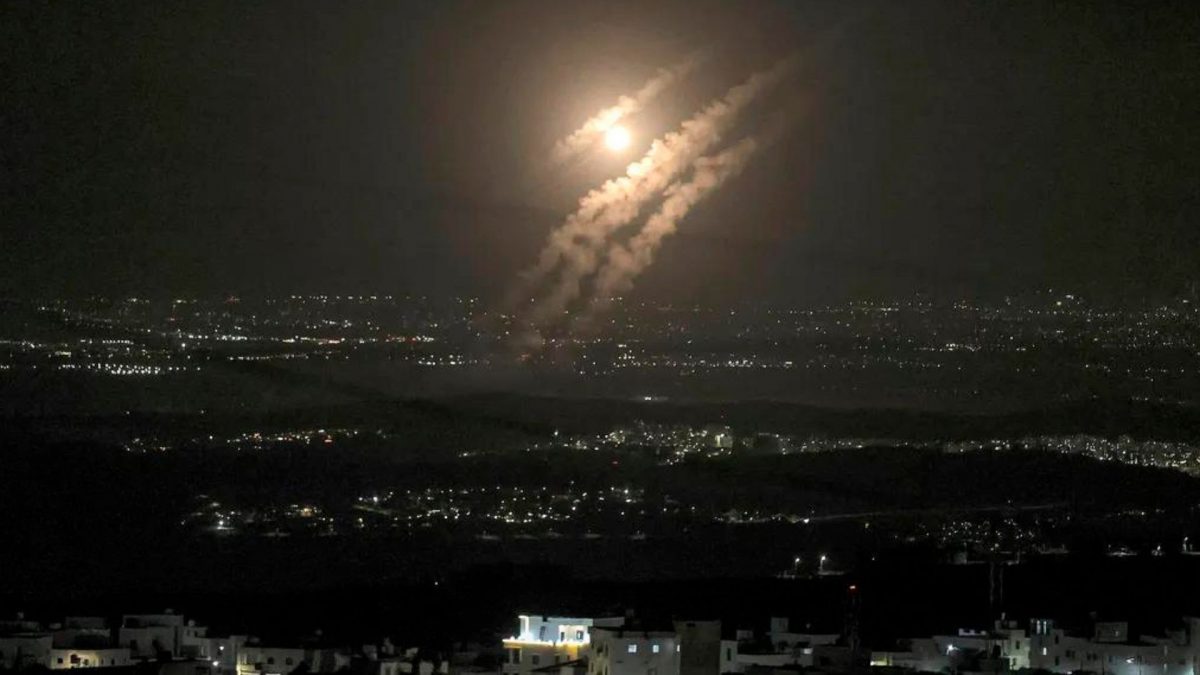
 "Projectiles above the Israeli city of Ashdod during the Iranian attack. Source: AFP.")
It was almost night, some were heading home, others were off to bed when Iran launched a barrage of over 180 missiles towards Israeli territory, its second attack this year after April when it fired around 110 ballistic and 30 cruise missiles towards Israel.
Air raid sirens were sounded in Israel and residents in the neighbourhood rushed to bomb shelters.
The night sky glowed orange with missiles which were fired by Iran towards Israel being intercepted by Israeli air defences including Iron Dome which is designed to intercept short-range rockets of the sort fired by Hamas and Hezbollah.
Meanwhile, Iran claimed that most of its missiles hit their targets with Iran’s paramilitary Revolutionary Guard alleging that 90 per cent of missiles it launched against Israel hit their targets.
Iran’s Supreme Leader Ali Khamenei tweeted an illustration of a large underground weapons cache, with the message: “Victory comes from Allah and it is close.”
Quick Reads
View AllNot just this, Iran’s armed forces joint chief of staff General Mohammad Bagheri went on to warn that his country will hit Israel’s entire infrastructure if it takes any action against its territory. He further claimed that the Revolutionary Guard was prepared both defensively and offensively to repeat its missile attack with “multiplied intensity".
The IRGC said the attacks on Israel were in response to killing of one of its top commanders Abbas Nilforoshan and leaders of Iran-backed militias – Hezbollah chief Hassan Nasrallah – in the region.
IRGC also referenced the killing of Hamas political leader Ismail Haniyeh in Tehran in July.
A report by Reuters quoted a senior Iranian official as saying that Ayatollah Khamenei, had personally given the order for Tuesday’s missile attack on Israel.
Interestingly, Iran’s attack on October 1, 2024, reminded of America’s attack on Iraq in 1991, particularly the initiation of Operation Desert Storm on January 17 of that year. Just as Iran sought to assert its military prowess against Israel, the United States executed a comprehensive aerial assault aimed at crippling Iraq’s military capabilities and restoring stability in the region.
Strategic targeting & military precision
Both Iran’s missile attack and the US assault on Iraq were characterised by strategic targeting. In 1991, the US focused on dismantling Iraq’s air defences, launching precision strikes against radar and anti-aircraft positions. This strategy opened the way for a broader air campaign.
Similarly, Iran aimed to hit key military and infrastructural targets within Israel, demonstrating its intent to retaliate against perceived aggressions and to assert its regional influence.
Immediate & calculated responses
The military responses in both cases were swift and calculated. The US coordinated a multifaceted attack that involved various military branches to ensure overwhelming force, while Iran claimed that a significant percentage of its missiles successfully struck their intended targets. This suggests a level of military planning and execution that echoes the intensity of the Gulf War.
Messaging & propaganda
In fact, even Khamenei, tweeting a message of impending victory, is reminiscent of the US emphasising the moral justification for military action and the liberation of Kuwait as a noble cause. Both countries leveraged propaganda to bolster national morale and legitimise their military operations.
Retaliation & justifications
Iran justified its attack as a direct response to the killing of key military figures, including a prominent commander and leaders of Iran-backed militias. This rationale parallels the US framing of its operations in Iraq, where military action was presented as a necessary response to Iraqi aggression and a means to protect regional stability.
International implications
The consequences of these military actions extend beyond the immediate conflict. The Gulf War fundamentally reshaped West Asia’s politics and solidified US involvement in the region.
Similarly, Iran’s recent missile attack raises critical questions about regional stability and the potential for escalating conflict. As nations around the world respond to this latest aggression, the reverberations could reshape alliances and power dynamics for years to come.
With inputs from agencies.