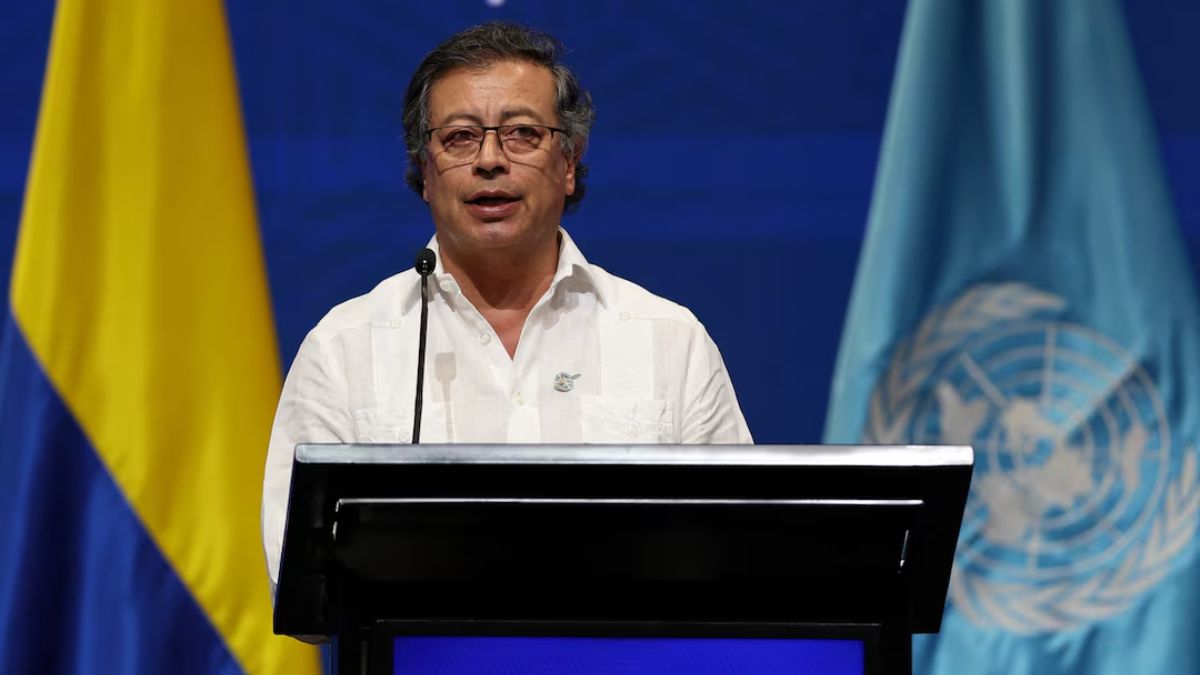
 "Colombian President Gustavo Petro announced the suspension of peace negotiations on Friday (January 17). Reuters")
Colombian President Gustavo Petro announced Friday (January 17) the suspension of peace negotiations with the National Liberation Army (ELN).
This declaration followed a violent confrontation between armed groups in the northeastern Catatumbo region that left at least 30 people dead and over 20 injured.
The clashes, which erupted Thursday (January 16), pitted the ELN, Colombia’s largest active guerrilla group, against dissident factions of the Revolutionary Armed Forces of Colombia (FARC). The latter had rejected a 2016 peace accord signed between FARC and the Colombian government to end more than five decades of conflict with the state.
Petro accused the ELN of committing “war crimes” and declared on social media, “The ELN shows no willingness to make peace.”
The president, elected in 2022 on a promise of pursuing “total peace,” had sought negotiations with the ELN and other armed groups. However, the ceasefires and peace agreements have repeatedly faltered, with violations by armed factions undermining progress.
Cocaine trade at the heart of conflict
The Catatumbo region, located near the border with Venezuela, has long been a hotspot for territorial disputes linked to Colombia’s lucrative cocaine trade. Tibu, the epicentre of this week’s violence, is a key coca production zone.
Colombia remains the world’s largest producer of cocaine, and armed groups, including the ELN, FARC dissidents, and the Gulf Clan, continue to battle for control of these areas.
William Villamizar, governor of the North Santander department, said the clashes were driven by “territorial disputes” over drug routes. “Data from the field indicates at least 30 people killed and more than 20 injured,” he told Blu Radio.
Quick Reads
View AllThe violence has also displaced dozens of families, according to ombudsman Iris Marin. She reported that ELN fighters were conducting house-to-house searches in the Tibu area, targeting civilians allegedly linked to the FARC dissidents. Preliminary accounts suggest that over 20 people are missing, while the United Nations confirmed that five former FARC combatants were killed during the clashes.
Peace efforts falter amid continued violence
Despite the government’s “total peace” initiative, which includes negotiations with the ELN, FARC splinter groups, and the Gulf Clan, progress has been slow.
Multiple ceasefire agreements in 2024 were undermined by inadequate preparation and monitoring, as well as non-compliance by armed groups.
As of June 2024, the Gulf Clan maintained a presence in 392 municipalities, the ELN in 232, and FARC dissidents in 299. Armed groups have continued to expand their influence, committing abuses against civilians, while security forces have struggled to protect vulnerable populations or dismantle criminal networks effectively, according to a UN report.
The 2016 peace deal with FARC was hailed as a historic achievement, but it failed to address the broader ecosystem of violence fueled by the cocaine trade.
Unless a sustainable strategy is implemented, Colombia’s cyclical violence is unlikely to subside.
With inputs from agencies