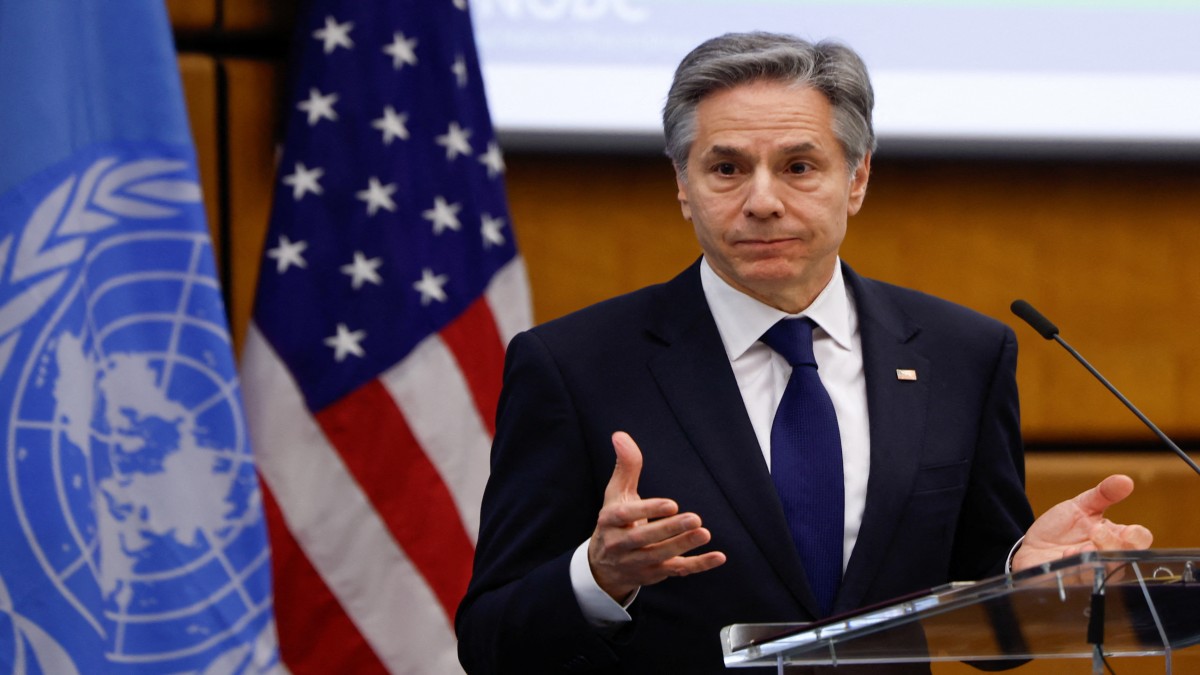
 "US Secretary of State Antony Blinken. Reuters File")
As Washington attempts to strengthen relations with two significant regional allies, US Secretary of State Antony Blinken landed in South Korea on Sunday, the first leg in a quick Asia visit that also included the Philippines.
Blinken touched here on Sunday afternoon, just in time for Monday’s third Summit for Democracy, which US President Joe Biden organised and is being hosted by Seoul this week.
Prior to travelling to Seoul, Blinken stopped briefly in Bahrain and discussed attempts to bring about a truce in Gaza with King Hamad bin Isa Al-Khalifa.
Attendees at the summit, which is scheduled for March 18–20, will include representatives from civil society, NGOs, and the government.
In order to assist defend Seoul against the nuclear-armed North, the US has stationed some 27,000 soldiers in the South, making Seoul one of Washington’s most important regional allies.
To better fend off Pyongyang’s threats, Yoon Suk Yeol, the conservative president of Seoul, has strengthened his connections with Washington and worked to put the past behind him with the former colonial power, Japan.
According to the ministry, Blinken will meet with South Korean Foreign Minister Cho tae-yul to discuss ways to strengthen the alliance while Washington and Seoul look into enhancing their so-called “extended deterrence” against North Korea.
The invitation list for the democracy summit has drawn criticism since it leaves out nations that identify as democratic, such Turkey and Thailand.
After Seoul, Blinken heads to Manila, a trip that will reaffirm “our unwavering commitment to the Philippine ally”, according to State Department spokesperson Matthew Miller.
Impact Shorts
More ShortsHe will talk with local officials including President Ferdinand Marcos, with issues with China including over the South China Sea likely to top the agenda.
The US is redoubling efforts to improve longstanding ties with regional allies such as Manila, in an effort to counterbalance China.
Beijing recently accused Washington of using the Philippines as a “pawn” in the dispute over the South China Sea, after a series of clashes around bitterly-contested islets in the waters.
China claims almost the entire waterway, brushing aside competing claims from a host of Southeast Asian nations and an international ruling that has declared its stance baseless.
The South China Sea is strategically vital for several countries – including China – providing a key route for the import and export of essential fuel, food and other goods.
China has rapidly grown its naval forces in recent years, and snatched vast tracts of maritime territory, hoping to project its military and political power well beyond the country’s shores.