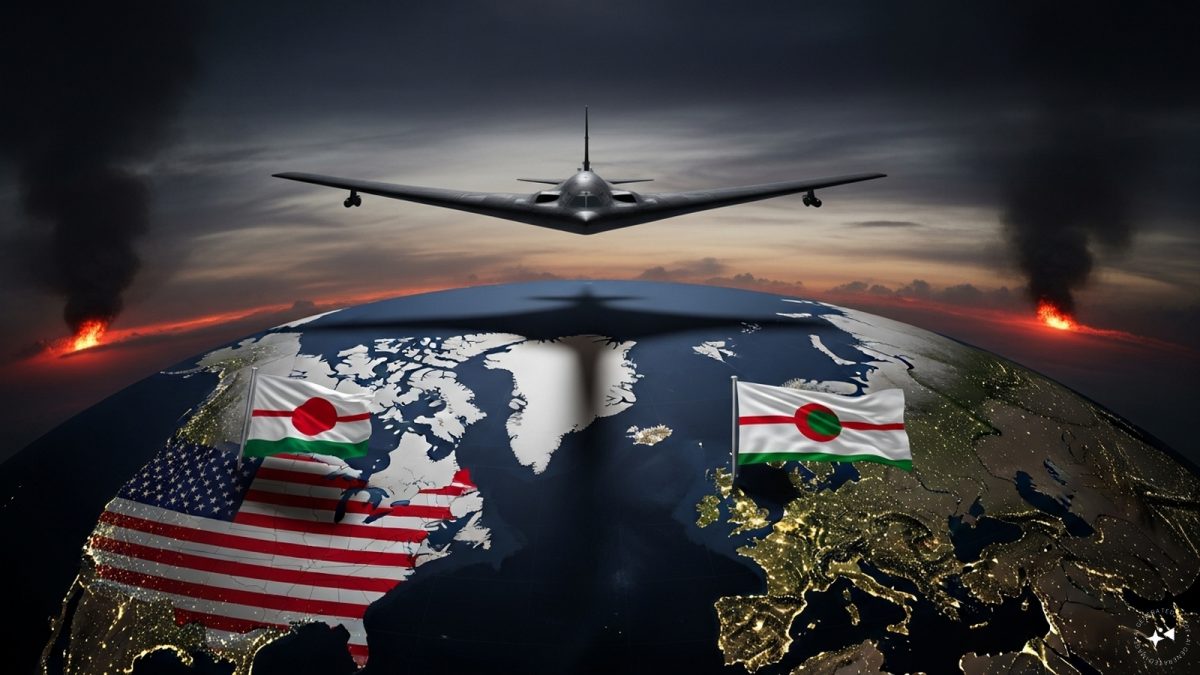
 "US strike on Venezuela jolts Europe, revives fears over Trump’s Greenland push")
The geopolitical equation appeared to shift abruptly this week following the United States’ military intervention in Venezuela, an action justified by Washington as a “restoration of democratic order.”
However, thousands of miles to the north, the smoke from Caracas is casting a long, chilling shadow over the Arctic. Analysts and European leaders are now sounding the alarm, suggesting that the audacity of the Venezuelan strike has set a dangerous precedent for another of Donald Trump’s long-standing ambitions: the acquisition of Greenland.
The concerns sharpened over the weekend after a social media post by the wife of Trump’s deputy chief of staff depicted Greenland painted in the colours of the US flag, accompanied by the word “SOON”.
The post drew swift rebukes from both Greenland and Denmark, with Greenland’s prime minister calling it “disrespectful” and Copenhagen’s ambassador to Washington stressing the need for respect for Danish territorial integrity.
While US officials reportedly insist there is no comparison between Venezuela and Greenland, analysts and diplomats say the audacity of the Maduro operation has altered how smaller states interpret Trump’s threats and negotiating tactics, particularly when national security and strategic geography are involved.
Trump’s Greenland push, revived
The renewed fear stems from a pivot in rhetoric coming from the White House. While the idea of purchasing Greenland was once dismissed as an eccentric real estate proposition, recent developments suggest a shift toward viewing the territory through a lens of “national security necessity.”
The Guardian reported that the US action in Venezuela has “shattered long-held assumptions in Europe that Washington would always operate within predictable diplomatic bounds”, prompting renewed concern in Copenhagen and Nuuk about Trump’s rhetoric on Greenland.
Quick Reads
View AllTrump has repeatedly argued that Greenland is vital to US security interests in the Arctic, citing shipping routes, missile defence and competition with China and Russia. Those arguments resurfaced late last year when Trump said the United States “has to have” Greenland for security reasons, remarks that drew a formal diplomatic protest from Denmark. At the time, the statements were dismissed by Danish officials as political theatre. After Venezuela, that dismissal has become harder to sustain.
Denmark’s Prime Minister has repeatedly stressed that Greenland is not for sale and that its future rests with its people. Speaking earlier this year, she rejected renewed US talk of acquisition, calling it “unacceptable pressure on an ally”.
Yet concern has grown as Washington has paired rhetoric with concrete steps. PBS reported that Trump’s appointment of a special envoy for Greenland strained ties with both Danish and Greenlandic leaders, who saw the move as bypassing normal diplomatic channels. Denmark later summoned the US ambassador over the issue, underlining how seriously Copenhagen views the matter.
A senior European diplomat told The Guardian that the Maduro operation showed Trump was “willing to test the outer edges of international law when he believes US interests are at stake”, a calculation that unsettles allies who rely on norms rather than power.
US aide’s Greenland post sparks backlash
Greenland and Denmark on Sunday expressed their distaste after the wife of President Donald Trump’s most influential aide posted a social media picture of Greenland painted in the colours of the US flag.
Katie Miller – wife of Trump’s deputy chief of staff Stephen Miller – put the contentiously altered image of the Danish autonomous territory on her X feed late Saturday, after the US military operation against Venezuela.
Her post had a single word above it: “SOON”.
SOON pic.twitter.com/XU6VmZxph3
— Katie Miller (@KatieMiller) January 3, 2026
Greenland’s Prime Minister Jens-Frederik Nielsen called the post “disrespectful”.
“Relations between nations and peoples are built on mutual respect and international law – not on symbolic gestures that disregard our status and our rights,” he stated on X.
But he also said that “there is neither reason for panic nor for concern. Our country is not for sale, and our future is not decided by social media posts”.
Denmark’s ambassador to the US, Jesper Moeller Soerensen, reacted earlier on Sunday with his own post saying “we expect full respect for the territorial integrity” of Denmark, above a link to Katie Miller’s image.
From rhetoric to risk perception
There is no indication that the US is planning any military move against Greenland. Analysts warn that Venezuela, a sanctioned state accused by Washington of drug trafficking, is fundamentally different from NATO ally Denmark. But the fear lies less in immediate intent and more in precedent.
Experts said that Trump’s language on Greenland has increasingly linked the island to hard security imperatives not abstract diplomacy, warning that such framing can escalate tensions by narrowing political off-ramps. Once an issue is cast as existential, compromise becomes harder.
The Venezuela episode has also sharpened debate within Greenland itself. While the autonomous territory depends on Denmark for defence, it hosts key US military installations. Greenlandic leaders have long balanced economic engagement with Washington against protecting their political autonomy. After Maduro’s capture, that balance looks more fragile.
“The concern in Europe is not that Trump will suddenly send troops to Greenland but that the “spectrum of the imaginable has widened”. Actions once thought unthinkable are now at least discussed,” they said.
For Denmark and Greenland, the lesson from Venezuela is sobering: in a world of intensifying great-power rivalry, geography can turn even steadfast allies into objects of strategic desire. Whether Trump’s Greenland threats remain rhetorical or become something more, the Maduro operation has ensured they will no longer be taken lightly.

 "Trump posts immigrant welfare chart: Pakistan, Bangladesh feature prominently; India not on list")
 "Venezuela crisis could unlock nearly $1 billion for India as US tightens grip on oil sector: Report")
 "Narco-state or oil jackpot? The real reason Trump sent US military to capture Maduro")
 "India’s traditional medicine systems gets recognition in free trade pacts with Oman, New Zealand")
 "Trump posts immigrant welfare chart: Pakistan, Bangladesh feature prominently; India not on list")
 "Venezuela crisis could unlock nearly $1 billion for India as US tightens grip on oil sector: Report")
 "Narco-state or oil jackpot? The real reason Trump sent US military to capture Maduro")
 "India’s traditional medicine systems gets recognition in free trade pacts with Oman, New Zealand")