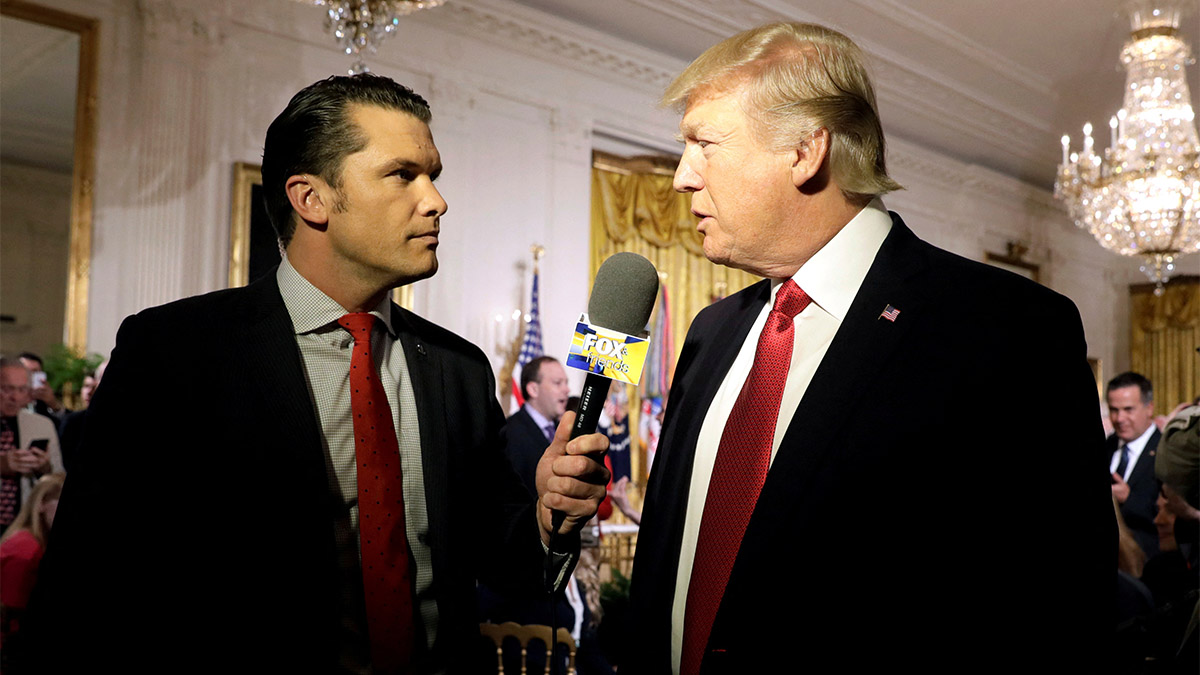
 "(File) US President-elect Donald Trump is interviewed by Fox and Friends co-host Pete Hegseth at the White House in Washington on April 6, 2017. Reuters")
President-elect Donald Trump has once again surprised many with his leadership style. His latest decision, choosing Fox News host Pete Hegseth as defence secretary, has raised eyebrows and stirred concern at the Pentagon, the core of the US military. Many in the defence community are surprised by this choice, given Hegseth’s background.
Hegseth has been a strong critic of the military’s “woke” culture, especially under President Joe Biden. Of late, Hegseth is focussed on promoting his latest book, The War on Warriors, which critiques the Pentagon’s shift towards social issues. While it may be too early to judge Hegseth’s ability as defence secretary, his experience doesn’t give much confidence, at least for now. Though he served in Iraq and Afghanistan, he held lower-ranking roles where he followed orders rather than creating strategy. However, there have been many other defence secretaries previously who did not have any military experience at all.
For instance, the first US Secretary of Defence, James Forrestal (1947–49), was appointed by President Harry S Truman and had no formal military experience. He came from a finance background as a Wall Street banker. Forrestal helped establish the Department of Defence and pushed for a more unified command structure. Similarly, Robert McNamara, defence secretary under Presidents John F Kennedy and Lyndon B Johnson, came from a business background as president of Ford Motor Company. Though he had no military background, McNamara brought a corporate focus on data and efficiency to defence planning, especially in managing nuclear policy and overseeing the Vietnam War.
In President Nixon’s administration, Elliot Richardson served briefly as Secretary of Defence in 1973. Although he had no military experience, Richardson had a strong background in law and public service. During his short time in the role, he focussed on making the Department of Defence more open and efficient.
After Richardson, James Schlesinger, an economist from Harvard, became Secretary of Defence from 1973 to 1975 under Presidents Nixon and Gerald Ford. Though he also lacked military experience, Schlesinger was known for pushing a strong US nuclear stance and emphasising military preparedness during the Cold War.
President Jimmy Carter’s defence secretary, Harold Brown (1977–1981), was a physicist with expertise in defence policy but no military background. Brown worked to keep the US technologically ahead of rivals promoting research on advanced weapons and nuclear arms control.
Impact Shorts
More ShortsUnder President Ronald Reagan, Caspar Weinberger (1981–1987), who specialised in budgeting, supported a significant military buildup to counter the Soviet Union. Despite his lack of military experience, Weinberger pushed initiatives like the Strategic Defence Initiative (SDI) to strengthen US defence.
In the Clinton administration, Les Aspin served as Secretary of Defence from 1993 to 1994. Although he had no military background, he had significant experience from his time on the House Armed Services Committee. Aspin focussed on reshaping the US military for the post-Cold War era, emphasising peacekeeping missions and efficient spending. Later, William Cohen, a Republican Senator with a background in law, served as defence secretary from 1997 to 2001. Despite lacking military experience, Cohen promoted a smaller, more efficient military and encouraged cooperation with other nations, especially during the Kosovo conflict.
Under President George W Bush, Donald Rumsfeld (2001–2006) and Robert Gates (2006–2011) served as defence secretaries. Neither had formal military training, but both had strong government experience. Rumsfeld led the Iraq and Afghanistan war efforts and pushed for changes to modernise the military. Gates, who continued in the role under President Obama, focused on counterinsurgency and stability in the military.
In President Obama’s administration, Leon Panetta served as defence secretary from 2011 to 2013. Although he didn’t have military experience, Panetta was a former CIA Director and White House Chief of Staff. He prioritised anti-terrorism efforts and played a key role in the mission that led to the death of Osama bin Laden.
Ashton Carter served as Secretary of Defence from 2015 to 2017, appointed by President Barack Obama. Although he wasn’t from a military background, Carter was a physicist and policy expert who focussed on modernising the military and promoting inclusivity. He advocated for greater roles for women and LGBTQ+ personnel in the armed forces.
In the Trump administration, Mark Esper served as defence secretary from 2019 to 2020. Although he was once an Army officer, most of his career was in defence industry roles and administrative jobs. Esper concentrated on military modernisation, especially due to rising tensions with China, marking a shift towards “great power” competition.
These examples show that many US Secretaries of Defence have come from various fields like business, law, intelligence and science, rather than the military. Their different experiences have brought new ideas and changes to the military, highlighting the US principle of civilian control over the armed forces. Each secretary’s contributions have addressed the needs and challenges of their time, demonstrating how civilian leadership helps shape defence policies to meet complex global issues.