 "Tim Walz wants the Electoral College 'to go': Is it time to switch to a popular vote?")
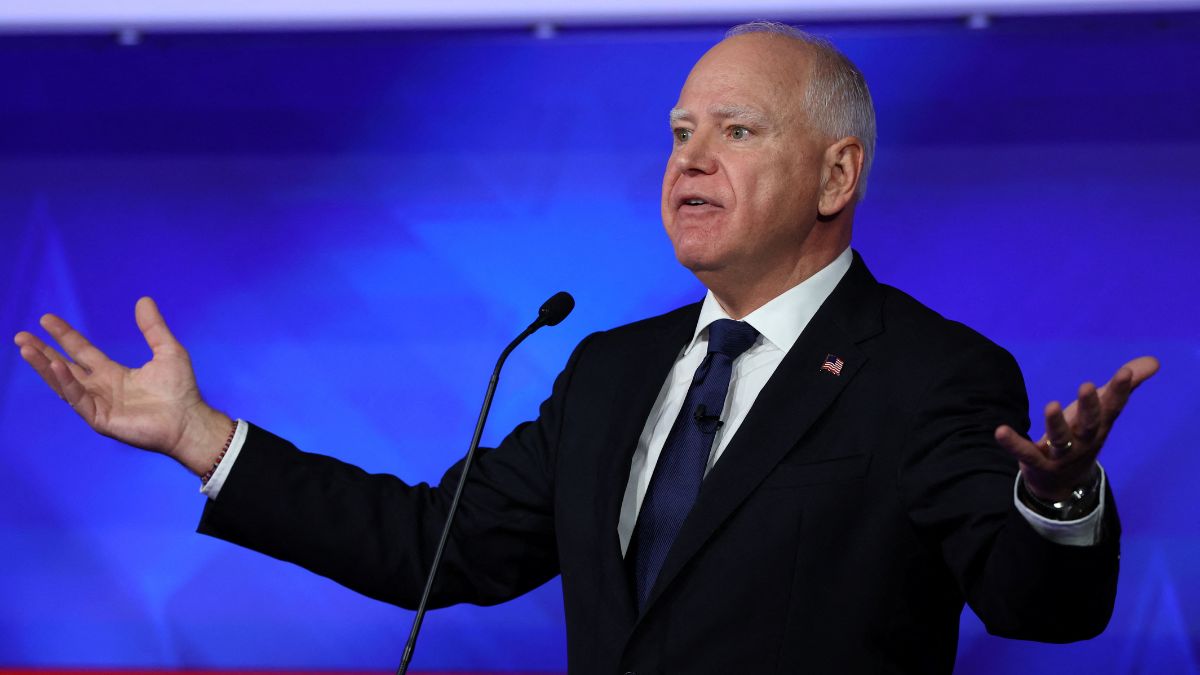
Minnesota Governor Tim Walz recently reignited the debate over the US Electoral College, calling for its elimination in favour of a national popular vote system.
Speaking at a campaign fundraiser with California Governor Gavin Newsom on Tuesday, the Democratic vice presidential nominee expressed his long-standing concerns about the Electoral College, which has led to multiple instances in American history where the candidate who won the popular vote failed to secure the presidency.
His remarks resonated with many Democrats, especially in light of the upcoming election where concerns are growing about US Vice President Kamala Harris potentially winning the popular vote but losing in the Electoral College.
According to reporters in the room, Walz remarked, “I think all of us know the Electoral College needs to go. We need a national popular vote. But that’s not the world we live in.”
While he acknowledged the current reality, his comments highlighted a deep frustration among Democrats about the Electoral College system.
How does the Electoral College work?
Americans do not directly vote for their president. Instead, they cast votes for electors in the Electoral College, a body that ultimately chooses the president.
There are 538 electors in total, representing 435 members of the House of Representatives, 100 Senators, and 3 electors from Washington DC. The magic number for victory is 270 electoral votes — an absolute majority.
Each state’s allocation of electors is proportional to its representation in Congress, with larger states like California having more electors (55) compared to smaller states like North Dakota (3).
The candidate who wins the most votes in a state typically takes all of that state’s electoral votes under a “winner-take-all” system, used in 48 states and Washington DC. Maine and Nebraska, however, use a proportional system that can split electoral votes based on district-level and statewide results.
As a result of this system, candidates can lose the popular vote but still win the presidency by securing key electoral votes, as demonstrated in the 2016 election, when Hillary Clinton garnered almost 3 million more votes than Trump but lost in the Electoral College.
Instances of popular vote winners losing the presidency:
The Electoral College was established as an indirect voting mechanism for electing the president, and while it has functioned in tandem with the popular vote in most elections, five cases in US history have seen the popular vote winner fall short of the presidency.
These instances include the elections of 1824, 1876, 1888, 2000, and 2016, each marked by close contests and sometimes controversial outcomes.
1. The election of 1824
The election of 1824 featured a unique race between four candidates: John Quincy Adams, Andrew Jackson, William Crawford, and Henry Clay.
Jackson won the popular vote with 153,544 votes (43.79 per cent) and even led in the Electoral College with 99 electoral votes to Adams’ 84.
However, none of the candidates secured a majority of electoral votes, forcing the House of Representatives to decide the outcome. The House, under the influence of US Speaker Henry Clay, chose Adams, despite Jackson’s lead in both the popular and electoral vote.
Jackson infamously condemned the decision, calling it a “corrupt bargain” after Adams appointed Clay as his US Secretary of State. As Jackson put it, “[T]he Judas of the West has closed the contract and will receive the thirty pieces of silver.”
2. The disputed election of 1876
In one of the most contentious elections in US history, Republican Rutherford B Hayes lost the popular vote to Democrat Samuel J Tilden by 264,292 votes. Tilden received 4,300,590 votes (51.12 per cent) compared to Hayes’ 4,036,298 votes (47.98 per cent).
However, disputed electoral votes from Florida, Louisiana, and South Carolina led Congress to establish a bipartisan Electoral Commission.
After a heated battle, the commission awarded all 20 disputed electoral votes to Hayes, giving him a razor-thin victory in the Electoral College, 185 to 184.
Many historians believe that this outcome was the result of a backroom deal, where Republicans promised to withdraw federal troops from the South, effectively ending Reconstruction, in exchange for the presidency.
3. The corruption-plagued election of 1888
The 1888 election between incumbent Democratic President Grover Cleveland and Republican challenger Benjamin Harrison saw significant allegations of bribery and voter manipulation.
Cleveland won the popular vote with 5,540,309 votes (48.70 per cent) to Harrison’s 5,439,853 (47.82 per cent), a margin of over 100,000 votes.
However, Harrison carried key northern and midwestern states, giving him a decisive 233 to 168 victory in the Electoral College.
Harrison’s victory, despite losing the popular vote, highlighted the flaws in the winner-take-all system used by most states, where a candidate can lose by small margins in populous states but win the presidency by securing smaller states with more electoral votes.
4. Bush vs Gore in 2000
The 2000 US presidential election between Republican George W. Bush and Democrat Al Gore was one of the closest and most controversial in US history.
Gore won the popular vote by 537,179 votes, garnering 50,992,335 votes (48.38 per cent) to Bush’s 50,455,156 (47.87 per cent).
However, the outcome hinged on Florida’s 25 electoral votes, where a razor-thin margin triggered a recount.
The Supreme Court ultimately intervened in Bush v. Gore, halting the recount and effectively awarding Florida, and thus the presidency, to Bush with 271 electoral votes to Gore’s 266.
This decision, combined with the controversy over Florida’s ballots, left many questioning the fairness of the Electoral College system.
5. Trump’s victory in 2016
The most recent instance of a popular vote loss leading to an Electoral College victory occurred in 2016, when Republican Donald Trump won the presidency despite losing the popular vote to Democrat Hillary Clinton by nearly 2.9 million votes.
Clinton received 65,853,514 votes (48.18 per cent) to Trump’s 62,984,828 (46.09 per cent).
However, Trump secured key battleground states such as Wisconsin, Pennsylvania, and Michigan by narrow margins, allowing him to win the Electoral College with 304 votes to Clinton’s 227.
This election saw the largest disparity between the popular vote and the Electoral College in US history, and it further fuelled calls for reforming or abolishing the Electoral College.
Four out of the five instances saw a Democrat losing the presidency to a Republican despite the former winning the popular vote.
Although there have been calls for reform, dismantling the Electoral College would require a constitutional amendment, an unlikely feat given the current political climate.
With inputs from agencies

 "'PM Modi a fantastic man... we're going to have a good deal': Trump tells Moneycontrol | Watch")
 "Greenland unveils 'crisis' guidelines as Trump renews call for talks on taking island")
 "Is Canada preparing for a US invasion as Trump unsettles allies? Report says...")
 "Trump says Ukraine war deal ‘reasonably close’, plans Zelenskyy meeting in Switzerland")
 "'PM Modi a fantastic man... we're going to have a good deal': Trump tells Moneycontrol | Watch")
 "Greenland unveils 'crisis' guidelines as Trump renews call for talks on taking island")
 "Is Canada preparing for a US invasion as Trump unsettles allies? Report says...")
 "Trump says Ukraine war deal ‘reasonably close’, plans Zelenskyy meeting in Switzerland")