

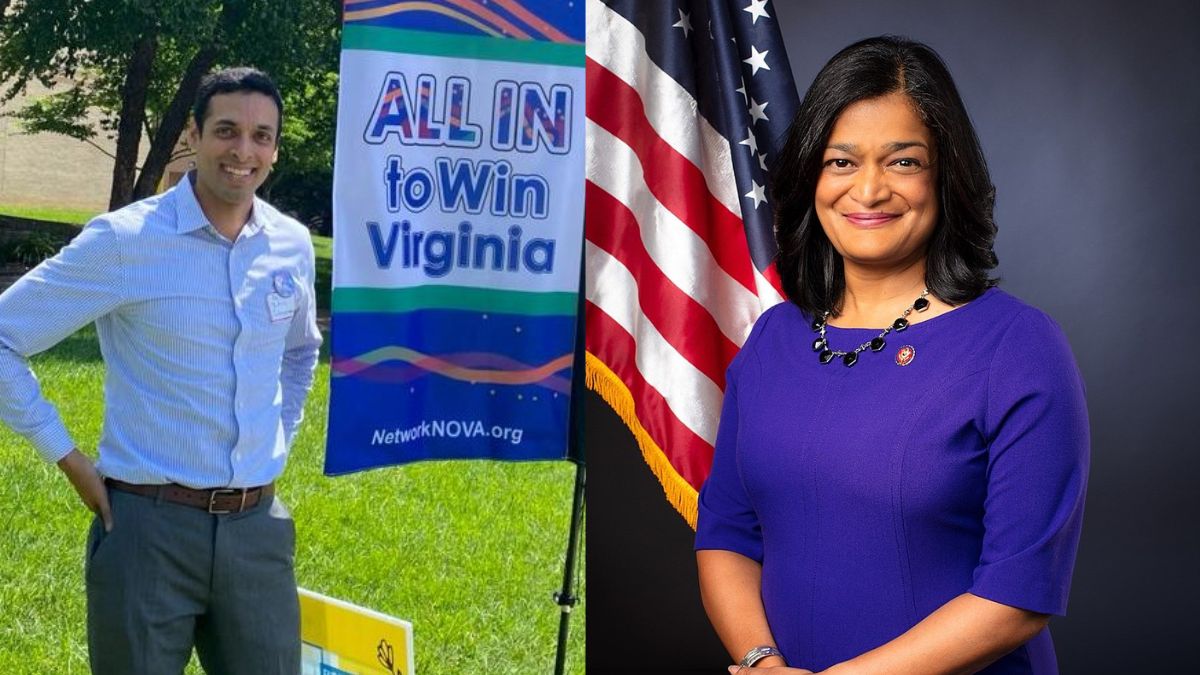
 "Suhas Subramanyam to Pramila Jayapal: The Indian American candidates running for US Congress")
Americans will head to polls on Tuesday, November 5, to choose their 47th President.
Beyond the presidential race, voters will also decide the control of both chambers of Congress, with all 435 House seats and 34 Senate seats up for grabs. While both chambers make laws and check other branches of government, their roles are also crucial for global affairs - including defence budgets, trade regulation, and foreign aid allocations.
Currently, Republicans hold a narrow majority in the House, while Democrats control the Senate by a slim margin. Both parties are battling over key seats that could shift the balance of power in Washington.
While the presidential race draws the most attention, results in congressional districts nationwide will influence whether the next president enjoys a unified government to meet his or her agenda or faces a potential gridlock.
ALSO READ | The Senate’s battle for control: Which seats will likely flip this US election?
Indian Americans in the fray
Nine Indian Americans are contesting for seats in the US House of Representatives, with five seeking re-election and three having their maiden foray into Congressional politics.
Suhas Subramanyam
Subramanyam, 38, is expected to make history as the first Indian American elected from Virginia and the East Coast. Currently a Virginia State Senator, Subramanyam is running in the 10th Congressional District, a Democratic stronghold.
He lives in a Virginia suburb close to Washington DC and represents an area with a large Indian American community.
Previously, he served as a White House Advisor under President Barack Obama. He is a practising Hindu and holds popularity among Indian Americans across the United States.
Ami Bera
Dr Ami Bera, a physician by profession, is the longest-serving Indian American in Congress, representing California’s 6th Congressional District since 2013.
Now 59, Bera is set to secure a senior leadership role if Democrats reclaim the majority in the House of Representatives.
ALSO READ | Why are US presidential elections held on a Tuesday in November?
Impact Shorts
More ShortsPramila Jayapal
Since 2017, Congresswoman Pramila Jayapal has represented Washington State’s 7th Congressional District and is considered an influential leader within the Democratic Party.
The 59-year-old is expected to be re-elected with ease, as are three other Indian American Congress members.
They include Raja Krishnamoorthi, who has represented Illinois’ 7th Congressional District since 2017, Ro Khanna, who has represented California’s 17th Congressional District since 2017, and Shri Thanedar, 69, who has represented Michigan’s 13th Congressional District since 2023. All of these districts are Democratic strongholds.
Amish Shah
After three successful terms in the Arizona State Assembly in 2018, 2020, and 2022, Dr Amish Shah is now contesting for a seat in the US House of Representatives from Arizona’s First Congressional District.
An emergency physician by profession, Dr Shah is challenging David Schweikert, a seven-term Republican incumbent in this district.
Prasanth Reddy
Republican Dr Prasanth Reddy is contesting from Kansas’ Third Congressional District, where he faces three-term Democrat Sharice Davids.
ALSO READ | US presidential elections: Why does Bengali feature on New York's ballot paper?
Rakesh Mohan
Dr Rakesh Mohan, also a Republican, is running for the House of Representatives from New Jersey’s Third Congressional District. However, both Dr Reddy and Dr Mohan face a challenging race with limited prospects of success this year.
Dalip Singh Saund made history as the first Indian American elected to Congress, representing California’s 29th Congressional District in 1957. Serving three terms, he paved the way for other Indian Americans in politics. Decades later, Bobby Jindal was elected from Louisiana in 2005, completing two terms in the House before becoming Governor of Louisiana for two terms.
Meanwhile, in the current US presidential election, early voting began in September. By Monday, November 4, around 81 million Americans had already cast their votes, according to the University of Florida’s Election Lab.
Of these, 44,402,375 were in-person votes, while 36,977,311 were mail ballots.
While this represents a large number, it is still lower than 2020, when over 110 million people voted early by mail or in person, accounting for around 70 per cent of total votes.
However, the early turnout this year has already exceeded the totals from 2016 (47.2 million) and 2012 (46.2 million).
With inputs from PTI

 "Russian drones over Poland: Trump’s tepid reaction a wake-up call for Nato?")
 "As Russia pushes east, Ukraine faces mounting pressure to defend its heartland")
 "Why Mossad was not on board with Israel’s strike on Hamas in Qatar")
 "Turkey: Erdogan's police arrest opposition mayor Hasan Mutlu, dozens officials in corruption probe")
 "Russian drones over Poland: Trump’s tepid reaction a wake-up call for Nato?")
 "As Russia pushes east, Ukraine faces mounting pressure to defend its heartland")
 "Why Mossad was not on board with Israel’s strike on Hamas in Qatar")
 "Turkey: Erdogan's police arrest opposition mayor Hasan Mutlu, dozens officials in corruption probe")



