

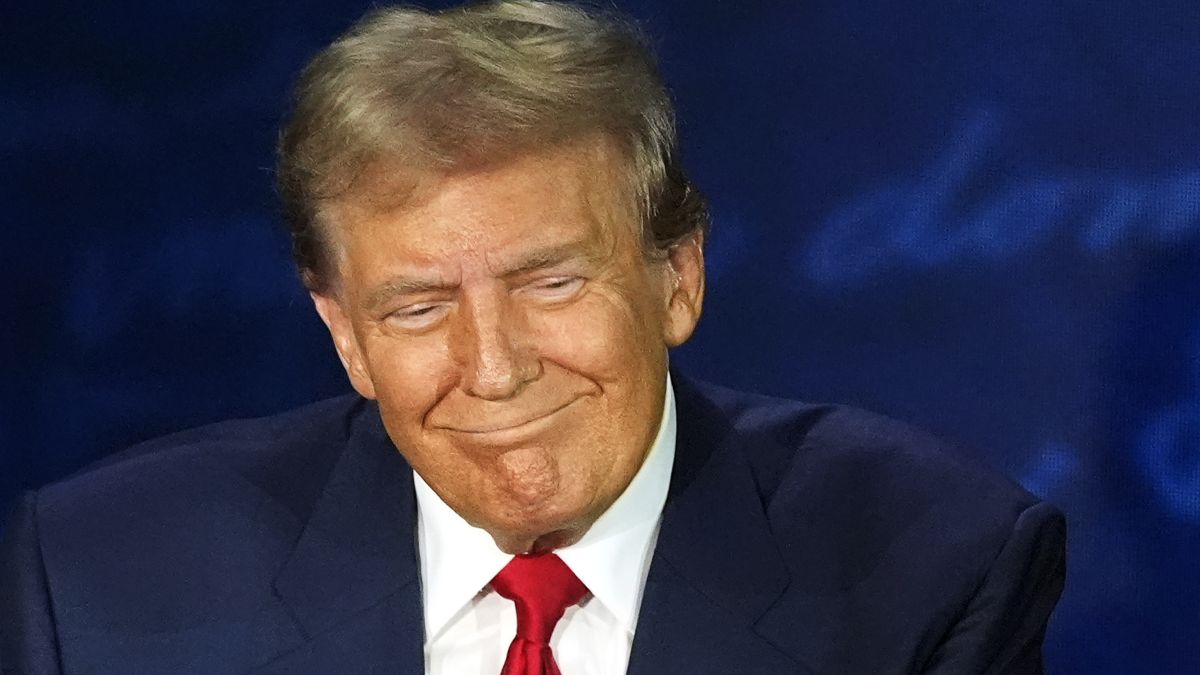
 "Democrats fear pollsters undercounting Trump, brace for 'repeat' of Hillary Clinton's 2016 loss")
Senate Democrats are worried that pollsters are once again undercounting Republican presidential candidate Donald Trump’s vote, particularly as Vice President Kamala Harris holds only a slim lead in crucial battleground states like Pennsylvania.
According to The Hill report, after the shock of Hillary Clinton’s loss in 2016 and Trump’s unexpectedly strong performance in 2020, Democratic lawmakers are preparing for another potential surprise on Election Night.
They are optimistic that Harris can exceed expectations by mobilising young voters and Black and Latino communities, but acknowledge that whether a larger-than-expected pro-Harris coalition emerges is an untested hypothesis, added the report.
“Polling has really been seriously damaged since 2016. And that’s one of the truths, is that Trump is going to be tough in Pennsylvania, and that’s absolutely the truth,” The Hill quoted Sen. John Fetterman (D-Pa.) as saying.
Democratic lawmakers are increasingly anxious that their party may be lulled into false optimism by polls showing Harris with slim, consistent leads in key states of the blue wall: Michigan, Pennsylvania, and Wisconsin.
Sen. Raphael Warnock (D-Ga.) told The Hill it’s difficult to determine the frontrunner, as many polls show Harris and Trump in a dead heat, well within the margin of error.
“We know this election is going to be close. It’s going to be close in the battleground states, including Georgia, which is why I’m doing everything I can to make sure we put Georgia in our column,” Warnock was quoted as saying. “The only poll that matters is November 5, right?” he added.
Impact Shorts
More Shorts“We talk about margin of error for a reason,” he said.
One Democratic senator who requested anonymity acknowledged that both Clinton and President Biden performed better in the polls against Trump in 2016 and 2020 than Harris is currently.
“That’s ominous. There’s no question that is concerning, but you’re working as hard as you can work, no matter what. My sense there’s not a lot more you can do than we’re already doing,” The Hill quoted the lawmaker as saying.
Trump voters reluctant to interact
The senator said pollsters struggle to gauge Trump’s support because many of his voters may be reluctant to interact or share their views.
“The only thing I can come up with is that people do feel embarrassed,” the senator was quoted as saying.
“Most of what he preaches, most of us have taught our children to try to not be that way on the playground. So there’s a certain amount of reluctance to admit I’m going to vote for somebody whose conduct I tell my children is wrong,” the senator added.
A second Democratic senator, also speaking anonymously, expressed skepticism about Harris’s lead, stating, “I don’t think any poll right now means much of anything.”
“I’m surprised that people look back on the Trump economy delusionally as being so good, which I think is the major factor that supports his approval rating,” the lawmaker added, commenting on Trump’s resilience in polls despite legal troubles and being outspent by the Harris campaign.
If Harris performs as polls predict, she will be elected president in November. However, Trump is within the margin of error in key battleground states and has a track record of outperforming polling averages, especially in the Midwest, reported The Hill.
In the 2020 campaign, Trump trailed Biden by an average of 5 points but lost Pennsylvania by only 1.2 points. Similarly, he lagged Clinton by 3.5 to 7 points in Pennsylvania before winning the state.
With 19 electoral votes, Pennsylvania is crucial for Harris. If she loses there, she must win either Georgia or North Carolina, where Trump has narrow leads, to reach 270 electoral votes, added the report.
A recent New York Times/Philadelphia Inquirer/Siena College poll shows Harris with a 4-point lead in Pennsylvania. However, Republicans claim the poll undersampled Trump voters, with only 37 per cent of respondents saying they voted for him in 2020, while he actually received 48.8 per cent of the state’s vote.
“I used to think it was incompetence. Now I think it’s part of the strategy. They’re trying to drive down enthusiasm. Why are you going to vote for somebody if you think they’re going to lose? And they’re trying to drive down fundraising and donations,” said a GOP pollster, who believes some media outlets are biased against Trump.
Unpredictability of voter turnout
David Paleologos, director of the Suffolk University Political Research Center, remarked on the unpredictability of voter turnout.
“We could be calling rural Pennsylvania today and a Trump voter could say, ‘I hate politics. I’m not going to vote.’ … But that person in four weeks could be very much animated if contacted by Trump or the NRA and then they become a likely voter. That’s why they say polls are a snapshot in time,” The Hill quoted Paleologos as saying.
Democratic lawmakers and pollsters recognise that the current public polls, which show Harris with slim leads in Michigan, Pennsylvania, Nevada, and Wisconsin, or Trump with slight leads in Arizona, Georgia, and North Carolina, have limited meaning six weeks before Election Day.
What’s particularly concerning for Democrats is Trump’s track record of outperforming polls, especially in the Midwest.
“Figuring out the turnout is the hardest thing out there. This cycle there may be a surprise Trump vote and a surprise Harris vote,” The Hill quoted Democratic pollster Celinda Lake as saying.
“I, too, share the concern that there are going to be some surprises. What accentuates my concern is when you poll people who have not voted in ’20 but are planning to vote today, they are disproportionately Trump voters,” added Lake.
“If you look at first-time voters who didn’t vote in ’20, they are leaning toward Trump and they’re very low information and they like his kind of style. And they like Elon Musk and they like a lot of things like that. I worry about that. I think it’s definitely a concern, and I think we just have to get enough margin to compensate for that,” she added.
Democrats have an edge in registering new voters, particularly young women in battleground states, energised by the Supreme Court’s Dobbs v. Jackson Women’s Health Organization decision.
“The new registration has been disproportionately Democratic younger women around the abortion issue,” Lake said.
The challenge for the Harris campaign is to ensure these voters turn out on Election Day.
“About two-thirds of the new registrants are female, which is advantageous for Democrats, but we need to ensure they vote. There’s been a surge in North Carolina, making it a key state for Harris,” Lake said.
“I think having an abortion rights initiative and a woman candidate on the ballot helps,” she added.
Several states, including Arizona, Florida, Montana, and Nevada, have abortion rights measures on the ballot this fall, with Arizona and Nevada being critical battlegrounds.
With inputs from agencies

 "Russian drones over Poland: Trump’s tepid reaction a wake-up call for Nato?")
 "As Russia pushes east, Ukraine faces mounting pressure to defend its heartland")
 "Why Mossad was not on board with Israel’s strike on Hamas in Qatar")
 "Turkey: Erdogan's police arrest opposition mayor Hasan Mutlu, dozens officials in corruption probe")
 "Russian drones over Poland: Trump’s tepid reaction a wake-up call for Nato?")
 "As Russia pushes east, Ukraine faces mounting pressure to defend its heartland")
 "Why Mossad was not on board with Israel’s strike on Hamas in Qatar")
 "Turkey: Erdogan's police arrest opposition mayor Hasan Mutlu, dozens officials in corruption probe")



