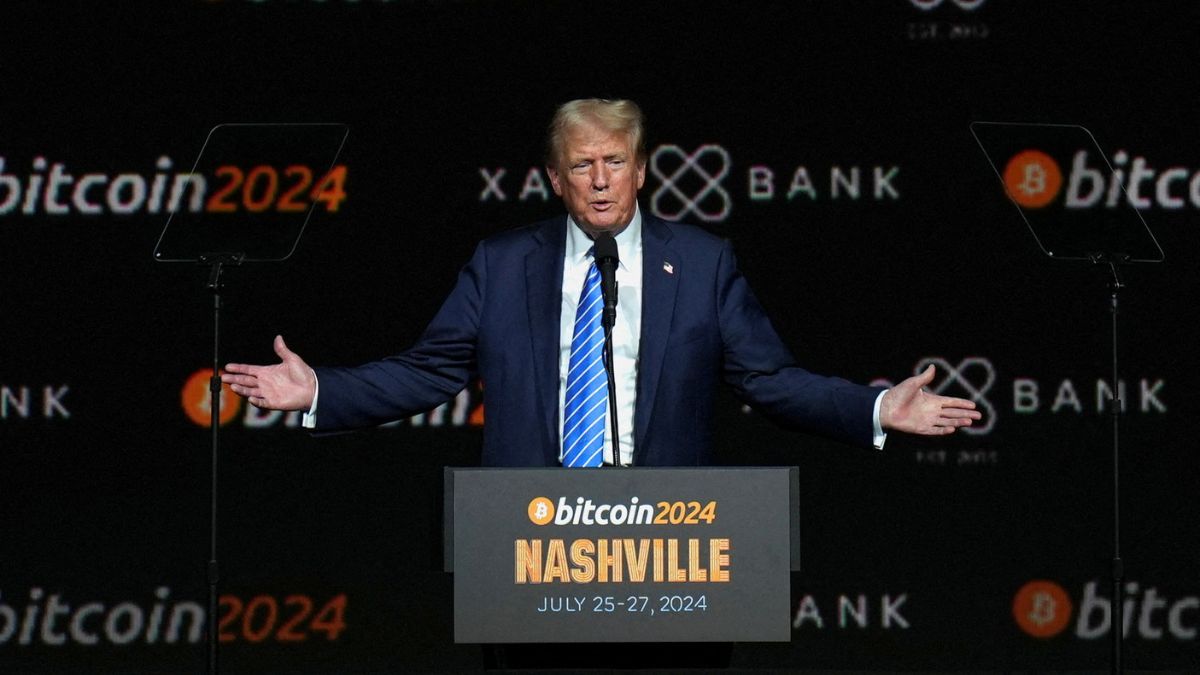
 "Republican presidential nominee and former US President Donald Trump speaks at the Bitcoin 2024 event in Nashville, Tennessee, US, July 27, 2024. File Image/Reuters")
US President-elect Donald Trump now has absolute control of the US federal government.
As the Republicans have retained the House of Representatives and won Senate, they have achieved the extraordinary feat of ‘trifecta’ , which refers to the situation when one party controls the White House, Senate, and the House. The Congress is now essentially a rubber-stamp body.
Moreover, with three appointees at the Supreme Court, Trump has long had the Apex Court in his pocket.
Such a situation would mean that checks and balances would definitely be affected , but alarm over the United States becoming a dictatorship is not warranted, says Saumyajit Ray, a scholar US polity at the School of International Studies (SIS), Jawaharlal Nehru University.
To understand the nuances of US polity, the Republican Party, and the US election, Firstpost’s Madhur Sharma sat down with Ray, an Assistant Professor at the Centre for Canadian, US & Latin American Studies at SIS. Excerpts:
With Republican control of the House of Representatives, President-elect Trump now essentially controls all three branches of the government — the Executive, Legislature, and Judiciary. As the Republican Party is firmly under his control, the Congress is not expected to put any checks and balances on his powers. How do you look at this extraordinary concentration of power?
It’s not the first time that all the three branches of government are in the hands of the same party. You can’t avoid this now. The other two branches will not just be favourable to the president, but will be very obliging as well.
Impact Shorts
More ShortsIn the American system of government, separation of powers was made workable by checks and balances. These checks and balances may now suffer because the three branches of government are in the hands of the same ideology.
However, this is not the first time such a situation has arisen. George W Bush had benefited from this and there was a time when President Obama had benefited from this, but he had a Chief Justice who was conservative — John Roberts.
To an extent, the current situation is unique, but that does not mean that there will be dictatorship. The American system of government does not permit a dictatorship. For example, even as Trump has spoken about deploying military at the border, it’s not possible to deploy the military on a whim. The United States is a federation of states, so states have vast law and order powers and the role of the federal government beyond national defence is very limited.
Trump appears to have a nearly unprecedented hold over the Republican Party that does not allow room for any diversity of opinion. As the Congress has often served as a check on the Executive’s power, how do you look at Trump’s hold on his party?
Trump had been wielding enormous power even when he was not president. House Speaker Mike Johnson was of course his nominee.
The Republican Party has changed under Trump. It’s Trump’s party.
While it was George HW Bush who first said that he would liberate the United States from special interests, he could not remove the influence of special interests of big businesses or evangelical groups on him or the Republican politics. The same was the case with his son George W Bush.
Trump is the only one who is actually eroding these interest groups. Instead of these groups dictating him, Trump seeks to dictate these groups to do his bidding.
The way Trump works, his Cabinet may not even comprise his closest advisors. His closest advisors may be outside of the government, such as in the think tank Heritage Foundation which produced ‘Project 2025’. Again, instead of think tanks or interest groups shaping his policy, Trump is seeking to shape their behaviour. All of them are a means to an end — not the guiding hand or an influential voice as was the case previously. The same is true for the relationship between the Republican Party and Trump.
Is President-elect Trump really the most powerful US president?
What we are seeing in the United States now is not very different from what often happens in parliamentary democracies where the same party controls different branches of the government. Does that in itself mean there is a dictatorship?
In the parliamentary system when a party wins an overwhelming majority like Trump has won, isn’t the prime minister an all-powerful entity? Trump is almost in the same position.
When liberal presidents have such a system, alarm bells don’t ring, so there should not be alarm just because there is a conservative president now.
Trump has emerged as the most hardliner leader on immigration and other issues lately. Do you think the extremist rhetoric around immigration would translate into policy?
Joe Biden was a Washington insider. He had been a senator for a very long time. He had also been vice president. So, he was part of the establishment. Trump was a billionaire businessman and a celebrity before he came into politics from outside. He is a completely different person.
The voters were done with a long period of unchecked illegal immigration and Democratic Party’s rule. Trump understood it as an outsider. While the USA is a nation of immigrants, Trump emphasised that it is not a nation of illegal immigrants and would become so under four more years of Democrats’ rule.
Illegal immigration is an issue where Trump cannot compromise on. If need be, he would deploy the military at the border as he has said. To rally people around him, he resorted to threatening rhetoric but the most extreme words may not translate into policy unless something very drastic happens.
Even if Trump takes the extraordinary step of deploying the military to tackle illegal immigration or even domestic unrest as he has said, is it that drastic a step? Doesn’t it happen in India too where the military is often deployed inside the country for non-war purposes?
As I said before, the United States is a federation. The military cannot be deployed just like that by bypassing the states.
Moreover, what appears as ‘hardliner’ to many in the Washington establishment insiders is common with the voters that Trump understood as an outsider. For example, as crime has risen with rising illegal immigration, people have found a sense of security in guns. Hence, Trump and the Republicans support gun rights.
Coming to elections, what do you think happened? Wasn’t it supposed to be a close race? Did late entry work against Kamala Harris?
This had to happen. The media had created a hype around Kamala Harris.
The US voters saw Kamala Harris as a usurper. In America, in either of the two parties, if the incumbent president seeks re-election, generally no party in the 20th century held him back. This is the first time that the incumbent, Biden, was forced to make way for Harris.
A presidential nominee has to prove themselves through primaries and caucuses by fighting against their rivals within the party. Harris didn’t go through the process. She had no advantage and no preparation.
Trump and Republicans maintained throughout it would not be a close contest and that’s how it turned out to be. He won all the battleground states and got votes from everyone whether Blacks, Hispanics, or women.
Does this mean Democrats have lost touch with common Americans?
It is wrong to say that Trump represents the business class since he’s a billionaire. Instead, he clicks with common Americans — the workers’ class. He always talks about bringing manufacturing jobs back. That’s all common Americans want — blue-collar jobs.
Coming to Trump’s foreign policy approach, is he really the isolationist that he is often dubbed as or is he set to seek a middle-ground of sorts between interventionism and isolationism? Has he fundamentally reshaped the foreign policy outlook of the Republicans?
Trump’s foreign policy outlook is an extension of his ‘America First’ domestic approach. Instead of isolationism, he has a nativist approach, the ‘sons of the soil’ kind of politics.
In his ‘New Nativism’, the interests of America and citizens are placed above immigrants and foreigners. So, that’s why Trump will not intervene abroad until it helps Americans.
Moreover, if you look at the history of the right wing, even immediately after the end of World War II, the interventionists of the right wing were a small section within the Republican Party. The party was isolationist in its worldview at the time.
The Cold War interventions were started by Democrats and were only later adopted by Republican leaders like George W Bush. For Trump, such interventionism is a waste of time, energy, and money.
Madhur Sharma is a senior sub-editor at Firstpost. He primarily covers international affairs and India's foreign policy. He is a habitual reader, occasional book reviewer, and an aspiring tea connoisseur. You can follow him at @madhur_mrt on X (formerly Twitter) and you can reach out to him at madhur.sharma@nw18.com for tips, feedback, or Netflix recommendations