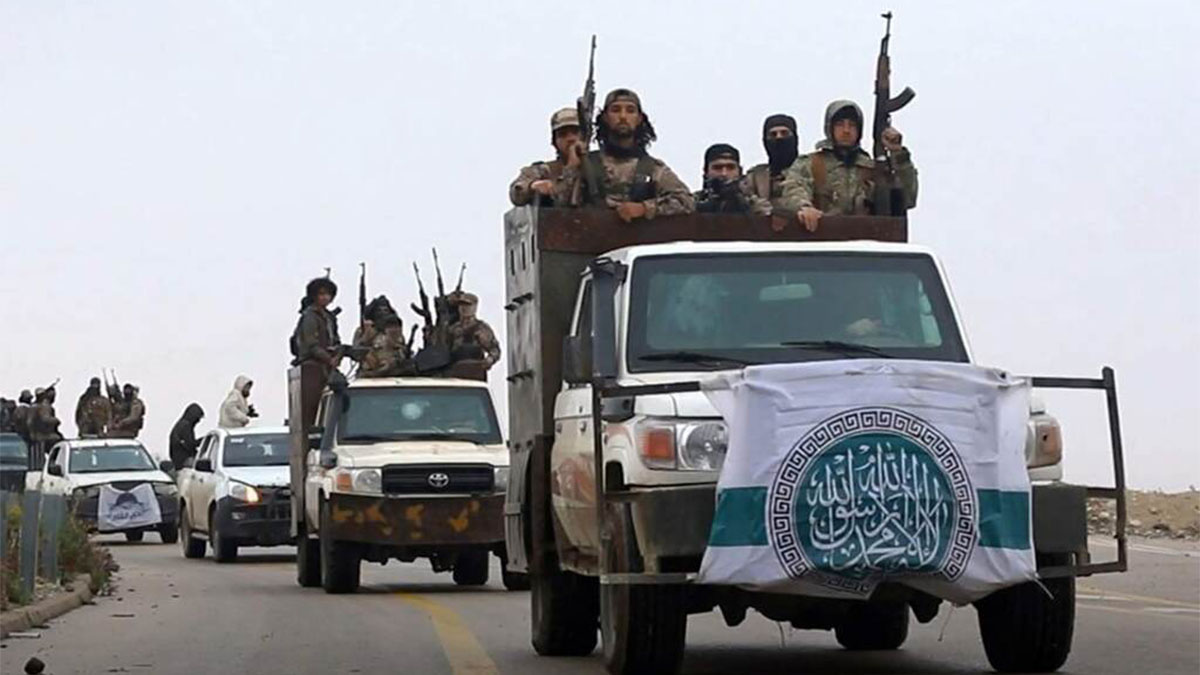
 "(File) Members of Hayat Tahrir al-Sham, or HTS, AP")
Top military commander of the Hayat Tahrir al-Sham revealed that the rebel group began planning the military assault to topple Syrian President Bashar Al Assad’s regime a year ago. In his first interview with foreign media, Abu Hassan al-Hamwi, the head of the HTS military wing, said that the group conducted a highly disciplined operation in which a new drone unit was deployed and where there was close coordination between opposition groups around the country.
HTS led the operation from the country’s northwest and communicated with the rebel group operating in the south to encircle the country’s capital, Damascus. During his conversation with The Guardian, Hamwi said that the planning to topple the regime started a year ago, the groups were preparing for a coup like this for years.
Hamwi noted that since 2019, HTS has been developing a military doctrine that it used to turn fighters coming from “disparate, disorganised opposition and jihadist groups into a disciplined fighting force.” “After the last campaign [August 2019], during which we lost significant territory, all revolutionary factions realised the critical danger – the fundamental problem was the absence of unified leadership and control over battle,” the 40-year-old military commander said in an interview in Jableh.
‘We studied enemy thoroughly’
In the interview, Hamwi maintained that the HTS and other rebel groups “studied the enemy thoroughly”. “We studied the enemy thoroughly, analysing their tactics, both day and night and used these insights to develop our own forces,” Hamwi told The Guardian. He mentioned how the rebel groups united with each other and how military branches, units, and security forces were created.
HTS soon began to produce its own weaponry, vehicles, and ammunition, which managed to outgun the Assad regime’s airforce and the backing of Russia and Iran. “We unified their knowledge and set clear objectives: we needed reconnaissance drones, attack drones, and suicide drones, with a focus on range and endurance,” Hamwi averred, adding that drone production started in 2019.
Impact Shorts
More ShortsThe latest iteration of HTS drones was a new model of suicide drone, named “Shahin,” which is Arabic for falcon. The drones were first deployed against the regime forces this month, which disabled Assad force’s military vehicle.
Hamwi said that the group sent out messages to rebels in the south a year ago and began to advise them on how to create a unified war room. An operation room was later founded, bringing together the commanders of around 25 rebel groups in the south. In late November, the group decided that the time was right to start the operation.
“We had a conviction, supported by historical precedent, that ‘Damascus cannot fall until Aleppo falls.’ The strength of the Syrian revolution was concentrated in the north, and we believed that once Aleppo was liberated, we could move southward toward Damascus,” Hamwi said. After the fall of Aleppo, Assad’s regime toppled like a house of cards.
When asked about the process of nation re-building, Hamwi assured that Syria’s religious minorities will not be discriminated against. “We affirm that minorities in Syria are part of the nation and have the right to practice their rituals, education, and services like every other Syrian citizen. The regime planted division, and we are trying, as much as possible, to bridge these divides,” he concluded.
With inputs from agencies.