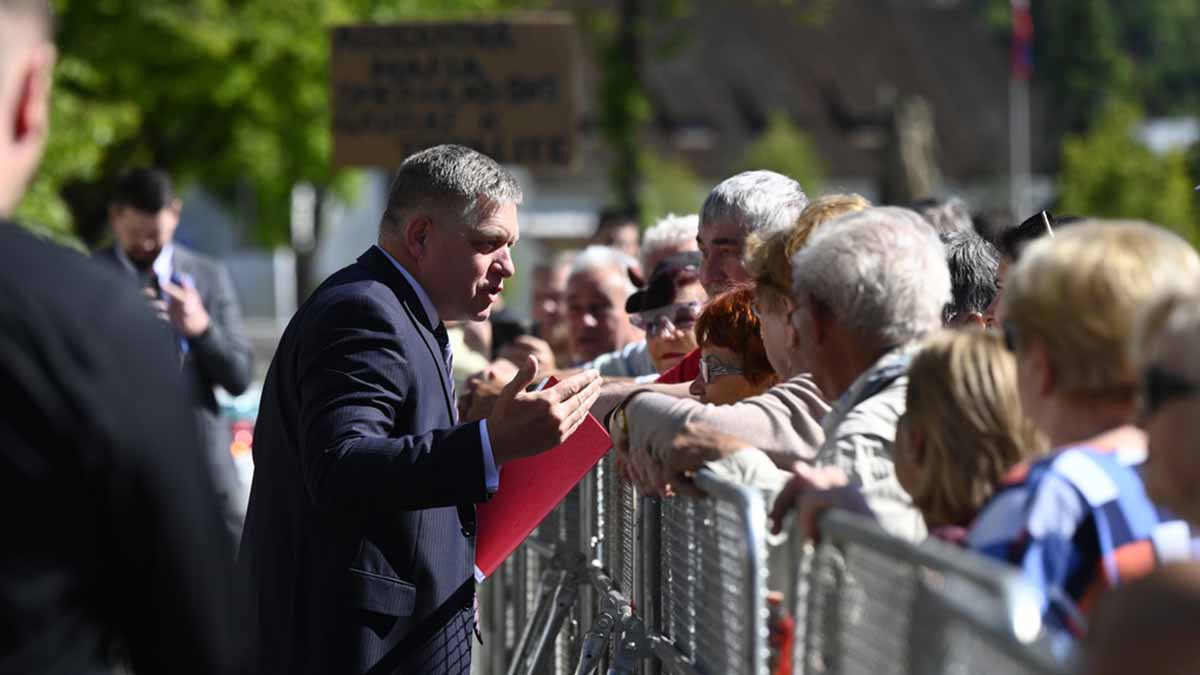
 "Slovakia's Prime Minister Robert Fico, centre, speaks with people before the cabinet's away-from-home session in the town of Handlova, Slovakia on 15 May, 2024. AP")
Due to the prompt transfer of Slovak Prime Minister Robert Fico to a medical facility on Wednesday following the assassination attempt, the premier’s condition is largely stable and it’s anticipated that he will recover in the coming days.
Despite having close protection teams from the Slovak Security and Intelligence Service. who are typically composed of highly trained agents specialising in security and tactics, the prime minister’s security was seriously compromised.
This incident serves as a reminder of the need to reassess security protocols concerning the close protection of highly important individuals.
Fear of unassuming individuals
The fact that the Slovak prime minister was targeted by a 71-year-old individual is significant. This age demographic typically wouldn’t be flagged by security services. Yet, despite the presence of close proximity security, the assailant successfully fired shots at the prime minister.
Unassuming individuals can be a significant threat to VIPs precisely because they don’t attract attention or suspicion. Their unremarkable appearance and behaviour allow them to blend into crowds or environments without raising alarms. This camouflage makes it easier for them to get close to VIPs without attracting attention from security personnel or others who might be on guard against potential threats.
Moreover, unassuming individuals may possess a keen ability to observe and analyse their surroundings without drawing attention to themselves. This enables them to identify vulnerabilities or opportunities to exploit without raising suspicion. Their seemingly innocuous presence can serve as a disguise for nefarious intentions allowing them to carry out covert actions or attacks.
Impact Shorts
More ShortsAdditionally, VIPs and their security teams may underestimate the threat posed by unassuming individuals, focussing instead on more obvious or high-profile risks. This lack of awareness can create vulnerabilities that savvy adversaries can exploit to gain access to VIPs or carry out attacks.
Yesterday’s incident again shows that the unassuming nature of individuals can make them effective threats to VIPs because they operate under the radar exploiting vulnerabilities and weaknesses while remaining undetected until it’s too late.
There are several cases where unassuming individuals posed threats to VIPs:
John Hinckley Jr. and the attempted assassination of Ronald Reagan (1981): John Hinckley Jr., who appeared unassuming to those around him attempted to assassinate president Ronald Reagan in 1981. He blended into crowds and approached Reagan during a public event, posing as a harmless bystander before opening fire.
Assassination of Indira Gandhi (1984): Former prime minister Indira Gandhi was assassinated by two of her own bodyguards in 1984. These bodyguards, despite their unassuming appearance and trusted positions turned against her due to political and personal motivations.
Assassination of Anwar Sadat (1981): Egyptian president Anwar Sadat was assassinated during a military parade in 1981 by members of his own army. The assassins, who appeared unassuming as they participated in the parade, exploited security vulnerabilities to carry out the attack.
Attempted assassination of Pope John Paul II (1981): Mehmet Ali Ağca, the man who attempted to assassinate Pope John Paul II in 1981, appeared unassuming and managed to get close to the Pope during a public appearance before firing shots.
How India guards its VIPs and VVIPs
India employs a comprehensive security framework to safeguard its VIPs and VVIPs. The Special Protection Group stands as the frontline agency tasked with shielding the prime minister.
Then there are specialised units like the National Security Guard’s Special Rangers Group (NSG SRG), the CRPF and the ITBP. These agencies operate with precision and expertise employing advanced security measures and highly skilled personnel to provide close protection. Their mission extends beyond mere physical security. They meticulously assess risks, devise strategic plans and maintain swift response capabilities.
Intelligence agencies like RAW and the Intelligence Bureau play pivotal roles in threat assessment and coordination while close protection teams ensure immediate security. Standard operating procedures (SOPs) dictate travel and public appearances while interagency cooperation ensures coordination between Central and state forces.
Assessing threats to VIPs
There is no doubt that unassuming individuals may pose a threat if they have malicious intent or if they are coerced or manipulated by others into carrying out an attack. This is why security protocols often include measures such as background checks, surveillance and access control to mitigate risks.
However, it’s also important to recognise that not everyone who appears unassuming is a threat. Profiling based solely on outward appearance can be ineffective and discriminatory. Close proximity security is indeed a tricky business!